 BACK TO Blog
Asset Rental Management
RFID Asset Tracking
IoT RFID integration explained: how smarter teams connect assets, automate tracking, and optimize supply chain decisions
- April 09, 2026
- DreamzCMMS Team
- 12 minutes read
- April 09, 2026
- DreamzCMMS Team
- 12 minutes read
Introduction
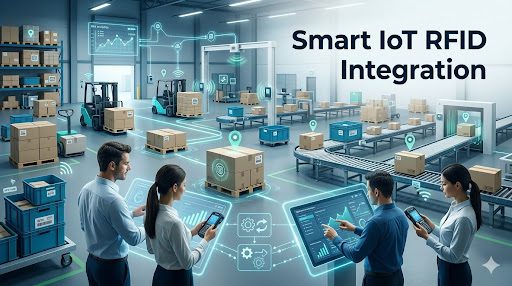
The supply chain is speeding up. To keep up, you need better supply chain visibility and control with a faster response. As a result, IoT RFID integration is becoming a priority for many companies. This technology integration links together RFID tags, IoT sensors, RFID readers, and supply chain applications, as well as business workflows. IoT and RFID integration is designed to leverage the intelligence of both technologies to create a more connected supply chain than simple tracking and tracing. The RFID IoT connected supply chain provides end-to-end supply chain visibility that removes many unknowns. With this technology, companies can automate business processes, integration, and workflows, to meet the daily operational challenges of the accelerating supply chain. Smart supply chain IoT RFID solutions enable greater accuracy and confidence for businesses.
Why IoT RFID integration matters now
A common belief held by many is that organisations are migrating towards the management of their inventory, the movement through the warehouse and the custody of assets as an integrated system. However, many companies are still operating separately integrated systems for the management of inventory and the production of reports.
That creates gaps.
We've been looking into a few issues with item persistence and visibility in inventory. We've seen items scanned but the player unable to see them until they reach a checkpoint, items that have been moved around the map but the inventory is not updated correctly, and items stuck in the 'staging' state and left to rot with no indication to the player of a problem.
We believe integrating RFID IoT sensors with movement tracking data is crucial for giving the best context to the information. In addition to basic data such as the item’s passage through a reader (e.g. timing, zone details) you can also receive real-time updates on environmental conditions as well as exceptions that occur.
With the IoT enabled RFID tags, comes more rich data that can be delivered in real time with more context to make better decisions. Tracking with RFID markers has long been a process for enterprises. However, as RFID and IoT convergence becomes more prevalent, it is increasingly critical to track physical objects connected to intelligence to gain meaningful insights.
While most businesses and individuals want more than just data for reporting and historical analysis, at the end of the day most also want access to live data.
The hidden cost of weak visibility
Poor visibility affects more than one department. Free warehouse staff to get on with their job by scanning an item to locate it on the shelf quickly. Provide operations managers with up to the minute information on the progress of the warehouse to support them in meeting customer demands. Give procurement staff the confidence that the stock level they see in the system reflects recent activity. Support service and maintenance staff by ensuring that they have the tools and materials they need in a timely manner.
What seems to be three separate issues turns out to be one fundamental operational problem. When multiple business systems and models utilize separate silos of IoT RFID technology, friction can eat into a company's overall efficiency. By integrating IoT RFID into your company, a single information stream that is relevant to your inventory, its movement, storage and actions can be created.
That means fewer surprises and better coordination. This also means less manual checks, less delays and less errors on an everyday basis!
What changes when RFID and IoT work together
Traditional RFID already helps businesses improve tracking. RFID delivers faster identification and less manual scanning, but what about the rest of the benefits that you may have missed.
Combining RFID with connected devices and sensors allows organisations to track not only the movement of products but also when something happened, the condition of it, its location, its behaviour and any exceptions. Real-time data allows organisations and their employees to react faster and more accurately.
Other advanced features that we find to be valuable to our customers include tracking and analytics such as time in location, tracking of handoffs in logistics that occur slowly, and monitoring of whether or not assets are staying in the correct general zone on a manufacturing floor with IoT RFID integrated into the cloud. This results in better performance with improved speed, responsiveness and control.
Why IoT RFID technology integration improves daily execution
The biggest strength of IoT RFID integration for those implementing the technology is timing. It helps teams realise what is happening whilst there is still time to do something about it. By running a few days behind, managers can see what’s trending. Missing items can be picked up by teams more quickly. And issues such as inventory going to the wrong location can be surfaced before they cause problems in the picking, packing or replenishment processes.
IoT RFID data analytics supply chain strategy is becoming increasingly popular, as organizations are eager to tap into the vast amount of data surrounding their business and unlock value. However, simply having more information available at your disposal does not necessarily translate to improved performance and the efficient flow of work. That shift changes how operations are managed. This service teaches teams how to identify and prevent problems from happening, thereby lessening the potential for harm.
How IoT RFID integration supports warehouse performance
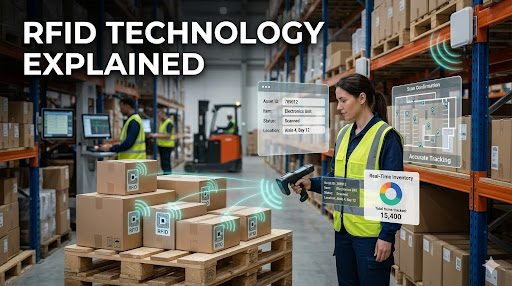
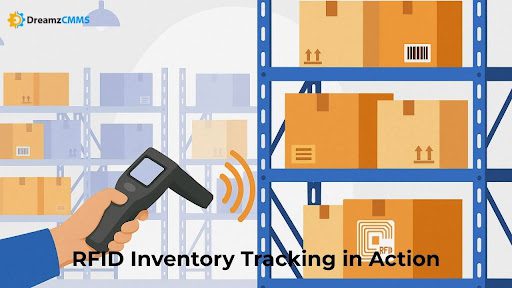
Warehouses depend on visibility. This occurs when stock is lost, late or miscounted, having a knock-on effect right through the organisation on receiving, put away, replenishment and order fulfillment. But what if you had an RFID sensor network IoT setup to help illuminate the situation for you. IoT RFID warehouse automation is becoming more and more important. Businesses are seeking more from their warehouse systems than just simple data collection. They also require their warehouse systems to support functions such as alerts, triggers, status changes, and automation.
Exposure to this product is especially useful when paired with an RFID Asset Tracking Software or Warehouse and Inventory Management system. Automate your processes and gain control over your inventory while decreasing manual labor. Warehouse teams work faster with fewer errors when they have visibility.
Better inventory control with connected tracking
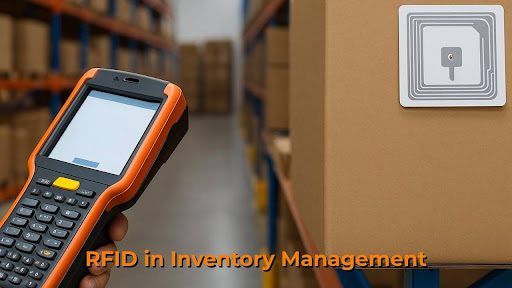
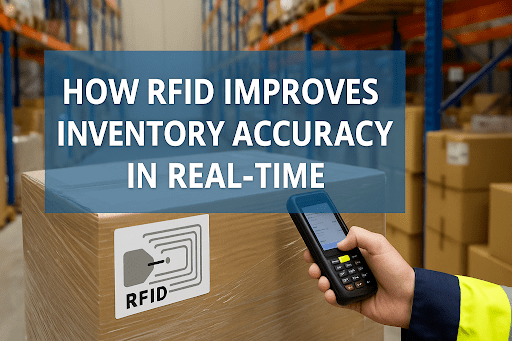
Of all the many business benefits associated with IoT RFID inventory management technology, accurately knowing your current inventory level is the most important.
Late or missing stock data will cause your plans to go awry. You will place orders for too much or too little product at the wrong time. You will miss customer commitments. You will loose time verifying numbers and data that is already available. We could all benefit from a bright idea to tackle that. Implement a stronger IoT RFID visibility strategy in your supply chain.
Rather than doing periodic inventories, teams can have on-going access to their data allowing them to have the most accurate of information on hand to ensure the most accurate of replenishment decisions. This list is not exhaustive, and RFID IoT predictive analytics will continue to surface more stock-related, zone-related, handoff-related, and accuracy-related issues as data is collected over time.
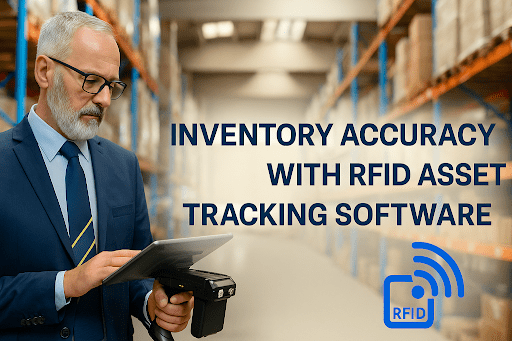
If you want to strengthen this topic inside the blog, a natural internal reference is Inventory Accuracy with RFID Asset Tracking Software.
Why cloud and edge both matter
Connected tracking is more effective when a game strikes a good balance between the speed and scope of its connected tracking. Cloud and edge technologies are also relevant for supply chain applications.
Connecting across multiple sites, Scalable IoT RFID solutions on the Cloud from Zetes enables organisations to streamline their reporting processes while achieving consistent site-wide visibility. With a solution that future proofs your growing business, you can be confident that your organisation is equipped for whatever the future brings.
The new release also supports faster local decisions for edge computing IoT RFID applications. Some of the decisions required for fast-moving workflows need to be made quickly on the production floor, close to the products in process. Edge computing supports real-time decision-making for these types of workflows, alerts and exceptions where a cloud round trip is too slow.
Together, cloud and edge create a stronger model. One supports more control over the zoom level, the other supports a faster response. Our optimal mixture is mainly used in large warehouses, manufacturing and distribution centers.
How IoT RFID integration improves decisions across departments
IoT RFID integration supports more than one team in a project. Our integration with Tradebox Inventory Tracking enables warehouse teams to quickly identify where stock is located within the warehouse to help reduce search time. Procurement teams can identify potential shortages earlier to allow quicker replacement. Logistics teams can manage flow within the business to help optimise processing and delivery.
This is incredibly powerful for the supply chain when considering an IoT and RFID integration strategy. It creates shared visibility across the business. It can reduce the number of conflicts that occur when updating data and it can reduce the number of issues that occur due to differing designs / configurations. The RFID IoT connected supply chain can enhance collaboration / coordination between a variety of teams through the use of live updated data that has been provided by all parties connected to the supply chain. This leads to better decisions and smoother execution.
Why RFID and IoT convergence is a long-term advantage
Both RFID and IoT technologies involve connecting physical objects to data streams. It’s therefore natural for IoT systems to pull in RFID for tag reading capabilities.
Although initial RFID implementation objectives for many companies revolve around inventory tracking, additional value may be realized.
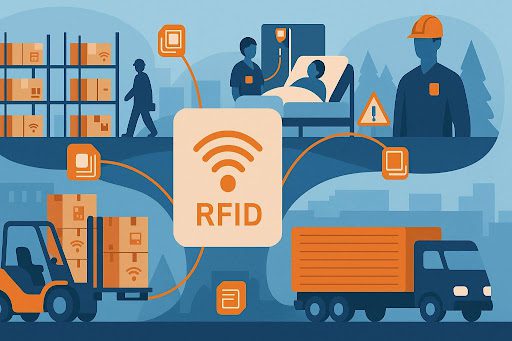
Eventually they get to see the value of RFID and IoT integration. By using identity, movement, sensing, analytics and workflow logic, businesses can exploit a range of technologies that have recently converged to create a single connected environment. The output is much more than simple read events.
IoT enabled RFID tracking provides your team real-time information. RFID IoT integration into their operations enables them to respond more quickly. Adding RFID IoT sensors to the system enables condition awareness. Through the implementation of cloud-based IoT RFID integration, they will gain real-time inventory and product visibility across all locations and track and store products accurately throughout the flow.
These technologies enable real time processing at the edge for IoT RFID applications. But most importantly, IoT RFID technology can greatly enhance one of the core components of supply chain performance - the inventory management foundation. This is what connected maturity looks like.
Common mistakes businesses make
A common pitfall with Open Source utilities is that they try to do too much. A tool with a good, usable solution to a particular problem is fine. But the creator can’t seem to leave well enough alone and instead tries to extend the tool to areas that are unrelated. The result is a tool that is difficult to adopt because people are deterred by the perceived scope and the inevitable shortcomings of what has become a bloated monster.
What problems could you solve with tracking and inventory management? These could be accuracy of your inventory, time to search for a specific item, visibility into tools and parts, or the flow of products through your warehouse. As each use case is addressed, more become valuable.
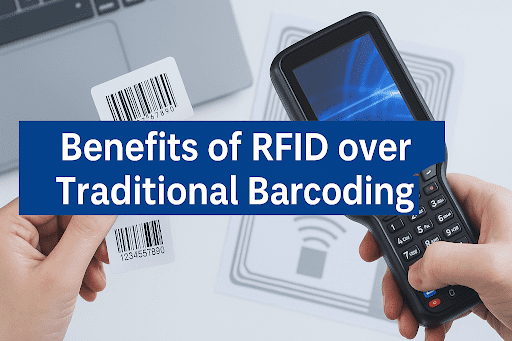
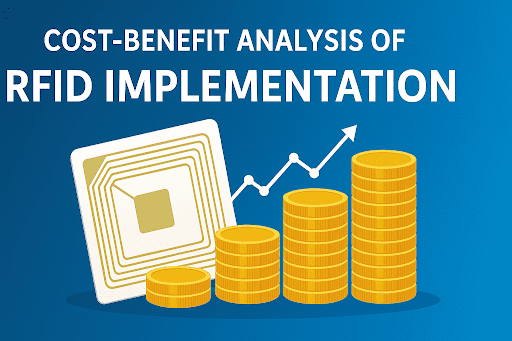
For those who don't know where this is going in the blog, a brief word on education where this information would apply would be useful. However, I'll also go ahead and add two additional sections on the Benefits of RFID over Traditional Barcoding and a Cost-Benefit Analysis of RFID Implementation.
Build smarter connected operations with DreamzCMMS
With our system, you can easily integrate and connect a wide variety of systems, putting efficiency back into your employees’ workflows and your customers’ experience. What are the unknowns or inconsistencies that are affecting others regarding tracking of current inventory, product flows, changeovers, and coordination between shifts or departments?
DreamzCMMS brings all of your company’s parts into harmony. With better visibility into your assets, workflows and inventory, you can build a more reliable and scalable business.
Integrating geospatial analysis, reporting, visualization, editing, mapping and web publishing with good data leads to results that are significantly more than the sum of their parts. It is better action. Want to cut down on blind spots and automate some of your tracking? Watch the free demo video to see how DreamzCMMS can boost your supply chain intelligence and connected execution.
For businesses focused on physical asset and inventory control, RFID Asset Tracking Software helps improve visibility and movement tracking. For stock-focused operations, Warehouse and Inventory Management supports better inventory flow and control. And for businesses that also need workforce visibility, Personnel and Labor Tracking adds stronger insight into people movement and operational coordination. When all of these systems work together, the result is not just better data. It is better action.
If your business wants to reduce blind spots, automate tracking, and improve connected execution, request a Free Demo and explore how DreamzCMMS can support smarter supply chain performance.
Conclusion
In conclusion, IoT RFID integration is helping businesses build a more connected and responsive operation. A strong IoT and RFID integration supply chain approach gives teams better visibility, stronger inventory control, and faster decisions. By creating an RFID IoT connected supply chain with the right IoT RFID technology integration, companies can reduce blind spots, automate workflows, and improve daily execution. Simply put, smart supply chain IoT RFID systems help businesses work with more speed, accuracy, and confidence.



Subscribe to Our Newsletter
 100% SECURE
 We Respect Your Privacy
 Ready for More?
Talk to one of our CMMS experts and see how DreamzCMMS can simplify your maintenance operations.
Book a free consultation