 BACK TO Blog
Asset Rental Management
RFID Asset Tracking
Active vs Passive RFID Tags: Which Technology Fits Your Asset Tracking Needs?
- February 13, 2026
- DreamzCMMS Team
- 16 minutes read
- February 13, 2026
- DreamzCMMS Team
- 16 minutes read
Why RFID Tag Choice Shapes Asset Visibility and ROI
Most leadership teams do not fail at RFID because they pick the wrong vendor.
They fail because they treat RFID as a procurement decision instead of an operating model decision.
The moment you begin comparing active vs passive RFID tags, you are not really debating hardware. You are deciding what kind of visibility your business will have over its assets. That visibility influences inventory accuracy, loss prevention, compliance confidence, and even customer trust.
That is why an Active RFID vs passive RFID comparison should never start with tag cost. It should start with business intent.
The Difference That Drives Every Other Outcome
The simplest explanation for the difference between active and passive RFID is also the most important one.
Active tags have power. Passive tags do not.
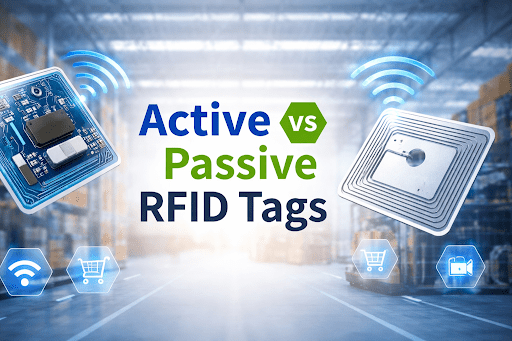
Active RFID battery powered tags transmit signals using their own energy source. Passive RFID battery-free technology depends on the reader to energize the tag before it responds.
That single design choice affects almost everything else: range, infrastructure requirements, maintenance burden, and long-term cost.
This is the reason most executives find that active passive RFID tags explained in a technical document still do not answer the business question. The real impact shows up in daily operations.
Range Is Not a Feature. It Is a Capability Boundary.
In many industries, the conversation turns quickly to distance. Everyone wants to know how far a tag can be read.
But a true RFID tag read range comparison is not just about meters or feet. It is about whether your organization can see assets automatically, or whether your teams still need to “walk the floor” and scan items.
Active tags are often chosen when leaders want location intelligence that behaves like surveillance. This is why they are associated with real-time tracking active RFID deployments.
Passive tags are usually chosen when visibility can happen at checkpoints. The asset does not need to broadcast continuously. It only needs to be detected when it passes a reader.
This is where the discussion of RFID tag types comparison becomes practical rather than theoretical.
Cost Looks Simple Until You Measure the Wrong Thing
The active vs passive RFID cost analysis is frequently misunderstood.
Yes, passive tags are cheaper per unit. In high-volume environments, that matters.
However, cost per tag is not the full cost of the system. The real expense includes the infrastructure required to read tags consistently, the labor cost saved or not saved, and the operational consequences of missed reads.
In some cases, a lower-cost tag creates higher long-term operational waste.
That is why the decision of choosing between active and passive RFID is rarely about what is cheaper. It is about what is sustainable.
The Use Case Usually Makes the Decision for You
In practice, active RFID tags vs passive tags becomes an easy decision when the environment is clear.
If your business needs to track expensive mobile assets across large sites, active RFID often becomes the obvious direction.
If your business is labeling thousands of items for inventory counts, passive RFID is usually the realistic choice.
This is also where the topic of active vs passive RFID for asset tracking becomes relevant for leadership teams. The question is not whether RFID works. The question is whether it works at your scale and under your constraints.
Some organizations also explore hybrid models. This is where semi-passive RFID tags comparison enters the conversation, especially when reliability needs to improve without committing fully to active tracking.
In UHF environments, executives often evaluate UHF active vs passive RFID options based on read reliability and coverage needs.
RFID Does Not Deliver Value Unless It Feeds a System
RFID tags do not create ROI by themselves.
The return appears when RFID data becomes operational intelligence, especially when it integrates into platforms such as RFID Asset Tracking Software or a broader Warehouse and Inventory Management strategy.
For organizations seeking continuous location awareness, RFID is often paired with a Real-Time Location System, which shifts the use case from scanning to tracking.
This is why the tag decision cannot be isolated from the software decision.
When Passive RFID Becomes the Smarter Business Move
There is a reason passive RFID dominates supply chains across the world.
It is not because it is more advanced.
It is because it scales quietly.
In the ongoing debate around active vs passive RFID tags, passive systems often receive less attention because they do not promise continuous broadcasting or live dashboards filled with moving dots. Yet in many environments, that is exactly why they work.
Passive RFID is built for volume
Unlike active tags, passive RFID battery-free technology does not transmit on its own. It waits for a reader to energize it. No internal battery. No transmission schedule. No battery replacement cycle.
That absence of power is not a weakness. It removes maintenance from the equation entirely.
For leadership teams reviewing an active vs passive RFID cost analysis, this difference changes long-term planning. A tag that does not require battery replacement avoids recurring service schedules and lifecycle tracking.
At scale, that matters.
Where passive RFID really shows its value is in structured environments
Imagine a warehouse where inventory moves through predictable pathways. Or a distribution center where pallets pass through fixed gates. In these cases, the asset does not need to broadcast continuously. It only needs to be detected at the right moments.
This is why passive systems integrate naturally into Warehouse and Inventory Management strategies. Movement becomes event-driven. Every scan updates stock records automatically. No manual reconciliation required.
In that context, the difference between active and passive RFID becomes practical rather than technical. One is constant visibility. The other is structured confirmation.
Range is often misunderstood in this conversation
Yes, active systems dominate in any RFID tag read range comparison. But range without workflow alignment does not create value.
If your process ensures that items pass near readers anyway, extended range becomes less critical.
This is why some organizations evaluate UHF active vs passive RFID not based on theoretical distance, but on how their facilities are designed.
The right answer depends on movement patterns, not marketing claims.
Cost becomes decisive when volume increases
If your operation involves tagging tens of thousands of items, the economics of active RFID tags vs passive tags change quickly. Passive tags allow wide deployment without heavy capital exposure.
That is usually the turning point when leadership moves from “which is better?” to “which is sustainable?”
The decision of choosing between active and passive RFID is rarely philosophical. It is operational.
Passive systems are not perfect
They do not provide continuous tracking. They require reader infrastructure. They rely on process discipline. In open, unstructured environments, they can fall short.
That is why the discussion around passive RFID tag pros and cons must always consider the environment first.
For organizations tracking mobile heavy equipment across large outdoor yards, passive tags may feel limiting. For organizations reconciling inventory daily inside a defined facility, passive RFID often outperforms more complex alternatives.
Some companies explore middle-ground solutions. In those cases, a semi-passive RFID tags comparison helps clarify trade-offs. Semi-passive models can improve reliability while avoiding full active transmission behavior.
Still, hybrid models only make sense when the use case justifies added complexity.
The larger issue is integration.
RFID tags do not generate insight alone. The value appears when tracking data feeds into systems such as RFID Asset Tracking Software or enterprise asset platforms like DreamzCMMS.
Without system-level integration, RFID becomes a collection of scans instead of operational intelligence.
When integrated correctly, passive deployments provide clarity at scale without adding maintenance burden.
Want to Choose the Right RFID Tag Strategy Faster?Still evaluating active vs passive RFID tags for your business?See how RFID tracking can connect directly with maintenance planning, inventory visibility, and asset lifecycle control using RFID Asset Tracking Software inside DreamzCMMS. Request a Free Demo today and identify the best RFID approach for your asset tracking needs. |
A Practical Executive Guide to Choosing the Right RFID Tag Strategy
By the time most organizations reach the evaluation stage, they already know RFID can improve tracking. The real uncertainty is not whether RFID works.
The uncertainty is whether the organization is about to invest in the right kind of visibility.
That is what the active vs passive RFID tags decision really represents.
This is not a debate about technology. It is a decision about operating style.
Start With the Business Question, Not the Tag
Before comparing specifications, leadership should clarify what the business actually wants from tracking.
Is the goal to prevent loss?
Is it to improve inventory accuracy?
Is it to locate equipment faster?
Is it to reduce downtime?
Is it to support compliance reporting?
Until that is clear, an Active RFID vs passive RFID comparison becomes noise.
This is also where many RFID initiatives fail quietly. The organization buys a system that technically functions, but does not match how operations work in the real world.
If You Need “Live Awareness,” You Are Already Leaning Toward Active RFID
If your environment requires immediate location awareness (not just confirmation at checkpoints), then passive systems often feel insufficient.
This is where real-time tracking active RFID becomes relevant.
In practical terms, active tags are usually chosen when assets are:
- mobile across wide areas
- frequently misplaced
- expensive enough that loss creates measurable impact
- critical to operations and downtime is unacceptable
This is where the difference between active and passive RFID becomes clear in business language.
Active RFID is not about scanning. It is about awareness.
Many organizations in this category also evaluate integration with a Real-Time Location System because it strengthens location accuracy and supports monitoring across large environments.
If You Need “High-Volume Accuracy,” Passive RFID Often Wins
If your primary challenge is scale, passive RFID usually becomes the more realistic option.
Warehouses, distribution centers, retail inventory environments, and manufacturing supply chains often benefit from passive RFID battery-free technology because it is cost-effective and maintenance-light.
This is where passive systems integrate naturally with Warehouse and Inventory Management workflows. Inventory movement becomes trackable without forcing teams to manually record stock changes.
For large organizations, this is often the most efficient path to accuracy.
This is why, in many real deployments, active RFID tags vs passive tags becomes less about features and more about volume economics.
The Range Question Should Be Handled Carefully
Executives frequently focus on range early, but range alone is not a strategy.
Yes, an RFID tag read range comparison typically favors active RFID. But range only matters if the operational environment requires it.
If assets move through predictable pathways (gates, aisles, checkpoints), passive RFID can deliver excellent accuracy with the right reader placement.
That is why many organizations evaluate UHF active vs passive RFID options based on facility layout rather than raw technical distance.
The practical question is simple:
Will the asset naturally pass close enough to be detected?
If yes, passive systems can deliver strong ROI.
If not, active systems may be required.
Cost Must Be Viewed as a Multi-Year Decision
The active vs passive RFID cost analysis should never stop at the tag price.
Active systems often carry higher ongoing costs because active RFID battery powered tags eventually require battery replacement or tag refresh cycles.
Passive systems typically avoid that maintenance category completely, which is why passive solutions often scale more smoothly in high-volume environments.
This is where the decision of choosing between active and passive RFID becomes more than budgeting. It becomes life cycle planning.
The Hybrid Option: When Neither Extreme Fits Perfectly
Some environments do not fit cleanly into “active-only” or “passive-only.”
In these cases, organizations explore hybrid deployment models, sometimes using passive tags for high-volume inventory and active tags for critical mobile equipment.
This is also where semi-passive RFID tags comparison becomes relevant. Semi-passive tags can offer improved signal reliability while still relying on reader interaction rather than full broadcasting.
Hybrid models are not always necessary, but in certain industries they can provide the best balance between cost and capability.
The Decision Is Incomplete Without Software
This is where many RFID projects make a costly mistake.
Tag selection is only one part of the system. The real value appears when RFID data becomes actionable intelligence.
That is why organizations must evaluate RFID deployment together with the software layer.
A modern RFID program should connect into RFID Asset Tracking Software so that tracking data supports reporting, compliance, asset lifecycle planning, and operational decision-making.
For organizations managing equipment maintenance and asset governance, platforms like DreamzCMMS can provide a centralized foundation for turning RFID data into measurable business outcomes.
Without software integration, RFID becomes a tracking experiment rather than a scalable operating system.
A Simple Decision Summary for Leadership
In most environments:
- Active RFID is chosen when visibility must be continuous and assets are critical.
- Passive RFID is chosen when tagging volume is high and checkpoint-based tracking is sufficient.
- Hybrid models work when different asset categories require different visibility levels.
That is the simplest way to understand active vs passive RFID for asset tracking.
The tag decision is not only technical. It defines how your organization will operate for years.
The Decision Is Easier Than It Looks
At some point in every RFID project, the conversation gets stuck.
One team says active RFID is the future.
Another says passive RFID is cheaper and safer.
A vendor pushes range numbers.
Someone brings up battery life.
And suddenly, what should have been a straightforward decision becomes a long internal debate.
That is why the discussion around active vs passive RFID tags needs to be simplified.
Not simplified in a technical way. Simplified in a business way.
Start With the Truth: What Are You Trying to Stop Losing?
Most companies do not implement RFID because they love technology.
They implement it because something keeps going wrong:
- equipment disappears
- inventory counts do not match reality
- teams waste hours searching
- downtime increases because assets are “somewhere” but not available
- leadership cannot get reliable visibility
Once you define the pain clearly, the difference between active and passive RFID stops being confusing.
Active RFID Makes Sense When Uncertainty Is Expensive
Active RFID is the right direction when the business cannot tolerate guessing.
If the asset is high-value, critical, mobile, and constantly moving, then passive scanning feels like an incomplete answer.
This is where real-time tracking active RFID becomes attractive. The tag broadcasts. You do not wait for a checkpoint. You get ongoing awareness.
In large facilities, it is often paired with a Real-Time Location System, because leadership wants more than identification. They want location confidence.
That is the practical value of active RFID battery powered tags.
But yes, batteries eventually become a lifecycle item. That must be included in any honest active vs passive RFID cost analysis.
Passive RFID Wins Quietly in High-Volume Operations
Passive RFID does not look exciting. It does not broadcast. It does not “track” in the dramatic way people imagine.
But in warehouses, distribution centers, and inventory-heavy environments, it works because it fits the workflow.
That is the strength of passive RFID battery-free technology.
It scales. It lasts. It stays inexpensive.
And when integrated into Warehouse and Inventory Management, it solves the biggest operational headache: inaccurate stock and wasted time reconciling counts.
This is why passive RFID remains dominant in real-world supply chain deployments, even when active solutions get more attention.
Range Is Important, but It Is Not the Only Metric
Every organization ends up doing an RFID tag read range comparison.
Active usually wins. That is not a surprise.
But range does not automatically create ROI. If your assets naturally pass through gates, aisles, or scanning zones, passive tags can deliver excellent accuracy without needing long-distance detection.
This is where UHF active vs passive RFID discussions become practical. The facility layout matters more than the brochure.
The Scale Question Usually Ends the Debate
Here is a simple truth leadership teams often avoid:
If you are tagging thousands of items, active tags are rarely realistic.
If you are tracking expensive mobile equipment, passive tags may feel weak.
That is why the comparison of active RFID tags vs passive tags is often decided by two variables: quantity and value.
The moment those two numbers are clear, choosing between active and passive RFID becomes less of a debate and more of a logical outcome.
Hybrid RFID Is Not Overcomplicated If You Do It Correctly
Some organizations do not need one answer.
They need two.
Passive RFID can handle high-volume inventory. Active RFID can be reserved for mission-critical equipment. Some teams also explore battery-assisted options, which is where semi-passive RFID tags comparison becomes relevant.
Hybrid approaches are common. The only mistake is trying to manage hybrid deployment without clear rules.
The Software Layer Is Where the Value Actually Lives
RFID does not create business value just because tags exist.
It creates value when data flows into a system that can act on it.
That is why RFID programs should always be planned alongside RFID Asset Tracking Software.
And if the goal is to connect asset location with maintenance scheduling and lifecycle tracking, integrating RFID into DreamzCMMS becomes a practical move for organizations that want centralized asset control.
Without software integration, RFID becomes a collection of scans. With integration, it becomes a management system.
That is the difference.
Conclusion
By the time most companies reach the RFID decision stage, the technology itself is not the real challenge.
The real challenge is alignment.
The discussion around active vs passive RFID tags can feel technical at first. Power source. Read range. Battery life. Infrastructure. All of that matters, but none of it matters more than this question:
What problem are you actually trying to solve?
If the issue is inventory accuracy at scale, passive RFID may already be enough.
If the issue is uncertainty around high-value moving assets, active RFID may be necessary.
That is the practical difference between active and passive RFID. One supports structured checkpoints. The other supports continuous awareness.
There is no universal winner. There is only fit.
The right decision is the one that matches how your assets move, how often they move, and how costly it is when they cannot be located quickly.
Once that is clear, the comparison of active vs passive RFID for asset tracking becomes far less complicated.
Take the Next StepIf you are still weighing the pros and cons of active vs passive RFID tags, it may help to see how RFID data actually connects to your broader asset strategy.A short Free Demo of DreamzCMMS can show how tracking information feeds maintenance planning, inventory control, and operational visibility in one system. Technology alone does not create control. Clarity and integration do. Explore what the right RFID model could look like inside your organization. |
Explore More on RFID and Inventory StrategyIf you want to deepen your understanding of RFID implementation and real-world applications, the following resources provide practical insights:What Is RFID Inventory Management and Why It Matters How to Use RFID for Inventory Tracking: A Quick Guide How RFID Is Used in Inventory Management Across Industries These reads will help you evaluate how RFID technology fits into broader inventory accuracy, operational visibility, and asset control strategies. |































Subscribe to Our Newsletter
 100% SECURE
 We Respect Your Privacy
 Ready for More?
Talk to one of our CMMS experts and see how DreamzCMMS can simplify your maintenance operations.
Book a free consultation