 BACK TO Blog
Asset Rental Management
Field Service
IoT in Facilities: Prevent Equipment Failures with AI
- December 30, 2025
- DreamzCMMS Team
- 9 minutes read
- December 30, 2025
- DreamzCMMS Team
- 9 minutes read
The Internet of Things (IoT) revolutionizes how organizations handle facility operations and maintenance activities. The integration of IoT technology with intelligent sensors enables facilities management to achieve predictive maintenance and operational excellence while reducing operational expenses.
The combination of IoT technology with artificial intelligence (AI) creates an effective system that prevents equipment breakdowns and reduces operational interruptions, and optimizes energy usage to create intelligent facilities that operate sustainably.
The Integration of IoT Technology Plays a Vital Role in Facilities Management Operations
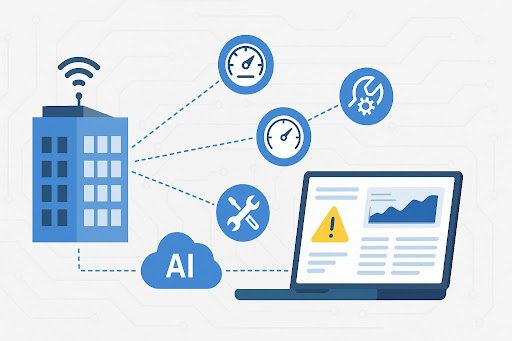
The integration of IoT technology in facilities management enables smart sensors to monitor all assets including HVAC units and water systems and elevators while tracking their performance and temperature and energy usage data. The system unites all collected data into a centralized platform which enables facilities managers to identify performance issues and irregularities at their onset.
The system provides complete asset visibility which enables organizations to make data-based choices while maintaining peak operational performance. The combination of IoT technology with Field Service Management Software enables organizations to optimize their maintenance operations through automated planning and scheduling and execution, which results in fewer unexpected equipment failures and better operational performance.
Gain Insights with Smart ReportingReporting Software Generate insightful reports on equipment health, asset performance, and maintenance trends — all powered by IoT analytics and automation.Reporting Software |
Predictive Maintenance Technology: From Reactive to Proactive
The current maintenance approach depends on reactive methods because it only responds after equipment failures occur. The system operates differently through predictive maintenance technology. The combination of AI technology with IoT sensor information enables systems to identify upcoming equipment failures before they actually occur.
The vibration sensors on motors track abnormal frequency patterns, which trigger an alert. The AI system processes sensor data to identify equipment deterioration, which triggers an alert for maintenance. The maintenance team receives alerts to perform preventive maintenance before equipment failures result in system downtime.
The predictive maintenance approach helps organizations save money on maintenance expenses while avoiding unnecessary service calls, and it helps extend the operational life of expensive equipment. The system enables maintenance personnel to concentrate on essential problems instead of performing unnecessary checks.
IoT for Facilities Management: Turning Data into Insights
The IoT system for facilities management provides instant monitoring of all building infrastructure operations. All assets that use sensors send performance data, which helps identify operational patterns and possible system inefficiencies. The AI system analyzes sensor data to create failure forecasts and optimize energy usage, and boost system reliability.
The system delivers three main advantages to users.
- The system tracks equipment performance in real-time to detect faults right away.
- The system uses IoT data analytics to help facilities teams discover extended performance patterns and operational weaknesses.
- The system uses IoT data to perform condition-based maintenance instead of traditional time-based maintenance schedules.
The system generates continuous feedback, which enables facilities teams to shift from crisis management to optimized operational control.
Smart Building Maintenance Software: A Connected Ecosystem
The digital center of connected facilities operates through smart building maintenance software. The system merges IoT information from all building subsystems, including HVAC and energy and lighting, and machinery into one centralized interface.
The system includes three main features.
- The system tracks all essential equipment through IoT sensors.
- The system uses AI to identify performance issues through anomaly detection.
- The system generates automatic work assignments to speed up maintenance responses.
- The system provides complete asset management through its smart asset management software interface.
The system enables automatic technician assignment through Job scheduling software when sensor alerts occur. The system minimizes downtime while delivering fast responses and enabling scheduled maintenance activities.
Prevent Equipment Failures with IoT and AI
The combination of IoT technology with AI enables organizations to gain essential knowledge, which helps them stop equipment breakdowns. The sensors operate continuously to track essential parameters, including pressure and vibration, and temperature. The AI system analyzes current sensor data against historical records to identify potential problems before they occur.
The system operates through three main stages.
- The system operates by gathering data from IoT sensors at all times.
- The system uses predictive models to detect anomalies through AI-based analysis.
- The system generates automatic alerts to notify users about potential system problems.
- The system performs scheduled maintenance tasks before equipment failures occur.
The system provides real-time data, which enables predictive maintenance instead of traditional reactive maintenance to achieve better asset availability and longer equipment lifespan.
Connected Facilities Management: Smarter Operations, Lower Risk
The digital network unites all building systems into a single platform, which enables connected facilities management. The system uses IoT sensors to track operational data from all systems while AI technology suggests the best course of action.
Benefits include:
- The system tracks all assets in real-time.
- The system uses predictive analysis to enhance operational performance.
- The system uses predictive analysis to enhance operational performance. The system achieves energy conservation through its ability to analyze data for making operational adjustments.
- The Field service dispatch software uses intelligent routing to send technicians to their destinations at a faster rate.
- Organizations achieve better control and sustainability, and operational efficiency through the combination of IoT connectivity with predictive analytics.
By merging IoT connectivity with predictive analytics, organizations can achieve greater control, efficiency, and sustainability.
IoT Equipment Monitoring: Always Watching
The system provides continuous monitoring of equipment and machinery through IoT equipment monitoring technology. The system uses sensors to monitor energy consumption and motor vibrations and airflow, and temperature changes, which produce ongoing system feedback.
The system produces instant alerts when any monitored value moves outside its established parameters, which enables technicians to perform inspections and repairs before equipment damage occurs.
The system operates continuously to reduce equipment breakdowns and decrease operational expenses while enhancing workplace safety through IoT-based facilities management.
Real-Time Equipment Health Monitoring: Data That Protects Assets
Modern facilities require real-time equipment health monitoring as their fundamental operational necessity. The system operates continuously to monitor assets while delivering simple-to-understand dashboard reports.
The system detects HVAC system overheating and water pump efficiency decline through automated maintenance alerts, which send instant notifications to the team right away. The system generates alerts that protect assets from damage while stopping operational disruptions that stop business operations.
Organizations achieve peak asset performance through the combination of IoT sensors for predictive maintenance and AI-powered dashboards.
Smart Asset Management Software: A Centralized Command Hub
The software unites all equipment and systems throughout buildings into one unified management platform. The system tracks asset usage information together with maintenance records and complete cost profiles for all assets.
The system tracks equipment performance through real-time monitoring.
- The system performs automated maintenance schedule generation.
- The system detects units that operate below maximum capacity or show decreased performance.
- The system enables organizations to develop extended asset management plans.
- The system provides complete visibility, which enables facilities to optimize their budget allocation and make strategic investment choices based on data.
This central visibility helps facilities allocate budgets more effectively and make data-driven investment decisions.
Automated Maintenance Alerts: Always One Step Ahead
The combination of IoT technology with AI enables automated maintenance alerts that detect all potential issues. The system generates automatic maintenance alerts to teams through notifications whenever it detects temperature increases or vibration irregularities, or fluid leaks, even during non-working hours.
The system enables users to set up automatic work order generation through the CMMS when specific alert conditions are met. The system enables fast issue resolution, which leads to better safety compliance and reduced equipment downtime.
IoT Data Analytics for Facilities: Insights That Drive Improvement
IoT data analytics for facilities enables organizations to move past basic monitoring because it enables ongoing improvement initiatives. The analysis of extensive IoT data enables facilities teams to detect operational patterns and locate original causes, and discover ways to decrease expenses.
The system generates reports that include:
- The system generates predictive data about equipment failure patterns.
- The system generates reports about energy usage performance.
- The system enables users to compare performance metrics between different facility locations.
- The system displays asset performance data through time-based visualizations.
Organizations that use data to make decisions about their facilities can predict upcoming problems.
Condition-Based Maintenance with IoT: Smarter Scheduling
The combination of IoT technology with AI algorithms enables maintenance scheduling based on actual equipment conditions instead of using fixed time intervals.
The system provides two main advantages to users.
- The system helps organizations save money through reduced maintenance expenses because it avoids performing unnecessary work.
- The system helps organizations maximize their asset lifespan through optimized maintenance schedules.
- The system enables organizations to maintain higher equipment availability because it detects problems before they result in major system failures.
- The system helps organizations decrease their environmental impact through its efficient energy management capabilities.
The system provides better precision and cost savings than traditional time-based maintenance approaches.
Reduce Equipment Downtime with IoT and AI-Driven Insights
The combination of IoT technology with AI enables organizations to perform predictive maintenance, which results in reduced equipment downtime.
The system provides real-time alerts, which enable technicians to fix problems before they develop into major equipment failures.
Organizations that implement IoT predictive maintenance solutions achieve a 40% reduction in equipment breakdowns while cutting their maintenance expenses for labor and spare parts.
Smart maintenance practices generate substantial financial benefits for organizations that implement them. The future of facility operations depends on connected facilities management which combines IoT technology with AI systems and automation. Smart buildings now function as self-sustaining ecosystems that perform continuous self-diagnostics and automated maintenance scheduling, and performance optimization.
The adoption of IoT technology enables facilities to shift from traditional reactive maintenance to predictive intelligence systems, which enhance operational performance and environmental sustainability, and financial performance.
The combination of predictive maintenance technology with IoT equipment monitoring and real-time equipment health tracking enables facilities to evolve into intelligent systems.
The Future of IoT-Enabled Facility Management
The future of facility operations lies in connected facilities management that unites IoT, AI, and automation. Buildings are evolving into smart ecosystems capable of self-diagnosis, auto-scheduling maintenance, and optimizing performance 24/7.
By embracing IoT integration, facilities can transition from reactive operations to predictive intelligence — improving efficiency, sustainability, and profitability.
With predictive maintenance technology, IoT equipment monitoring, and real-time equipment health monitoring, facilities become not just connected but truly intelligent.
Experience the Power of Smart Facility ManagementDreamzCMMS The AI-based CMMS system from DreamzCMMS enables users to manage maintenance operations while maximizing facility availability and achieving complete smart facility management.DreamzCMMS | Free Demo |





















Subscribe to Our Newsletter
 100% SECURE
 We Respect Your Privacy
 Ready for More?
Talk to one of our CMMS experts and see how DreamzCMMS can simplify your maintenance operations.
Book a free consultation