 BACK TO Blog
Asset Rental Management
Field Service
Geofencing in Field Service Management: How Leaders Improve Accountability, Automate Workflows, and Scale Faster Service
- March 18, 2026
- DreamzCMMS Team
- 15 minutes read
- March 18, 2026
- DreamzCMMS Team
- 15 minutes read
Introduction: Field Visibility Is No Longer Just a Dispatch Problem
Companies that deploy Geofencing technologies and practices within their Field Service Management (FSM) operations will be in a better position to achieve the goals of accountability, process improvements and scalability in their operations, and will, therefore, be better positioned as competitive leaders. By leveraging location awareness technology and practices to enhance their business operations, companies are empowered to realign resources more effectively, service a broader customer base more quickly and reduce costs and downtime to their benefit.
There are still an awful lot of field service organisations who see location visibility as a back office issue – something that affects IT, but doesn’t really have an impact on the engineer or technician in the field.
All they care about is where the tech is when you call to ask “where is my tech?”. They look at timesheets at the end of the day. They correct job log entries long after it has caused a problem with your pay for the day in question. They look at arrival windows long after it has caused you any inconvenience.
That way of operating no longer works.
One of the most common misconceptions in the Field Service Management industry is what geofencing really is and what it does. What was once considered to be a basic tracking tool is now so much more and is truly a core performance metric for labor accuracy, technician accountability, dispatch efficiency and customer engagement. It’s also a critical metric when looking to scale out into new markets and territories.
That is where geofencing changes the conversation.
Location tracking for real time location fencing Job sites or service zones for real time tracking of field workers in specific areas Around a site for real time fencing of customer locations Restricted areas for real time monitoring of locations a business wants to keep track of, such as for safety purposes. Real time location tracking allows for immediate response to events that occur such as confirmation of arrival, improved start and stop time tracking for time clock applications, route and dispatch improvements because the field worker’s location is always current. Customers can be automatically updated on the status of their appointment eliminating the need for a receptionist to make individual phone calls to update the status of the appointments.
Why are service leaders more interested in geofencing in field service? Because they care about innovation. And so should you! That’s why we’re seeing more service leaders interested in understanding what geofencing in field service means, as well as how it can be used as part of a broader smart operations strategy.
The Executive Reality: Why Location Accuracy Has Become a Service KPI
Field teams don’t view disconnected workflows as “software problems”. They view them as “friction”.
The customer notices when the service technician does not show up on time and is not contacted to keep them posted. The dispatcher notices when the service techs are not marking themselves as “Available” when they approach the job location. The techs notice that they have to remember to clock in and out and always have some method of verifying that they actually were at the job location. The finance team notices when the labor disputes, mileage issues and timesheets with discrepancies start to pile up.
For leaders, the impact is even clearer.
First, better visibility protects profitability. Labor leakage, unnecessary drive time, and inaccurate job logs quietly erode margins.
Second, better location awareness improves service execution. With geofencing for field technicians, teams can route faster, assign smarter, and reduce confusion between office plans and field reality.
Third, better automation increases customer trust. Automated arrival triggers and geofencing customer notifications make the entire experience feel much more organized and trustworthy.
Fourth, we can’t scale as a business if we don’t know what time our technicians arrive at a customer’s home, what time they leave, and where we have persistent bottlenecks.
That’s why we believe that GPS geofencing is no longer a niche feature suitable for a handful of field service management platforms. Rather, it should be a fundamental component of modern service operations.
The Hidden Cost of Poor Field Visibility
Many companies assume a little location ambiguity is normal in field service.
It is not.
The real cost shows up everywhere.
Dispatch teams are still receiving too many calls from field service technicians who need updates from the office. Operations managers still spend a lot of time going back and forth just to confirm technician start times and end times. Field service managers are still manually correcting job and time data so payroll can be processed accurately. Estimators also face a challenge when they give ETAs. They do not want to underpromise or overpromise because they often do not know exactly when the current job will finish.
Field service managers also struggle to prove that geofencing was actually completed at the job site. When service history is audited, operations managers often cannot clearly show that geofencing job site verification really happened. This is not just about seeing dots on a map. It is about whether a business can take meaningful action using real-time location data. The issue is not only whether someone can “see dots on a map.” The issue is whether the business can act on live location data.
Without geofencing technology field service teams often rely on disconnected habits:
- Manually clock in and out
- Manually enter job arrival notes
- Manually send time clock information to employees via text message
- Manually use paper approvals for time clock entries
- Correcting past due time clock information for employees, jobs, and/or activities.
- That model is too slow for modern operations.
When visibility is lost, time to make decisions is lost. Lost time equals lost service quality. Lost service quality equals lost revenue, lost customers, and a damaged brand.
Why Traditional Tracking Models Fail in Modern Field Operations
Traditional field tracking tools were built for simpler service environments.
Field Service Technicians would punch in at the start of their day and would call the main office to let them know they were on site. The Dispatcher would then advise of the next job to be done on their schedule for the day. The manager would then have to review and correct the timesheets at the end of each week. In those days the company was smaller and the customers were not as demanding as they are in today’s society. The distances that had to be travelled for service and repairs were not as great, nor as complex.
Field operations are not that simple anymore.
Schedules change instantly, traffic conditions change by the minute, and unexpected maintenance must be addressed as it occurs. With customers wanting updates on the status of their work and managers wanting to know that the work they are paying for is being done, phone and spreadsheets are no longer adequate to manage the mobile workforce.
This is where location-based field service automation creates value.
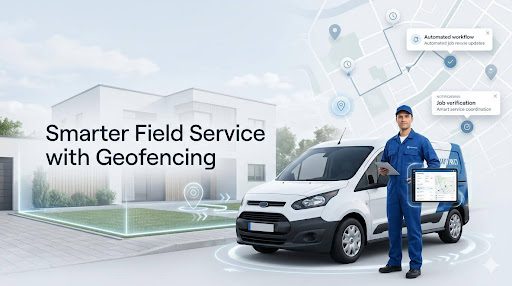
Virtual boundaries Field Service Management Virtual boundaries allow you to define areas where specific workflow events are relevant to your business. An action can be triggered when a resource enters or leaves a job zone. For example, you could trigger time capture, status updates, dispatch rules, or customer notifications.
Traditional tracking tells you what someone reported.
Geofencing is about being in the right place at the right time, while at the same time getting visibility of the activities taking place in the field, and being able to automatically adapt the workflows.
What Modern Geofencing in Field Service Management Must Deliver
While many think of geofencing as being about mapping out locations, we believe a geofencing strategy that drives meaningful business outcomes is more about what you can accomplish within those boundaries.
Geofencing is a location-based service technology that uses cell network location technology and GPS to track devices and locations. New geofencing technology in ServiceTrade offers the following five benefits to field service operations.
Better Time Accuracy
The Geofencing automatic clock in clock out feature cuts down on the need for field staff to remember to clock in and out. Lots of paperwork and unnecessary corrections are eliminated. Field staff have more time to work in the field, and Payroll receives an accurate data set.
Smarter Dispatch Decisions
Dispatchers can utilize geofencing dispatch automation to send work to the field staff who are closest to the job’s location. Eliminating the need for guess work, the closest staff to where the work needs to be done can be assigned the job. When combined with Vehicle GPS Tracking, operations managers will be far better informed of their mobile workforce’s location and readiness for assignment.
Stronger Accountability
Our Geofencing technician tracking gives you more confidence in tracking the arrival and on-site duration of workers and provides a more accurate record of job history. Operations are cleaner and less manual work is required.
Faster Customer Communication
Geofencing customer notifications can update customers when the technician is on the way, nearby, or has arrived. That reduces inbound status calls and improves the overall service experience.
Clearer Operational ROI
Leaders need to see whether field service geofencing solutions reduce overtime leakage, improve technician utilization, lower admin effort, and support more predictable service delivery.
That is the real promise of geofencing. Not more data for the sake of data, but more reliable action.
The Geofencing Blueprint: How High-Performing Service Organizations Win
High-performing service teams do not start with the question, “Which map feature should we turn on?”
They start with the cost of friction.
Start With the Cost of Friction, Not the Technology
Geofencing works best when it solves a real operational problem.
For one company, the biggest issue may be inaccurate time capture. For another, it may be repeated disputes about whether technicians actually reached a site on time. For another, it may be slow dispatch decisions during high-volume windows.
That is the leadership lesson.
How geofencing works field service operations should always be tied to business pain:
lost time, delayed response, disputed jobs, weak customer communication, or poor field visibility.
When leaders start there, adoption improves because the technology is connected to a clear outcome.
Build Around Real-World Technician Movement
Technicians do not move through the day in neat, predictable patterns.
They face traffic, cancellations, job overruns, urgent calls, and site access issues. A good geofencing setup has to reflect that reality.
That means defining the right zones:
customer addresses, service territories, branch service radiuses, staging yards, high-priority commercial sites, and restricted zones where compliance matters.
It also means paying attention to GPS geofencing accuracy field service performance. A geofence that is too wide becomes vague. A geofence that is too narrow can trigger poorly in dense or complex environments. The goal is not perfection in theory. The goal is dependable workflow behavior in practice.
Connect Geofencing to Field Operations
A location trigger alone does not create value.
The value appears when geofencing is connected to work.
A practical system should support actions like:
arrival verification, automatic job status updates, technician time capture, routing decisions, and customer messaging.
That is why geofencing performs best inside connected Field Service Management Software instead of operating as an isolated feature. The stronger the link between location events and work execution, the more useful the system becomes.
When time capture is also tied to Time Tracking Software, the business gains a cleaner workflow from field arrival to payroll review.
Use Real-Time Triggers, Not Just Historical Logs
Historical tracking has value. It helps teams review what happened.
But fast-moving field operations need more than history. They need real-time geofencing alerts field service teams can act on immediately.
If a technician enters a service zone, the next workflow step should move. If they leave a job site unexpectedly, the system should surface it. If a nearby emergency call comes in, dispatch should be able to spot the best available technician faster.
That is what separates basic tracking from field service geofencing solutions that actually improve performance.
Technology Is the Engine, Not the Strategy
This is what decision-makers need to remember.
Geofencing does not fix unclear workflows.
GPS does not fix poor dispatch discipline.
Automation does not fix weak service standards.
The operating model must come first.
Leaders should not ask, “How do we add geofencing because everyone else is doing it?”
They should ask:
Where do manual updates slow us down?
Where do labor records become unreliable?
Where do customers lose confidence?
Where can location-based automation improve both speed and accountability?
That is how better adoption happens.
Geofencing in field service management works best when it is part of a broader operating system built for visibility, service consistency, and continuous improvement.
How Leaders Know Geofencing Is Working
Many companies say they are improving field accountability because they turned on location tools.
That is not enough.
Leaders need business metrics.
Look at job arrival accuracy. Are scheduled appointments beginning closer to promised windows?
Look at payroll correction volume. Has geofencing automatic clock in clock out reduced manual edits and supervisor overrides?
Look at dispatch response time. Has geofencing dispatch automation improved how quickly urgent jobs are assigned?
Look at customer communication. Are proactive updates reducing “Where is my technician?” calls?
Look at operational trust. Are managers spending less time resolving disputes and more time improving performance?
Look at technician productivity. Are teams completing more jobs with less back-and-forth because status changes happen automatically?
If those signals improve, then benefits of geofencing field service are not theoretical. They are measurable.
Common Field Service Geofencing Use Cases
The fastest way to understand field service geofencing use cases is to look at where the friction usually lives.
One of the most common use cases is automatic arrival and departure capture. Instead of asking technicians to remember every status update, the system records site-based workflow changes for them.
Another major use case is dispatch optimization. When a cancellation, emergency, or priority request comes in, dispatch can use geofencing and live location context to identify the nearest viable technician more confidently.
Another is compliance and proof of service. Geofencing job site verification creates a stronger service record for customer disputes, internal reviews, and quality control.
And another is customer communication. When location events trigger status messaging automatically, communication becomes more consistent without creating more admin work.
Teams already focused on route efficiency can also combine geofencing with GPS Tracking for Field Technicians and route optimization thinking to tighten ETAs and reduce wasted miles.
FAQ: What Service Leaders Usually Ask
What is geofencing field service?
It is the use of virtual boundaries around job sites, service areas, or operational zones so the system can trigger actions when a technician enters or exits those areas. In field service, those actions often include time capture, arrival updates, dispatch changes, and job verification.
How geofencing works field service teams in practice?
A company creates digital service zones using GPS-based mapping. When a technician’s mobile device or vehicle enters that zone, the platform can log the event and trigger a workflow response such as clock-in, arrival confirmation, or customer notification.
What are the benefits of geofencing field service?
The main gains are better time accuracy, stronger accountability, faster dispatching, less manual admin, better customer communication, and more reliable proof of service activity.
Geofencing in Field Service Management Is Not a Feature. It Is an Operating Model.
At first, geofencing can look like a location tool.
Add some map logic. Trigger a few alerts. Improve a few timesheets.
But the impact is bigger than that.
It changes how teams document work.
It changes how dispatch responds to live conditions.
It changes how customers experience service.
It changes how leaders measure field performance.
That is why geofencing in field service management is no longer just a convenience for growing service businesses. It is part of how smarter organizations reduce friction, improve accountability, and scale without losing control.
When field movement stays manual, delays hide in the gaps.
When field movement becomes part of an automated workflow, the service runs with more confidence.
Build Smarter Field Visibility
If your team is still having to clock in manually, are having to submit their timesheets after the requested date and are having to reply to every single dispatch update, then it’s probably time for a change.
DreamzCMMS is a tool designed to simplify and streamline work activities and related business information. It integrates all the elements that are important to a service business such as movements of technicians, works in progress, schedules and reports. Modern field activities and location-based technologies like GPS, Wi-Fi, cellular and Bluetooth can be used to enhance time tracking, capture of proof of service and real-time decision making between dispatch and field operations.
Here’s a real-life example of how using geofencing, scheduling and tech visibility can make a real difference. Book a Free Demo to find out more.
Explore More


















Subscribe to Our Newsletter
 100% SECURE
 We Respect Your Privacy
 Ready for More?
Talk to one of our CMMS experts and see how DreamzCMMS can simplify your maintenance operations.
Book a free consultation