 BACK TO Blog
Asset Rental Management
Rental Asset
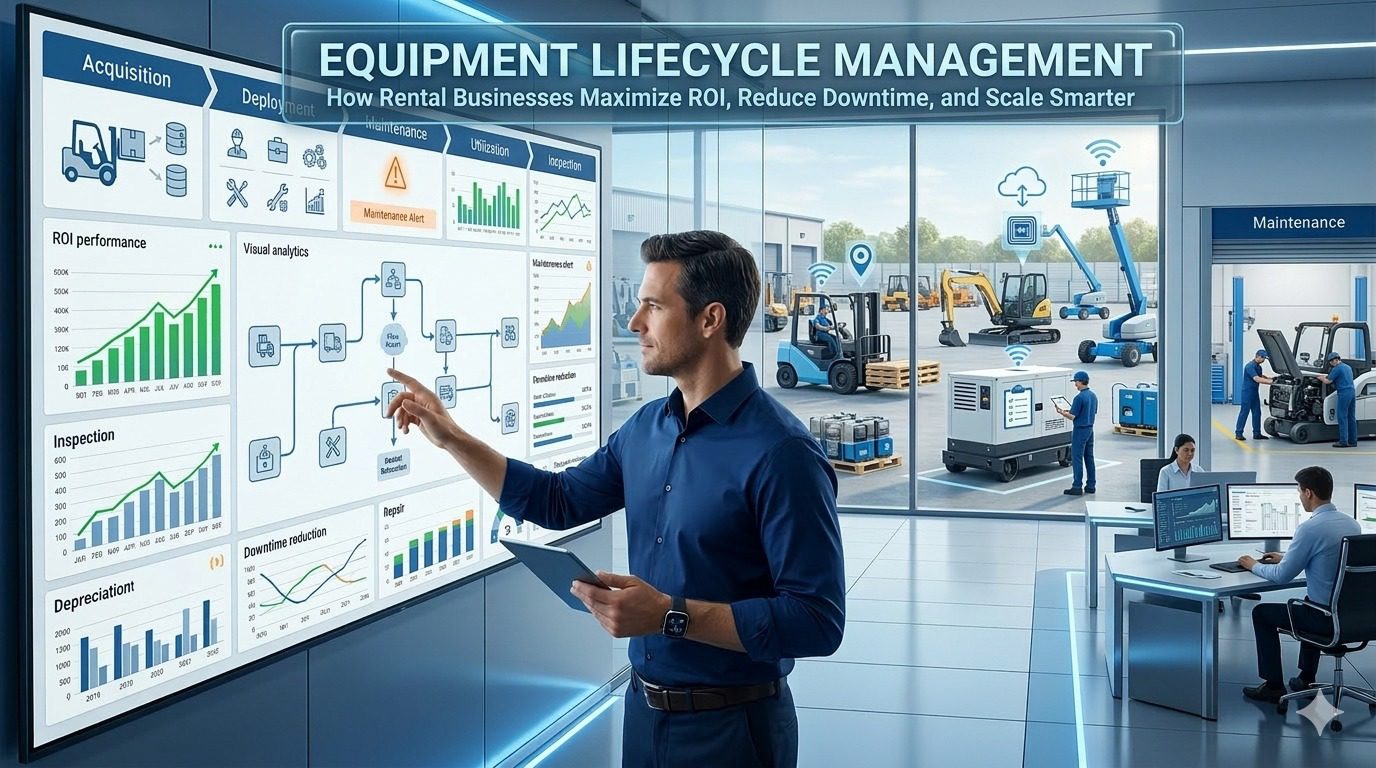
Equipment Lifecycle Management: How Rental Businesses Maximize ROI, Reduce Downtime, and Scale Smarter
- March 12, 2026
- DreamzCMMS Team
- 17 minutes read
- March 12, 2026
- DreamzCMMS Team
- 17 minutes read
Introduction: Equipment Lifecycle Management Is Not a Maintenance Task, It Is a Business Strategy
With evolving market dynamics and intensifying competition, managing equipment effectively is no longer a minor consideration – it’s a matter of survival. Companies must balance
In today’s Results-Oriented Business Environment it is essential to have effective practices in place for the management of all types of tangible assets. Routine maintenance is a straightforward and essential part of maintenance but it is only one element in the broader scope of Maintenance.
Most rental companies today still manage the lifecycle of their assets as an administrative cost. Items are purchased, rented, maintained as needed and replaced when costs become prohibitive. This seems like common sense but what are the unintended consequences and how are they affecting profitability, inventory availability and future business development.
That is why equipment lifecycle management deserves executive attention.
All rental assets have a lifecycle. Your rental assets go through cycles of acquisition, use, maintenance, depreciation and disposal/replacement/sale. Without proper management of this cycle, your rental business is likely to experience adverse effects on margin, uptime and planning.
If companies fail to manage the equipment lifecycle of their rental operations, the effects are almost immediate:
- Assets stay idle longer than they should
- Maintenance becomes reactive instead of planned
- Depreciation is tracked too late
- Replacement decisions are based on guesswork
- Downtime starts affecting customer trust
On the other hand, maintenance organizations that take a more methodical and structured approach to asset lifecycle management (ALM) are able to achieve higher asset availability, lower total cost of ownership, less unplanned downtime and better investment decisions.
That is why more leaders today are beginning to view Asset Maintenance and Reliability as an opportunity to produce and grow, rather than just an operational challenge to maintain their assets.
The Executive Reality: Why Lifecycle Discipline Has Become a Competitive KPI
Your customers likely do not care about the inner workings of how you manage asset aging, depreciation and maintenance history. Quite likely they will not notice, or perhaps not care, that you do not have a robust lifecycle management process in place. You’ll only find out that they don’t when you get a missed rental and have to rent from a competitor at the last minute, or when a bad rental or bad customer rants about the condition of a piece of equipment. You’ll only find out that they don’t care when a repair part cannot be obtained when required, when the wrong repair person is sent to the wrong location or when an asset fails unexpectedly.
The rental business is at the centre of the asset economy and the management of the asset lifecycle has become a key performance indicator for all stakeholders. It is a huge opportunity to increase customer satisfaction, efficiency and profitability.
For leadership teams, the impact shows up in four critical areas.
First, lifecycle control protects capital.
If an asset is introduced into service too early, replaced too late or used insufficiently in between, then margins will be lost.
Second, lifecycle control improves availability.
Rental companies can’t charge more rent if their heavy equipment is sitting idle in the shop, lost in a spreadsheet or not rented because it is in need of repair.
Third, lifecycle control sharpens forecasting.
The age of your assets, maintenance cost trends, and utilization are all key elements to consider when deciding when to buy, lease, or replace assets.
Fourth, lifecycle control reduces operational friction.
Knowledge of your internal processes and systems is key to running a successful business. If your internal processes and systems are well understood, you will likely be less reactive and more focused on delivering value to your customers.
Rental equipment businesses are growing in size and complexity, and managing diverse asset classes and large inventory levels is becoming more challenging. Raising asset lifecycle management to best practices is therefore no longer a choice but rather a necessity in order to become part of the operating model of rental businesses, and to maintain a level of operational discipline that helps to differentiate the more successful rental companies from those that are more reactive.
The Hidden Cost of Weak Lifecycle Management
Most companies do not lose money because a single machine breaks down. They are losing money because they are making individual lifecycle decisions at the wrong time. A piece of equipment is purchased without a clear utilization target. Maintenance records are stored in one place, rental history in another, and depreciation records in yet a third location. Repair spending creeps upward, but no one compares it to replacement cost.
Rental assets are constantly being deployed because they are still available when in fact, the Total Cost of Ownership (TCO) of the rental profile is no longer justified to continue providing asset availability.
This is the real danger. Most people associate poor Asset Management with dramatic equipment failures, which may not necessarily be the case. Perhaps instead, the effect is more like slowly draining away value over time.
That leakage appears as:
- higher service costs
- shorter useful life
- more downtime between rentals
- missed revenue from poor asset readiness
- delayed retirement of low-value equipment
We previously brought to your attention a guide for Rental Leaders to cover the whole life cycle of rental equipment. We cannot have lifecycle management as the title for a guide, and not reflect what the term really means. So here is the starting point for any such guide: Lifecycle management is not about extending the life of the asset. It is about optimizing the value of each phase of that asset’s life.
Why Traditional Lifecycle Models Fail in Rental Operations
The majority of rental companies currently rely on either experience or some form of manual process such as spreadsheets and ad-hoc reviews to determine when to replace assets. Typically this approach works reasonably well for modest and relatively uniform fleets. However, as a rental business grows and becomes more complex, together with greater customer expectations, the original simplistic approach is no longer effective.
Traditional methods usually depend on:
- manual asset logs
- disconnected service records
- delayed depreciation reviews
- reactive maintenance planning
- replacement decisions based on instinct
This approach creates blind spots.
A team may not have the information about the age of an asset, nor if it is still contributing financially. Even if they feel like maintenance costs are rising, they don't have any idea where those costs stack up to the cost of replacing a building or system.
They may recognize that not all of their equipment is utilized equally, but they may not have a complete understanding of which pieces of equipment are not being operated to their most efficient capacity within their entire fleet.
That is why a good equipment lifecycle tracking software is necessary. It brings to bear all the information that you should consider when making a decision. Operational history of the piece of equipment, maintenance effectiveness, patterns of usage and overall cost of ownership. Without that visibility, rental equipment lifecycle optimization becomes nearly impossible.
What Modern Equipment Lifecycle Management Must Deliver
DreamzCMMS platform will ensure that all of your equipment reliability, maintenance and asset optimization initiatives are delivered in a fully integrated and automated business system. This means more than just having a neat inventory of assets. It means more than having good information about your assets and what needs to be done. Your maintenance operations need to be able to dynamically react to real time changes in the performance of your assets, and your workforce needs to have the right information to execute tasks effectively.
A modern lifecycle strategy should consistently deliver five outcomes.
1. Smarter acquisition timing
Could enable the company to assess when new resources are required and what performance these should deliver.
2. Higher asset utilization
A core part of the leadership toolkit is the ability to determine whether the wrong assets are being used or under or over utilized, too expensive or the wrong configuration.
3. Lower maintenance-driven disruption
The lifecycle model shall be applied to optimize the maintenance lifecycle of the equipment items through activities of preventive maintenance and reliability centered maintenance (RCM).
4. Better replacement timing
Wesfarmers, the conglomerate that owns Coalfields Gas, wants to be alerted at the earliest sign of mechanical or financial decline in any of its assets.
5. Stronger retirement decisions
It is important to remove Equipment from service via a planned Asset Retirement activity rather than as an emergency measure after someone realizes that the piece of equipment has become a problem.
When we achieve these outcomes, it means that our efforts to improve the reliability of our equipment and implement asset management have advanced beyond the stage of being merely a paper exercise.
The Lifecycle Blueprint: How High-Performing Rental Businesses Win
Many organizations believe that the purchase of higher class or quality of equipment will provide the most benefit to the performance of the asset throughout its life. While the purchase of higher class or quality may impact the performance, it is not the dominant factor.
High performing rental companies are moving towards a more advanced asset management model. As such they manage the entire lifecycle of the asset – from procurement to retirement – in an integrated manner.
That blueprint is built on five strategic pillars.
Pillar 1: Start Lifecycle Management at Procurement, Not at First Repair
One of the biggest rental operations mistakes is the lack of understanding that the asset’s life cycle really starts before it’s rented to the customer.
It begins much earlier.
All the rest follows from how an asset was acquired. One bad choice of asset, quality, factor, or usage factor and years if not decades can pass before the full financial effect of the error is fully realized.
That is why procurement should not focus only on purchase price.
It should also evaluate:
- expected utilization rate
- maintenance burden
- parts availability
- reliability history
- resale or residual value
- service complexity across branches
It’s the Total Cost of Ownership (TCO) of rental equipment that really highlights the value of the dollar. A lower purchase price for a piece of equipment may make it seem like a better deal, but a lower priced asset with a higher failure rate and a higher rate of depreciation may not be as cost effective.
The best lifecycle strategies begin by aligning procurement with expected lifecycle value.
Pillar 2: Manage Every Lifecycle Stage With One System of Record
A rental business cannot control lifecycle performance when critical information is fragmented.
- Acquisition data in one system.
- Maintenance history in another.
- Utilization reports in spreadsheets.
- Retirement decisions made by memory.
This is exactly where equipment lifecycle tracking software changes the game.
A connected system helps leaders manage:
- asset purchase and commissioning
- inspection and service history
- rental frequency and idle periods
- downtime patterns
- cost accumulation by asset
- replacement and retirement timing
There is a need for visibility in any business and this is even truer in a paperless/spreadsheetless environment. Many growing rental companies are using some form of Equipment Rental Software and are integrating their Rental Inventory & Asset Management processes with it in order to have the information they need readily available and all of their asset data linked to the availability, location and performance of the assets.
This kind of visibility is especially important for companies moving beyond manual processes and spreadsheets. That is why many growing rental teams adopt and connect it with workflows so availability, location, and lifecycle performance are tracked together.
When all lifecycle stages are connected, equipment lifecycle stages management becomes measurable instead of reactive.
Pillar 3: Optimize Maintenance Around Lifecycle Value, Not Just Breakdowns
A reactive maintenance mode is defined as a CMMS reporting that 60% or more of the work order efforts are spent on addressing failure versus preventative maintenance.
Maintenance is still carried out in rental companies primarily with the goal of putting the rental item as quickly as possible into operational condition. Lifecycle leaders, however, ask themselves whether the maintenance intervention provided any lasting benefit to the asset or was merely an exercise in delaying the inevitable. In other words, that the asset had reached the end of its lifecycle and needed to be replaced.
This is where predictive maintenance lifecycle management becomes powerful.
Instead of treating every service event as isolated, leaders study:
- recurring failure points
- cost-per-asset over time
- service frequency by equipment type
- downtime per rental cycle
- repair cost versus replacement threshold
Why Service Execution should be related to Maintenance and Work Orders. This is a common theme in CMMS and EAM systems and I couldn’t agree more. Here is why: Relating work orders, inspections and asset repair history to maintenance allows us to make all our decisions relative to the asset state in relation to its life cycle. It helps us avoid any potential unexpected or unplanned downtime.
Reliability and Maintenance (R&M) professionals who realize the importance of maintenance to their business understand that a change of heart is in order relative to the practice of lifecycle management. All too often maintenance activities are viewed as reactive repairs necessary to correct some failure in plant and equipment rather than being seen as planned activities to enhance the operational performance of that plant and equipment.
Pillar 4: Measure Profitability Through Utilization, Cost, and Age Together
Many companies track utilization. Many track maintenance costs. Some track age.
Too few combine them. That is the weakness. An older asset with high utilization may still be highly valuable. A newer asset with low utilization may be a capital drag. Items that need to be replaced within a few years will typically be expensive to replace and may often be rented.
Rental operations and asset utilization are closely intertwined and hence should be related to lifecycle economics.
Leaders need an equipment lifecycle analytics dashboard that reveals patterns such as:
- Revenue generated by the asset age band
- cost-to-maintain by asset class
- downtime trend by branch or region
- idle time versus deployment frequency
- repair cost versus replacement threshold
Once the data is in the open, it’s much harder to go back to the same decisions based on emotion rather than information and sound business practice.
The business stops asking, “Can we keep this asset running?” It starts asking, “Is this asset still producing the right return?” That shift is what defines mature equipment lifecycle management.
Pillar 5: Plan Retirement Before Failure Forces the Decision
A strong lifecycle strategy does not end with maintenance. It ends with structured exit planning. This is where asset retirement planning strategies become critical. Retirement decisions should consider:
- maintenance trend acceleration
- declining rental demand for the asset type
- resale timing
- compliance or safety risk
- parts obsolescence
- replacement availability
Unless there is planning involved, assets are taken out of service at the wrong time. This can have significant impact on the business including higher than necessary repair costs, customer dissatisfaction, loss of business and disruption to operations.
If management is aware of upcoming replacement needs, it may be possible to follow an equipment replacement planning guide that helps to synchronize the retirement of obsolete items with major budget cycles and that matches new demands to replacement capacity and also provides advance warning of upcoming replacements.
This also supports the right end-of-life disposal of equipment. Some assets need to be re-sold when they still have value. Others need to be redeployed to less peak demand areas. Others need to be decommissioned earlier in order to avoid deterioration in service quality.
We’re not trying to extend the lives of all of our assets. We’re trying to replace all of our assets at the right economic time.
The Blueprint in Action: Lifecycle Management as a Profit System
When you combine the 5 pillars of Asset Management you are simply left with Lifecycle Management for assets.
It becomes a growth system.
Rental businesses that manage the full equipment lifecycle well can:
- buy with more discipline
- deploy with more confidence
- maintain with better timing
- replace with less guesswork
- retire assets without margin loss
That’s why the best ELMS for rental business models do not view lifecycle as an after the fact back office function but rather an operational discipline that protects both revenue and capital.
Technology Is the Engine, Not the Strategy
This is one of the most important lessons for leadership teams.
Software improves visibility. It does not create judgment by itself.
Our asset management platform allows for the storage of historical data for individual assets; trending of cost, and usage patterns. However, executive level business decisions such as asset type, life, and economic obsolescence require consideration.
That is why technology should support strategy, not replace it.
Our users from Rental Companies can now easily integrate purchases, asset history, work orders and operation activities in a unique and structured way and if DreamzCMMS is well implemented by a smooth on-boarding process the Operations Manager will be able to upgrade the Asset Lifecycle Management into real Operational Management. Combined with a structured review process and a clear Free Demo path, it gives leaders a practical way to turn lifecycle management into everyday control.
How Leaders Know Lifecycle Management Is Improving
Many companies assume lifecycle performance is improving because assets are still moving. That is not enough. Leadership should judge equipment lifecycle management through signals that actually reflect control.
The first signal is the maintenance cost trend.
Are repair costs rising faster than the asset value justifies?
The second signal is downtime concentration.
Are the same asset classes repeatedly disrupting availability?
The third signal is utilization quality.
Is the rental return being derived from high-value assets that are commensurate with the age of the asset and the cost of ownership?
The fourth signal is replacement timing.
Is the business planning replacements early, or waiting for an emergency failure?
The fifth signal is retirement discipline.
Are low-performing assets being retired as a result of good asset management or are they being removed because of other factors?
The sixth signal is visibility.
Can a leader see the asset age, repair history, utilization, and replacement risk for their assets in a single view without having to chase reports from various teams?
If those answers are improving, lifecycle maturity is improving. Is the company still active but not yet fully acquired? If no, then the company may still be active but not yet fully acquired.
Equipment Lifecycle Management Is Not an Asset Task. It Is a Growth Decision.
Weak Equipment Lifecycle Management (LCM) is a symptom that the business has to “swallow” the inefficiency. High maintenance costs, inconsistent asset reliability and poor asset utilization are common signs of weak Equipment LCM. Rather than being done in a planned and scheduled manner, capital maintenance activities become more reactive in nature. While leadership may not see any changes in monthly performance metrics, your customers are likely to start experiencing the effects of poor asset reliability before management is even aware of the trend.
On the opposite side of the ledger, designating Equipment Maintenance and ECLC as a structural item is good for business stability.
- Availability improves.
- Planning gets sharper.
- Repairs become more intentional.
- Replacement becomes proactive.
- Asset performance becomes visible.
Today, managing the lifecycle of assets and equipment is no longer a maintenance task, but a strategic one.
Build a Smarter Lifecycle Strategy With DreamzCMMS
If you're tired of doing emergency repairs, managing paper files and choosing replacement parts because they sound fine, now this is time to rethink your Rental Lifecycle Management (RLCM) strategy.
Companies who use our Industry leading class of Equipment Rental Software, combined with Rental Inventory & Asset Management and Maintenance and Work Orders are able to bring every aspect of their assets under control. Starting with acquisition and ending at the end of life, these companies have a completely transparent view of the full lifecycle of their assets. Operations are streamlined with less down time for the assets, better resource utilization and long term value is realized from the assets purchased.
With connected, and integrated, DreamzCMMS helps rental teams manage assets from acquisition to retirement with far greater visibility and control. Request a Free Demo to see how lifecycle-driven operations can reduce downtime, improve utilization, and strengthen long-term ROI.
Explore More
Any other ideas for exploring this topic? These resources link with our previous notes on the lifecycle strategy:
Subscribe to Our Newsletter
 100% SECURE
 We Respect Your Privacy
 Ready for More?
Talk to one of our CMMS experts and see how DreamzCMMS can simplify your maintenance operations.
Book a free consultation