 BACK TO Blog
Asset Rental Management
Asset Maintenance
Asset Criticality Ranking: How to Prioritize Maintenance
- June 25, 2026
- DreamzCMMS Team
- 12 minutes read
- June 25, 2026
- DreamzCMMS Team
- 12 minutes read
Asset criticality ranking provides a systematic way to prioritize all the assets in your facility. In the case of a 2 am failure of a compressor on a packaging line, criticality ranking helps to determine which assets need to be repaired first. In this example, the compressor on the packaging line supplies 3 other production lines, so its repair is critical and must be done as quickly as possible. The air handling unit in the administration building is less critical and can be switched off for the time being and allowed to fail. Determining which assets to repair on the basis of seniority (i.e., who last had service work done on them) or loudness (i.e. who is shouting the loudest) would be disastrous.
Asset criticality ranking can also be referred to as maintenance prioritization or simply maintenance prioritization ranking. An asset criticality ranking or maintenance prioritization ranking for maintenance is a process to rank the assets in your facility. The ranking helps your maintenance team to see which of the assets in your facility need to be maintained and repaired the most. As a result of an asset criticality ranking for maintenance, companies have seen as much as a 50% reduction in unplanned downtime. The reduction in unplanned downtime occurs because all assets are no longer receiving equal amounts of time and resources, as is the case with basic maintenance strategies.
What Is Asset Criticality Ranking and Why Does It Matter?
Asset criticality ranking refers to the process of evaluating the assets of a facility, scoring each to reflect the potential consequences of a failure of each asset. The score that an asset receives for ranking by criticality will influence how much focus will be put on the maintenance of that asset, and the resources that are used for the maintenance (i.e. time, money, supplies).
Not having an asset criticality ranking system leads to either too much reactive maintenance or, even worse, over-maintaining of low-value assets. Companies that use a structured asset criticality assessment for maintenance even reduce their unplanned downtime by up to 50%.
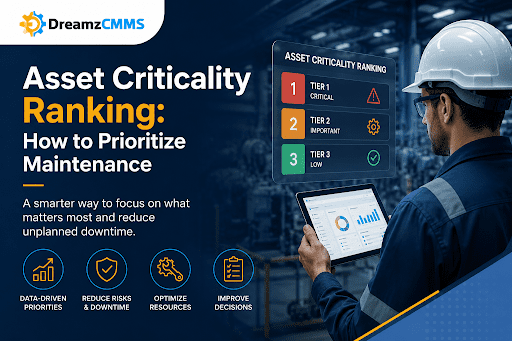
Using A Criticality Assessment To Set Priorities for Maintenance of Assets. A criticality assessment provides a structured approach to establishing priorities for a number of assets. After the assessment has been carried out, the results can be used as the basis for all maintenance activities, providing a data-driven approach to prioritizing work. The use of a criticality assessment also allows maintenance staff to speak with one voice and provides a basis for decisions that are made during meetings with other departments or during handovers with other shifts. The results of the assessment provide a simple way to indicate the priorities for individual assets, with higher-scoring assets being classified as Tier 1 and lower-scoring assets being classified as Tier 3, for example.
Asset Maintenance Management Software will store your criticality scores for your assets, as well as all other relevant information about the assets in your facility. They will hold details of your assets, their full maintenance history, and any records of past failures to assist with future maintenance work. As all of the relevant information is held in one place, there is no need for you to refer to multiple spreadsheets when trying to prioritize your maintenance.
The Core Factors in a Criticality Assessment for Maintenance
There are several core factors that need to be taken into account when completing a criticality assessment for maintenance. These factors can vary between companies and even between different plants within the same company, the majority of assessments use the same criteria to evaluate assets.
Production Impact. How long will it take to fix a problem with an asset? How many hours a day/week is the asset in operation? How many weeks of the year will the loss of production exist? The Production Impact is a calculation of minutes lost by the hour, as a percentage of total minutes in the hour, times the hours in a week, times the number of weeks of lost production, and then times 100 to get a percentage. The Production Impact looks at an asset’s ability to process material and the impact that a failure of that asset would have on production.
Safety and Environmental Risk. This assesses the risk of injury to people or the release of hazardous materials or environmental damage as a result of the failure of an asset. The scores for safety risk for each asset should reflect the degree of potential harm to people in the event of a failure. This can include both immediate harm and longer-term effects. Assets such as pressure vessels or chemical dosing pumps would score highly for safety risk as they have the potential to cause serious harm to people. In contrast, assets such as conveyor belt motors would score low for safety risk as they are not likely to cause serious harm to people in the event of a failure.
Regulatory and Compliance Exposure. This is the impact that an asset failure could have on an organization’s regulatory compliance. Most industries consider the consequences of an asset failure to be greater than normal if they could result in a violation of compliance, an audit finding, or a reportable incident. Food processing, pharmaceuticals, utilities, and healthcare are examples of such industries.
Repair Cost and Lead Time. The higher the financial penalty for an asset’s failure (including the cost of repair and any necessary spare parts), and the longer time required to complete repair (including the time to manufacture or procure any new parts and the time of a skilled technician to complete the work), the higher the criticality score for that asset. Assets that take three weeks or more to repair have a much higher criticality score than assets that can be replaced within hours.
Redundancy is the only factor that decreases the Failure Consequences of other factors.
Building Your Asset Criticality Matrix
The asset criticality matrix is a simple and straightforward tool. It graphically depicts the four core factors of an asset criticality assessment. There are two axes in the matrix: The first axis depicts the likelihood of failure of an asset. The likelihood of failure can be categorized in three different tiers of criticality: high, medium or low. The second axis represents the consequences of a failure of an asset. The consequences of a failure can also be categorized in three different tiers of criticality: high, medium or low.
Step 1: List all assets. The list of all the assets in your plant or facility. Typically, this is an existing table in your PM Software, but if you don’t have that, simply creating a list of all the assets at the facility will do. For example, Preventive Maintenance Software that has an existing complete list of assets (in a table or registry) for the facility can export the list of assets from their Software. Then the list of all assets at the facility can be used as the starting point to assign criticality scores.
Step 2: Define your scoring scale. Define the Scoring Scale and Weights for the Criticality Factors – Most organizations that complete an Asset Criticality assessment use a 1-5 rating scale for each of the criticality factors. These factors are then weighted by the organization’s priorities or operations. A company that produces food would most likely give the safety and compliance criticality factors a much heavier weight than would a company that manufactures discrete parts and has no production impact due to an asset failure.
Step 3: Score each asset. Every asset is rated for every factor using a score of 1 through 5 where 1 is low and 5 is high. Each score is then weighted by a factor that represents the business priorities for that factor. The scores are then summed up to give a total score for that asset. If work being done on the asset is being managed in a data-structured system (such as a Work Order Management system) then the failure frequency and the repair costs can be pulled from the historical work orders for that asset.
Step 4: Assign criticality tiers. Determine the criticality of all of your assets by ranking them into 3 tiers of criticality (critical, important and standard). The criticality of your assets will determine your maintenance strategy for each of your assets. For example, critical assets will require the most aggressive of Preventive Maintenance strategies, potentially including the online monitoring of critical parameters in real time. Work orders raised against critical assets will be prioritized above all others and serviced 24/7 where possible. Important assets will be serviced under a routine PM schedule, but may not receive the same level of urgency for repair as critical assets. Standard assets will be serviced under a routine PM schedule on a fixed calendar and can be run to failure with a stocked inventory of spare parts held for that asset.
Step 5: Review and validate. Get all of the stakeholders together and present their respective scoring of the assets to the operations people, to the safety people and to the engineering people. The maintenance people can input their knowledge of failure patterns that have occurred with the assets. The operations people can input their knowledge of production flow. The safety people can input their knowledge of potential safety risks to people and the environment. Then discuss the scores with all of the stakeholders and validate the final scoring of the assets.
How to Prioritize Maintenance by Asset Criticality
After you have assigned scores to all of your assets, the next step is to use them to implement your PM strategy. Below are some examples of how you could use the information that you have collected and scored in your asset criticality matrix to determine a maintenance strategy for your individual assets.
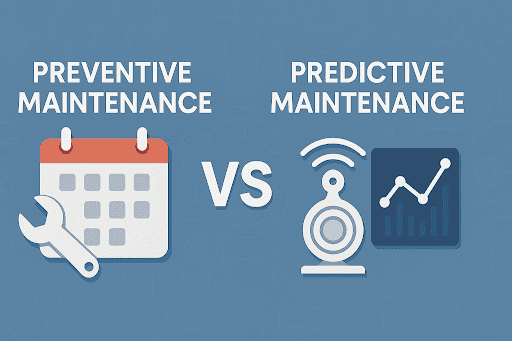
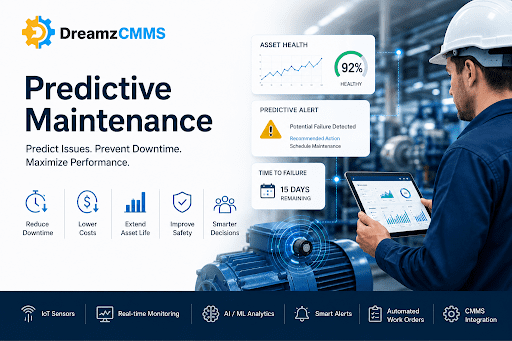
Match maintenance strategy to criticality tier. Critical assets warrant a monitoring/Predictive type of maintenance strategy, including analysis to predict possible failure with minimal cost to analysis versus potential failure cost to repair. Important assets can be monitored on a less frequent basis with a Reliability-Based/Preventive Maintenance type of strategy. Standard assets warrant a routine/Corrective type of maintenance strategy and can be maintained on a fixed time basis or allowed to fail.
Prioritize work orders by criticality. When two work orders are competing for the time of one technician, the criticality score of the asset that the work order is for should be used as the deciding factor. Thus, PM work on Tier 1 assets will always be prioritized over non-urgent repair work on Tier 3 assets. DreamzCMMS can be set up to flag work orders by the criticality tier of the asset that the work order is for.
Allocate spare parts by criticality. Also, spare parts should be chosen based on the criticality of the assets that they will be used for. Even though some failed components might be more expensive to repair or replace than others, for critical assets you might want to have a larger stock of those spare parts than for less critical assets. For lower criticality assets a just-in-time stocking strategy for failed components that you would otherwise keep in inventory might be more appropriate.
Schedule inspections more frequently for critical assets. For critical assets increase the frequency of the inspections in order to assess the asset’s condition more often, to log any trends of degradation that may lead to a potential failure, and to assess the impact that the asset’s failure will have on the organization.
Putting Asset Criticality Ranking to Work with DreamzCMMS
Ranking assets by their criticality is most powerful when that ranking is used to support and drive the criticality of your maintenance workflow. This is why we support criticality-driven maintenance within DreamzCMMS. The ranking of your assets by their criticality is stored with the asset record. Work order priority, PM schedules, and the parts inventory are updated to include the failure history to help your criticality assessment to keep getting sharper with each service cycle.
By storing the criticality scores within the asset’s record along with the other relevant details, that information can be used in a number of ways, such as automatically prioritizing work orders, revising a PM schedule for an individual asset, or even viewing historical failure information to further refine the criticality scoring as more information is gathered. As the scores change so too does the information used for the maintenance of the assets and the prioritization of that maintenance to maintain the facility. The more the team uses the system to service the various assets the sharper the prioritization will become.
Facilities benefit from criticality assessment for maintenance by having it embedded into their Asset Maintenance Management Software. Criticality assessment for maintenance can become sharper with each service cycle as criticality scores are stored in the asset records of the software. Work order prioritization, inspection frequencies and parts inventory analysis can automatically be driven by criticality assessment for maintenance.
Conclusion
Asset criticality ranking is an ongoing discipline that helps to keep the maintenance resources of a facility aligned with the operational risks of that facility. In order to support the effective maintenance of a facility, the failure of an asset must be assessed for its impact. A clear matrix of criticality must be developed and the scores that have been assigned to the assets must be connected to the real maintenance decisions that are made on a daily basis.
A structured criticality assessment for maintenance is an investment that pays off very fast. As a facility, you have a lot of advantages by doing a criticality assessment. There are fewer unplanned shutdowns. The maintenance budget is used optimally. The maintenance staff has always focused on what is most important when it gets really tough.
Make a smarter Maintenance Prioritization System. Start your free DreamzCMMS demo today and see how asset criticality ranking works in practice.






























Subscribe to Our Newsletter
 100% SECURE
 We Respect Your Privacy
 Ready for More?
Talk to one of our CMMS experts and see how DreamzCMMS can simplify your maintenance operations.
Book a free consultation