 BACK TO Blog
Asset Rental Management
Asset Maintenance
What Is Predictive Maintenance? Benefits, Tools & Examples
- June 03, 2026
- DreamzCMMS Team
- 12 minutes read
- June 03, 2026
- DreamzCMMS Team
- 12 minutes read
Many failures can be prevented if they occur at a time that is planned. No company can afford losses caused by unexpected failures and the resulting standstill or reduction in production. Many potential problems can be anticipated with the aid of predictive maintenance. This is one of the most effective kinds of maintenance and is explained by Warrix in detail in this guide, including examples of its practical application. You will also learn about the required tools and technologies as well as about potential return on investment.
While many companies have traditionally adopted a preventative maintenance strategy for managing their assets, the way that those assets are used have changed dramatically in recent years. This means there is so much more value in adopting a Predictive Maintenance strategy. In this guide we look at the benefits of using Predictive Maintenance for your business, we outline the tools and technology that are available and we also look at a number of examples of how it is being used in industries such as fleet management, the maintenance of hospital equipment and in manufacturing.
What Is Predictive Maintenance? The Definition
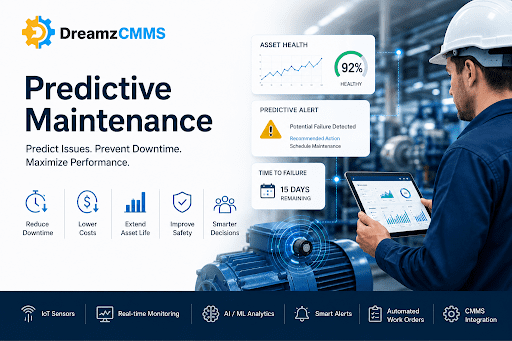
Predictive maintenance (PdM) is a form of condition-based maintenance, by means of real-time data, sensors, IoT-Devices and machine learning, failures can be predicted before they occur. Unlike reactive maintenance and preventive maintenance Smart Maintenance is doing the right maintenance at the right time on the right asset – not too early and not too late.
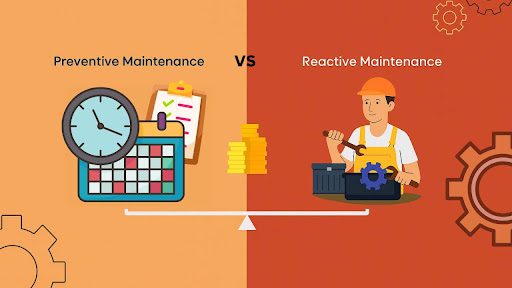
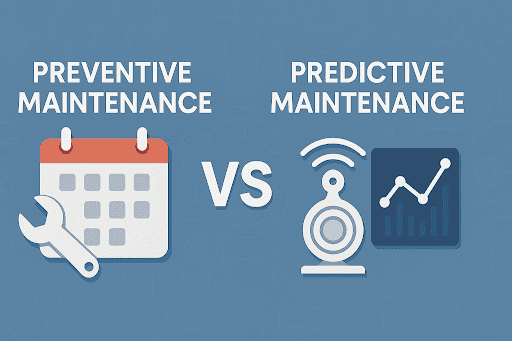
Predictive Maintenance vs Preventive Maintenance: A Quick Comparison
| Feature | Preventive Maintenance | Predictive Maintenance |
|---|---|---|
| Trigger | Fixed time schedule | Real-time condition data |
| Cost | May service unnecessarily | Service only when needed |
| Downtime | Planned downtime | Minimal, targeted downtime |
| Technology | Basic scheduling tools | IoT, AI, ML sensors |
| Best For | Low-criticality assets | High-value, critical assets |
How Predictive Maintenance Technology Works
In this article we will explain how Predictive Maintenance Technology works.
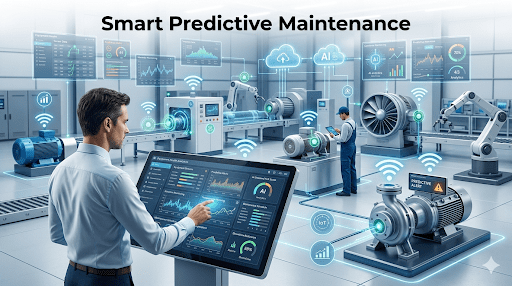
- Sensors collect data: Equipment is monitored by sensors such as vibration, temperature, pressure, acoustic and oil analysis sensors are attached to equipment to monitor the condition of the equipment and the data collected from these sensors.
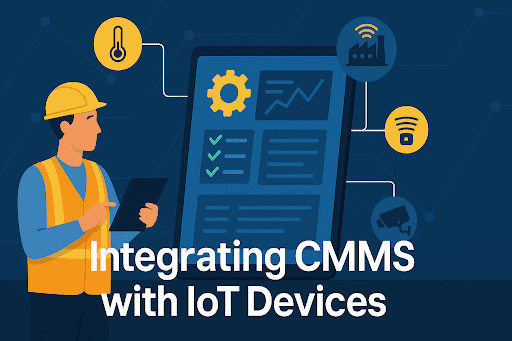
- IoT connects assets: The next step in the predictive maintenance process is to connect your assets up to your chosen Smart Maintenance technology. This allows the data collected by the various sensors attached to the assets to be transmitted in real time to a central software platform. The data is transmitted via wireless networks such as Wi-Fi, cellular or satellite.
- AI/ML detects anomalies: The AI/ML algorithms within the predictive maintenance software go through the data collected by the sensors and detect any anomalies. They learn the normal behavior of the different assets within the organization and are able to pick up on any behavior that is not normal which could signal a potential failure.
- Alerts trigger action: Alerts issued by the monitoring of the Predictive Maintenance enable the intervention of the maintenance teams in time (weeks before the failure).
- Work orders are generated: The automated Smart Maintenance software generates work orders and automatically distributes work orders to the appropriate field service technician(s) or maintenance internal employee(s) for repair. The automated management of work orders and distribution to required personnel helps track work being performed and is managed utilizing a Computerized Maintenance Management System (CMMS) such as DreamzCMMS.
The data collected from the condition monitoring of assets within a Predictive Maintenance closed loop is then used to further improve the process as more data is gathered and more insight is gained into the way assets perform. More information on how asset data flows through the maintenance workflows can be found in our Predictive Maintenance Guide.
Predictive Maintenance Benefits: Why It Matters
The business case for predictive maintenance is compelling. Here are the core benefits that organizations consistently report:
1. Dramatically Reduced Downtime
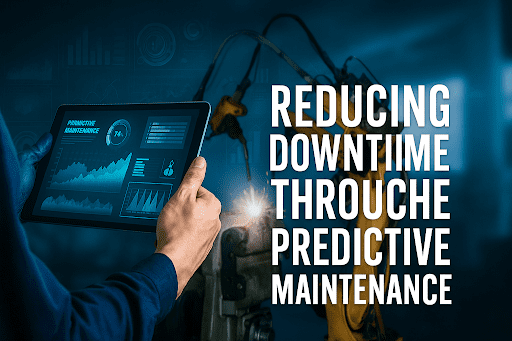
Unplanned downtime is some of the most costly types of downtime for a company. PdM can help reduce unplanned downtime by up to 50% by anticipating failures before they occur. As a result, assets are more available, customers are better served and company can generate additional revenue due to reduced loss of production.
2. Significant Cost Savings
Predictive maintenance can be extremely profitable for companies by saving on unnecessary work on assets and parts. It also prevents the huge costs caused by sudden equipment failures. According to several studies, the overall maintenance costs can be reduced by 25% to 30% using effective Smart Maintenance.
3. Extended Asset Lifespan
Many of the maintenance activities could be completed to keep assets in the best possible condition and extend their life. Work to maintain your assets to ensure that the capital that was spent on them will provide the best return for the longest period of time. This is an integral part of the Asset Lifecycle Management Best Practices.
4. Improved Safety and Compliance
Failing equipment can pose serious risks to health and safety. Using PdM in industries such as healthcare, manufacturing and logistics, will allow organizations to plan maintenance before it fails, reducing risk to staff, patients and others. It also allows organizations to meet legislation and compliance requirements by providing an audit trail of maintenance activity and asset condition data.
5. Better Resource Allocation
Organizing maintenance work in a very structured fashion by utilizing a Mobile CMMS and by performing maintenance as required by a variety of triggers (for example: time, usage, predictive maintenance indicators) allows for work to be distributed in an organized manner amongst the labor force. When knowing what work is required, and when it is required, utilizing a Mobile CMMS optimizes the labor, parts and scheduling required for the maintenance.
See how a Mobile CMMS can be the key to putting lifecycle work execution into the hands of your field technicians.
Predictive Maintenance Examples Across Industries
There are Predictive Maintenance examples in industries. There are many different ways that Smart Maintenance can be implemented and for many different industries. In this article we will take a look at several examples of the different Predictive Maintenance implementations in different industries.
Manufacturing
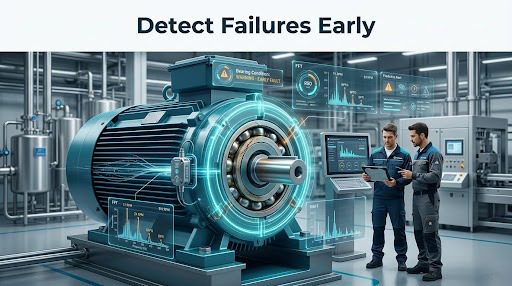
A production plant for metal processing equipped with vibration sensors on CNC-machines and on the motors of the conveyors. An AI-based predictive maintenance system recognizes bearing wear weeks in advance. The replacement can then be done during a planned shut down.
Healthcare
In healthcare for example, an AI predictive maintenance system can be used to monitor an MRI machine or a ventilator. The system can perform condition-based predictive maintenance and alert the biomedical engineers and the maintenance staff before the failure of critical components. The hospital will then have the necessary equipment available for patient care. As the system also creates a complete audit trail at all times, the hospital is always audit-ready.
Fleet and Logistics
As an example of Predictive Maintenance in action the ambulances and service trucks of the transport company are continuously monitored by the IoT Predictive Maintenance System. Engine diagnostics, oil quality and tire pressure of all the vehicles are recorded in real-time. This means that before any required service is due the drivers of the vehicles are notified in time so that no breakdowns will occur on the road. This, in turn, will lead to minimized repair costs for any unexpected breakdowns and will improve the on-time performance.
Facilities Management
There is also the option to run real time predictive maintenance monitoring on the buildings HVAC systems, boilers and elevators. This will give the building’s managers real time predictive maintenance alerts and allow them to keep energy waste down, improve the comfort of their tenants and extend the life of their building equipment.
Utilize Predictive Maintenance as a method to transform and create added value to your organization’s processes and operations, by combining the Predictive insights with a robust Asset Maintenance Management Software platform. Transform from viewing Maintenance as a Cost Center to becoming a strategic business function.
Predictive Maintenance Tools and Software Solutions
Most predictive maintenance require more than one tool to read data from assets. In addition to these tools to read data from assets, there are also tools to process the data collected to make predictions of failures.
Sensors and IoT Devices
Typically for a Predictive Maintenance implementation, we include various sensors. The types of sensors that are typically included for Predictive Maintenance are vibration, infrared, acoustic, and oil analysis to name a few. The key is to determine which type(s) of sensors would be the best to monitor the various assets as well as the individual components of those assets. In some cases a single sensor may be sufficient to monitor a particular piece of equipment or asset. In most cases however, it will be necessary to include several sensors to monitor different aspects of the various assets as well as the individual components.
AI and Machine Learning Platforms
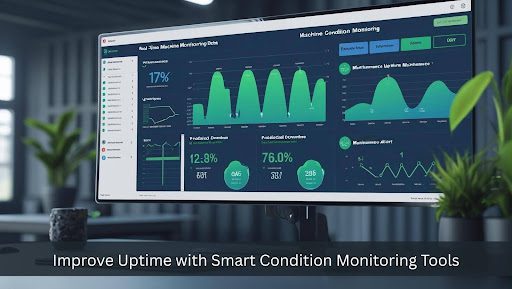
The AI predictive maintenance models can be implemented within the existing maintenance systems. They can be trained with the historical data as well as the real-time data and can recognize the failure signatures as they evolve over time. The more the data of the assets is fed into the system, the more accurate the predictions become.
CMMS and Asset Management Software
A Predictive Maintenance technology stack includes a software solution for Condition-Based Maintenance. Here at Dreamz IT Solutions we are able to offer you the best Predictive Maintenance software solution, DreamzCMMS. It is a totally integrated, comprehensive Asset Maintenance Management Software.
DreamzCMMS also supports Asset Warranty Tracking to ensure that warranty coverage is always considered when maintenance decisions are made, avoiding unnecessary spend on repairs that should be covered.
For broader context on how to approach asset management as a whole, explore these Asset Management Strategies that complement a predictive maintenance program.
Predictive Maintenance Best Practices
Predictive maintenance is more than just installing sensors and collecting data to achieve long-term added value. Several best practices have to be pursued.
- Start with your most critical assets: Start with your most critical assets and work your way down the list. This could include production critical equipment, life safety equipment or high value equipment that will bring the greatest return on investment (ROI) for your organization.
- Build a clean data foundation: AI-Powered Maintenance systems are only as good as the data they receive. Ensure sensors are calibrated correctly and that your CMMS records are accurate and complete from day one.
- Integrate with condition-based maintenance workflows: Condition based maintenance triggers should feed directly into your work order system so that alerts automatically generate scheduled tasks — no manual steps required.
- Train your maintenance team: The most important feature for the successful implementation of predictive maintenance is the sufficient training of the maintenance staff. By reading and evaluating the signals from the predictive maintenance, the staff must be in a position to act in time. In addition, after completion of the corresponding maintenance work, the staff must update the CMMS (Computerized Maintenance Management System). Only this way the technology is also implemented successfully in practice.
- Review and refine regularly: Continuing to analyze data and to fine-tune your maintenance on an ongoing basis is equally important. The insight gained from predictive maintenance enables the repeated identification of the same failures and thereby the fine-tuning of the corresponding maintenance schedules. This form of maintenance thus develops into an ongoing process of optimization as opposed to merely solving individual failures from time to time.
- Align finance, operations, and maintenance: Finally, the greatest value to your organization will come when you have synchronized the efforts of your finance, operations and maintenance teams to get the full value from all of your assets throughout their entire life. By sharing the information that your application of these best practices of predictive maintenance has developed, your company will be able to make the best budgetary, capital improvement and operating decisions, based on the current true condition of your assets.
The Connection Between Predictive Maintenance and Asset Lifecycle Management
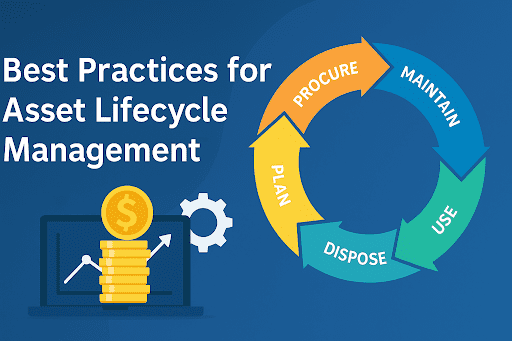
In practice, Predictive Maintenance is one of the building blocks of Asset Lifecycle Management (ALM). Therefore, it can be used throughout all the different phases of an asset’s lifecycle. The acquisition and procurement of an asset can be optimized based on the analysis of samples from suppliers by means of Condition-Based Maintenance. The operation of an asset is conducted in the most efficient manner, i.e. without overloading critical components. In the course of the maintenance of an asset, work is performed exactly when required in order to achieve maximum efficiency. Finally, the disposal of an asset is optimized on the basis of historical data. This means that at the point when the cost of continued repair is more than the cost of replacement with new assets, the latter alternative is chosen.
Operation: By monitoring your equipment’s condition in real time, you can operate your assets in the most efficient manner and avoid over working them to extend their lifespan. Monitoring equipment operation allows for the identification of inefficient operation prior to any potential damage occurring. This can extend the life of your equipment and reduce the likelihood of equipment failure.
Predictive maintenance and Asset Lifecycle Management are locked in a circle of virtue. The best results for the maintenance of an asset are achieved by the best decisions throughout the entire lifecycle of an asset. And the data collected throughout the entire lifecycle of an asset is used for the best possible maintenance strategies.
Ready to Take the Next Step?
Predictive maintenance for large complex assets is no longer the domain of large organizations with vast resources. DreamzCMMS now provides intelligent CMMS, IoT Predictive Maintenance and Asset Lifecycle Management functionality to organizations of all sizes and types, with physical assets of critical importance to their business, without the need for a large budget and a team of data scientists.Book a Free Demo to learn how our Predictive Maintenance, Asset Lifecycle Management and robust CMMS can help you manage your physical assets better.















Subscribe to Our Newsletter
 100% SECURE
 We Respect Your Privacy
 Ready for More?
Talk to one of our CMMS experts and see how DreamzCMMS can simplify your maintenance operations.
Book a free consultation