 BACK TO Blog
Asset Rental Management
Rental Asset
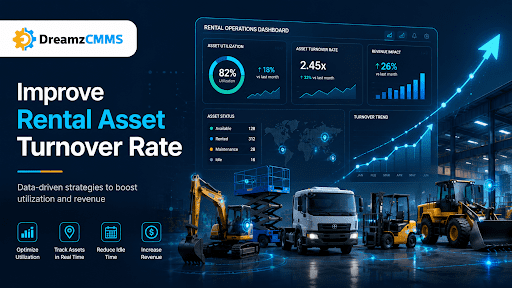
How to Improve Rental Asset Turnover Rate by 40%
- June 17, 2026
- DreamzCMMS Team
- 13 minutes read
- June 17, 2026
- DreamzCMMS Team
- 13 minutes read
The costs of idle equipment and assets are not only the maintenance, storage, and insurance charges of the idle equipment and assets but also the loss of income from not having that equipment and assets generating income.
The rental asset turnover rate is a financial indicator that shows how well a rental company can generate rental income with the assets they hold. For every increase of the rental asset turnover rate of 10-15% the profitability of the rental company increases strongly.
This guide covers Rental Asset Turnover Rate (also known as Rental Asset Turn) in depth. The article covers 3 key points including: 1) What Rental Asset Turnover Rate means for Rental Businesses 2) How Rental Asset Turnover Rate is calculated using Rental Asset Management Software to manage rental inventories and create reports to increase rental income and 3) 8 Proven rental asset turnover rate strategies used in Rental Businesses that have seen an increase in Rental Asset Turnover Rate up to 40% with data-driven Rental asset management.
What Is Rental Asset Turnover Rate?
Rental asset turnover rate is a key performance indicator (KPI) for Rental Companies. It measures how often rental assets are generating revenue for the company. The Turnover rate thus shows how efficiently a company is using its rental inventory to generate money. If a company’s rental assets are not working enough to cover their costs, then they are likely losing money for the company.
The formula is straightforward:
Rental Asset Turnover Rate = Total Revenue Generated / Average Asset Value
The more your Rental Assets are used to generate revenue from your customers, the higher your Rental Asset Turnover Rate is. A low Rental Asset Turnover Rate on the other hand, indicates that your Rental Assets are idle, you schedule your assets inefficiently or you have an imbalanced supply of Rental Assets to meet customers’ requests for Rentals.
Related KPIs that complement this metric include:
- Asset utilization rate (percentage of time an asset is on rent)
- Asset’s contribution to revenue (Revenue per rental asset): This important indicator assesses how much individual assets can earn in terms of rent. It is therefore
- Asset idle time (time assets sit unused between rentals).
- Asset Inventory Turnover (how often does the full Rental Inventory go through from rentals).
Together, these rental asset turnover KPIs give you a comprehensive picture of asset performance.
Why Rental Asset Turnover Optimization Matters
In all rental sectors (construction, medical, audiovisual & events, heavy machinery, fleets of cars, trucks and vans) the greatest part of the turnover is generated from the rental of owned assets. Therefore, it is crucial to make optimal use of these assets in order to keep a healthy margin.
- 20% idle time on assets could be costing your business a lot of money.
- Also keep in mind that whether an asset is rented or not, it is incurring in maintenance costs, therefore idle assets are literally losing money for you.
- Missing rental opportunities because equipment is late arriving with a customer or the customer is late returning the rental unit, and another customer is waiting for that unit to become available to rent.
- Underestimating future demand to buy underutilized assets and overestimating future demand to buy underutilized assets are both equally bad. And failing to have the right amount of the most in-demand assets can also be very costly.
Rental asset turnover is another crucial KPI for rental companies to track and to optimize. The goal here is to increase the turnover of rental assets in order to increase the revenue per asset and to achieve a better return on investment.
When integrated into Rental Software, rental asset utilization analytics have been proven to increase asset utilization of up to 40% within a 12-month period. This will translate into increased Rental Revenue per Asset and better overall ROI for the Rental Company. Industry leaders are able to gain a competitive advantage by utilizing Rental Asset Turnover tracking.
How to Calculate Rental Asset Turnover Rate Accurately
In order to improve the number first the number has to be correct. The number of times an asset was rented out in a time frame is measured by the rental asset turnover rate. This rate is calculated by only measuring the top-line of rental revenue. This means that time that assets could have been rented out but were not, is not taken into account. Every rental company has a seasonal pattern. Some times of the year, more assets are rented out than others. When calculating the rental asset turnover rate, one has to make sure that this seasonal pattern is taken into account in order to get a correct picture.
Step 1: Define Your Asset Base
Make a List of Your Assets to Calculate Rental Asset Turnover Rate. Define your Asset Base for the Calculation by first making a list of all your active rental assets. Then calculate the average book value or replacement cost of each asset. Group similar assets by category (e.g. aerials, diggers, forklifts, etc.).
Step 2: Capture Total Revenue per Period
Total rental revenue for the period (e.g. monthly, quarterly or annually) – including all revenue streams from all rental products and services such as short-term/long-term rentals, and others such as maintenance contracts, refueling contracts, etc.
Step 3: Apply the Formula
To calculate the Rental Asset Turnover Rate (Step 1 of the calculation above), divide the total rental revenue for the review period by the average value of the assets in rental service during the same time frame.
To illustrate using the Rental Asset Turnover rate formula: Total Rental Revenue / Average Asset Base = $250,000 / $167,000 = 1.5 or 150%. A Rental Asset Turnover rate of 1.5 or greater is typical for most rental companies and provides an indicator of return from rental revenue that their assets are generating.
$250,000 ÷ $167,000 = 1.5, or 150%
Rental Asset Turnover Rates can range from 1.3 to 1.7 or higher with 1.5 being the average for most rental organizations. This is a comparison of how efficiently your assets are generating revenue in relation to the average value of their asset base.
Step 4: Track by Asset Category
Don’t just calculate your total rental revenue and divide it by the total value of your rental assets. Review your Rental Asset Turnover Rates on a per asset category basis. You will likely find that you have some very fast-turning rental assets and some slow-turning rental assets. Knowing which are which is critical to taking corrective action to increase the turnover on your slowest assets.
Using a CMMS or rental management platform like DreamzCMMS to calculate your Rental Asset Turnover Rate will automatically update the data on a regular basis so you can get the most from your Rental Asset Turnover Rate data and see it plotted on a variety of different Rental Asset Turnover Rate dashboards.
Using a you can automate this calculation and get real-time dashboards instead of relying on spreadsheets.
7 Proven Strategies to Improve Rental Asset Turnover Rate
1. Implement Real-Time Asset Tracking
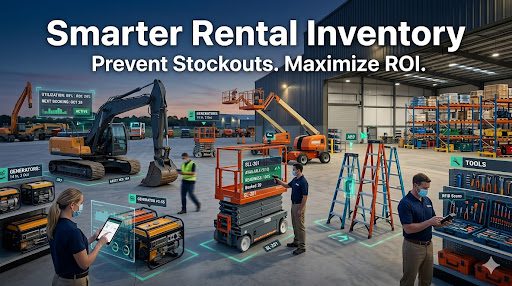
You can’t manage what you can’t measure. Many rental companies have no idea where their assets are at any point in time. The assets could be on rent, idle in a depot, in transit or even broken down somewhere and all the company will know is that the asset is available. By implementing real-time asset tracking the rental companies can dramatically improve their management of assets and increase the number of turns that can be achieved on each item. This is particularly critical for rental companies with very large fleets of assets.
The information provided by real-time tracking of rental equipment is also used to prevent “ghost assets,” i.e., equipment listed as available in the rental company’s system that in reality is on a customer’s site, in transit or under repair. Fast changeovers between individual rentals increase the turnover rate of rental equipment.
With the best Equipment Rental Software from DreamzCMMS, your operations team can view a live map of all rented out equipment, check in and out your rental equipment, and set up alerts for the on-time return of your rental equipment.
2. Use Demand Forecasting to Align Inventory
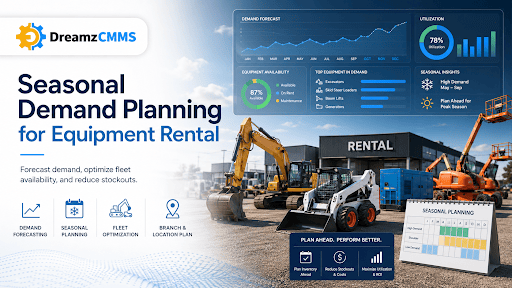
Demand forecasting of Rental asset demand is one of the most powerful tools to increase rental equipment turnover. By using historical data from past rentals, seasonal cycles as well as current market signals, we can predict which assets will be needed and when. This way, high-demand assets can be stocked in locations where most of their potential customers are, maintenance can be planned for low-demand times, one can avoid investing in assets with low turnover, and even negotiate higher rental fees during peak times.
This allows you to:
- Pre-position high-demand assets closer to likely customers
- Schedule preventive maintenance during predicted low-demand windows
- Avoid over-investing in low-turnover asset categories
- Negotiate prices on a dynamic basis to maximize possible return on rental assets in times of peak demand.
Rental software with analytics can find and display these demand patterns for you. They can make your life a lot easier by planning your rental inventory for maximum utilization.
3. Reduce Rental Asset Downtime with Preventive Maintenance
In any form of rental, each and every day an asset is not on-rent due to repair will not bring any revenue. This scenario can and frequently does happen when an asset suffers an unexpected failure. If planned maintenance is performed on a rental asset on a time basis (e.g. every 200 hours), on a mileage basis (e.g. every 1,000 miles) or on a calendar basis (e.g. every 6 months), it will dramatically reduce the number of days an asset would otherwise not be on-rent due to breakdowns.
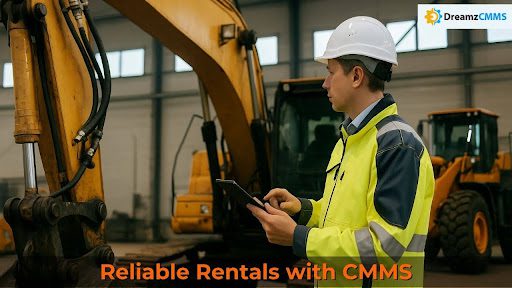
A CMMS (Computerized Maintenance Management System) is used to schedule all of the required maintenance on your rental assets automatically. This system also sends out notifications to your technicians on when and where service is to be performed. The service history for all of your rental assets is also stored within this system to refer to in the future. This type of maintenance helps to keep your rental assets operational longer in order to maximize rental asset turnover and extend the ROI of your assets.
Key benefits of preventive maintenance for rental turnover:
- Get your equipment back to work and earn money from it as soon as possible.
- Fewer emergency breakdowns and customer compensation events
- Better compliance with safety and regulatory requirements
- Higher asset resale value at end-of-life
4. Optimize Rental Asset Scheduling
Schedule assets in the most optimal manner so that they are delivered to the correct customer with the right equipment at the right time, and then retrieve the equipment in the most efficient manner possible to ensure an optimal turnover of rental assets. There is much time between rental periods that could have been used to make additional revenue if assets were scheduled more efficiently.
Advanced scheduling tools within rental platforms let you:
- Visualize booking calendars across all asset categories
- Identify and fill scheduling gaps proactively
- Set automated reminders for returns and handovers
- Even at very short notice, find an alternative rental for your customer.
A more efficiently filled rental calendar = higher asset turnover for your rental business.
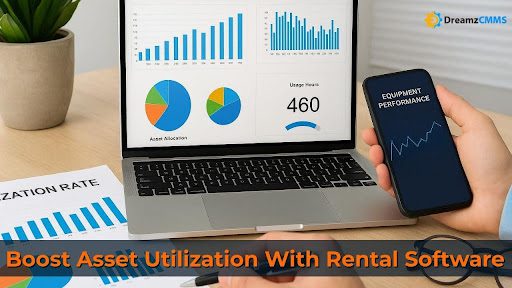
5. Leverage Rental Asset Utilization Analytics
Data is nothing until it is used to make decisions. Rental asset utilization reports present patterns, bottlenecks or even opportunities of all rental assets.
With analytics dashboards, you can answer questions like:
- Which of your rental assets are the most utilized (highest % of time rented) and which are the least (lowest % of time rented?
- Which customer or user segment(s) generate the greatest amount of rental revenue per rental asset?
- Are certain asset categories consistently overbooked or underbooked?
- How long on average does it take from the time an item of equipment is returned until it is rented out again (the turn time)?
You then use this information to create the ideal rental inventory turnover strategy (the “turn strategy” for short). This turn strategy contains recommendations regarding pricing, retirement and/or new investment of assets, and more.
6. Manage the Full Asset Lifecycle
Assets within different lifecycle stages have different turnover potential. Managing rental assets in a better way through the different stages in a lifecycle leads to better decisions (e.g., refurbishment, different strategy) for an optimal return on investment.
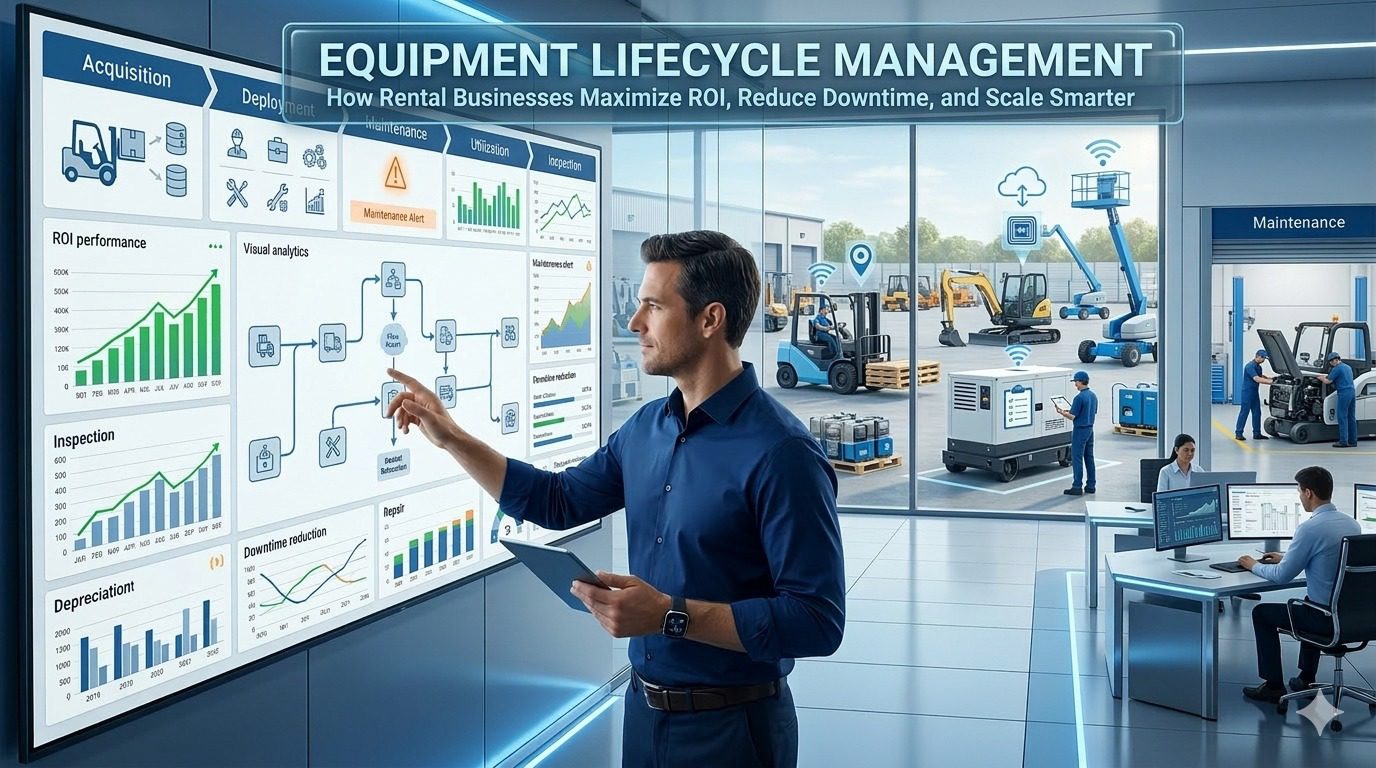
The Equipment Lifecycle Management Software enables the analysis of the total cost of ownership of an asset against the cumulative rental revenue earned from that asset. As a result, one is able to establish at what point an asset breaks even, at which point the asset reaches its highest rental income and when it is best to dispose of the asset in order to invest the capital in the most profitable rental asset.
Key lifecycle management actions that boost turnover:
- Recondition assets that are in high demand and that are showing signs of wear in order to generate the highest possible return before they go off-rent.
- Retire low-turnover assets and invest the capital in the best-performing assets.
- Track warranty and compliance information for Rental Assets to avoid unexpected maintenance downtime.
7. Use Fleet-Level Visibility for Multi-Location Operations
With companies that have multiple locations/depots, tracking all the equipment within a rental company’s portfolio can become a complex task. Often, sufficient amounts of equipment are stocked in one of the depots, and in other locations of the same company, not enough rental equipment is available for rental. In extreme cases, unnecessary equipment is even purchased whilst there is adequate rental equipment idle somewhere within the company.
So as to be able to track Rental Equipment throughout Multi-Location operations, the software to use is a dedicated Fleet Rental Software solution. The aim of such software is to provide a complete view of your Rental fleet operating across all locations, i.e., depots. This software will enable potential transfers of equipment between locations to be identified, thus balancing the amount of stock held at individual Depots against demand for Rental equipment from other locations. This in turn prevents the incorrect purchase of new Rental equipment, together with assets being idle and left to deteriorate as they are currently due to them being held at the wrong locations.
Conclusion
There are a few metrics in the rental industry that are far more impactful than others and – for a host of reasons – have remained for long undertracked and undermanaged. The Rental asset turnover rate is certainly one of them. However, with the right set of tools and a coherent set of processes around tracking demand for your rental equipment, using that for forecasting, scheduling, and managing preventive maintenance, as well as in maximizing the usage of the best assets in your rental inventory, you can achieve an increase in your rental asset turnover of 40% or more.
Start with a Free Demo to see how DreamzCMMS can help you track, optimize, and maximize the performance of every rental asset in your portfolio. Our team will walk you through the features most relevant to your business and show you exactly how other rental operators have achieved 30–40% improvements in asset utilization and turnover.

Subscribe to Our Newsletter
 100% SECURE
 We Respect Your Privacy
Ready for More?
Talk to one of our CMMS experts and see how DreamzCMMS can simplify your maintenance operations.
Book a free consultation