 BACK TO Blog
Asset Rental Management
Construction
What Is Asset Lifecycle Management and Why Does It Matter?
- May 28, 2026
- DreamzCMMS Team
- 13 minutes read
- May 28, 2026
- DreamzCMMS Team
- 13 minutes read
However, most organizations operate each of the asset lifecycle stages in complete isolation to the other stages. They purchase an asset to exploit it and then maintain it until it no longer adds value to the organization. It is common practice to treat the assets of an organization as mere tools to deliver value to the organization when all of the lifecycle stages are managed as a single discipline within the organization’s overall strategy.
Asset lifecycle management (ALM) is more than just physical assets going through different phases of a lifecycle. It is a process that needs to be managed in an intentional and structured manner. An organization managing assets using ALM looks at each and every asset as tools that can be used to generate returns in the different phases of the lifecycle of the asset. The total of the cost and the benefits of an asset equals the value of that asset. Value can be measured and followed throughout the lifecycle of an asset.
In the following pages we will take a more in-depth look at the processes of the Asset Lifecycle Management (ALM), the importance to your organization and how to put the ALM processes into action.
What Is Asset Lifecycle Management?
Asset lifecycle management (ALM) is the planned management of an asset throughout the entire asset lifecycle from the time an organization recognizes a need for an asset until the asset is finally decommissioned and disposed of. ALM encompasses more than just routine servicing of assets. Effective Asset Lifecycle Management is a strategic and operational discipline that manages acquisition, deployment, use, maintenance, monitoring, and decommissioning of assets in a manner that maximizes value from each asset throughout its lifecycle.
The cost of owning an asset, when we discuss Asset Lifecycle Management (ALM), is often limited to the acquisition cost of the asset. However, the cost of owning an asset extends far beyond the initial acquisition price. The full cost of ownership of an asset must also include the cost of installation and commissioning, the cost of the warranty period, any consumables and spare parts, the cost of routine and scheduled maintenance, the cost of any repairs and maintenance that are outside of the normal schedule, any compliance costs, the operating cost of the asset, including fuel and other forms of energy, the cost of operator training and the final cost of decommissioning the asset at the end of its lifecycle.
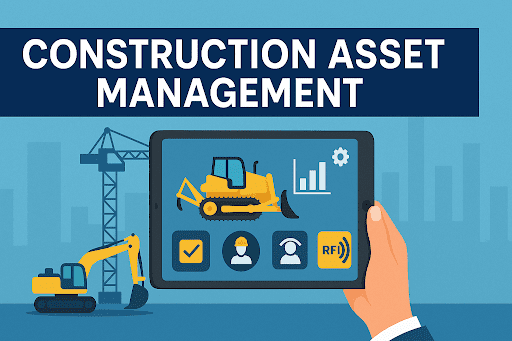
If you are managing assets across construction projects specifically, tools built for that environment make a significant difference. Construction Project Management Software integrates asset tracking directly with project scheduling and cost management — giving project teams visibility that generic spreadsheets simply cannot provide. Read more in here - Construction Asset Management Best Practices
Why Asset Lifecycle Management Matters
Many organizations around the world have a very fixed mindset about Asset Lifecycle Management. They are focused on increasing the usage of their physical assets and reducing idle time. They get fixated on trying to find more work for their assets, and in doing so, they only gain small incremental returns on their investment. The real focus of Lifecycle Management should be the costs of the assets to the organization throughout their lifecycle, and whether the assets are providing adequate return on investment for the organization during their lifecycle.
By monitoring an asset through its lifecycle a number of problems can be uncovered. Issues with underperforming assets, unknown root causes of recurring maintenance tasks and deciding whether to repair & maintain, upgrade or replace an asset.
Utilizing a Computerized Maintenance Management System (CMMS) such as DreamzCMMS for managing information regarding your assets can save a great deal of time and help minimize errors when it comes to making decisions for your assets throughout their lifecycle. By having all information stored within a database that is well organized, all necessary information can be retrieved and reviewed when required eliminating the extra time, potential for errors, and increased workload that would typically be incurred by utilizing spreadsheets to store and manage similar information.
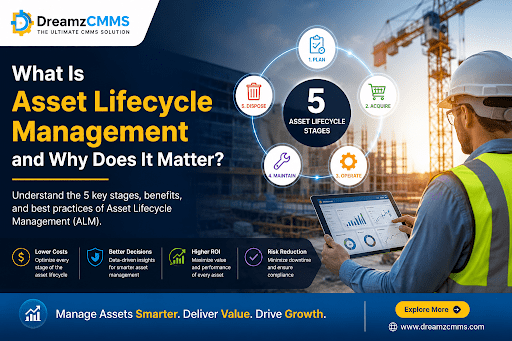
The 5 Asset Lifecycle Management Stages
Regardless of the type of asset (construction plant and equipment, medical equipment, manufacturing equipment, vehicles, aircraft or ships), the 5 ALM Stages will always apply.
Stage 1: Planning
Asset lifecycle management starts before an asset is even acquired by an organization. The planning stage of an asset’s lifecycle includes the organization determining what work will be done with the asset, the technical characteristics of the asset, how the asset will be used, the costs of the asset, how the asset will support the organization’s overall strategy, and how the asset will be maintained and operated throughout its lifecycle.
Even when choosing an asset to purchase for your organization, there is a common misconception that the biggest cost of an asset is the price of the initial purchase. The reality is that the cost of an asset to an organization is often 10 times greater than the initial purchase price. This is because the biggest cost to most organizations is the cost of ownership. When choosing an asset for your organization to use, remember to choose an asset that will support the long-term strategy of your organization and fit within your organization’s budget to own and operate the asset for the next 10 to 15 years.
For construction procurement, a Specialty Contractor Management Software can be very helpful in managing the asset acquisition for a specific project. This Software takes into account the processes and ways of working of the contractor.
Stage 2: Acquisition
All asset records in your CMMS should be set up during this stage of an asset’s lifecycle with details such as the purchase date, serial number, supplier details, warranty information, estimated life, required maintenance etc.
The first problems that most lifecycle managers come across in relation to managing their organization’s assets, are problems created in the Acquisition Stage. The fact that the asset’s full and complete record was not created at the time of acquisition – i.e. when the asset was first purchased, or acquired, or brought into the organization – to serve as a reliable source of information regarding that asset’s complete lifecycle, is perhaps the largest single problem encountered by itself. Many organizations do not create full and complete records of their assets at the time of acquisition. For a variety of reasons the records created at the time of acquisition are only partially complete and are not consistently updated.
Asset Warranty Tracking is also a key feature of our Computerised Maintenance Management System (CMMS) DreamzCMMS. It allows your organization to add and track warranty information of assets that you have purchased during the acquisition process to ensure that all coverage is utilized.
Stage 3: Operation and Utilisation
The operation and utilization of the asset within an organization’s operations are recorded in this stage. The information on how an asset is being used to complete work can show whether the asset is being used more than anticipated thereby reducing its lifecycle and conversely if an asset is not being used enough to provide value from the initial capital expenditure.
Utilizing the collected information on the operational use of an asset, decision makers are able to redistribute workloads to maximize the use of their capital assets and thereby avoid the two biggest mistakes that are made with assets: over utilize and under utilize.
For organisations managing assets across multiple sites or projects, technologies like RFID are making real-time utilisation tracking significantly more accurate and less labour-intensive. For a deeper look at how this works in practice, see our guide on RFID in Construction Projects.
Stage 4: Maintenance and Optimisation
Maintenance is one of the most critical functions of the asset lifecycle and where most lifecycle programs either fail or succeed. Effective maintenance or maintenance optimisation in a lifecycle framework is more than just reactive maintenance (i.e. break down maintenance) and includes a variety of functions to ensure that assets continue to operate in a reliable, safe and cost effective manner over their entire lifecycle.
Maintenance within a lifecycle framework is very important and effectively optimising maintenance can lead to a successful program.
It includes:
- Preventive maintenance — scheduled servicing based on time, usage cycles, or operating conditions, carried out before failure occurs
- Condition-based maintenance — servicing triggered by real-time performance data rather than fixed schedules
- Service history tracking — a complete, searchable record of every intervention, repair, and part replacement
- Inspection routines — regular assessments of asset condition that catch deterioration early
Field technicians complete work orders, view the service history for assets, complete and add notes to the work done whilst on-site.
For contractors who manage to mix commercial and residential assets within their fleet there are various software programs available that can be tailored to their needs. Commercial Contractor Management Software is ideal for managing a large number of commercial assets, while Pool Construction Management Software is designed to manage pool construction within larger construction projects. Both programs have been set up with specific maintenance and service tasks, as well as the most suitable reporting and compliance tasks for the relevant assets.
Stage 5: Retirement and Disposal
The Asset Disposal Stage of the lifecycle has become more apparent in recent times as the cost of maintaining an asset has reached a point where it is actually more cost effective to replace the asset. Retirement of an asset is crucial as to ensure that maximum value is achieved from the assets that you own, and that of not disposing of an asset too late, where the cost of maintaining the asset could increase dramatically, thus incurring downtime, additional risk, and potential non-compliance.
If an asset is retired too early then money is being wasted, and if an asset is kept in service for too long then it will enter into the failure phase of its life which will be cost detrimental due to increased maintenance, increased down time and potential non compliance with regulations. To avoid this a replacement threshold must be established. This could be things such as repeated failures within a time frame, annual cost of maintenance as a percentage of new asset cost, decline in availability etc. The key is to make a logical decision to replace an asset rather than an emotional one.
What the Asset Lifecycle Management Process Looks Like in Practice
In summary, it is very important to realize and understand that the processes of the various stages of an assets’ lifecycle are inherent to the assets themselves. Therefore, these processes must be continued to be addressed until an asset has been decommissioned and retired from service. Hence, it is critical to realize that Asset Lifecycle Management is not a project and, therefore, not something that can be a completed project and put on a shelf and then be forgotten.
Many software solutions can store an organization’s service history, usage, costs and future maintenance schedules for all its assets in an organized single database, or so-called asset management database. This information can be retrieved at any time from anywhere in the world by all the people who are authorized to do so.
It is worth noting that there are specific industry requirements and processes that can need to be integrated with Asset Lifecycle Management Process. For those working in the construction industry it will also be important to integrate the processes of Asset Lifecycle Management with Construction Project Management Software. This will allow the project manager to see the information on the asset’s availability, condition and the maintenance schedule whilst managing the project’s forward looking timelines and budget. Managing construction timelines can be challenging. Read our guide to this here : Managing Construction Timelines Effectively.
The Role of Software in Asset Lifecycle Success
However, as an organization’s portfolio of assets grows, managing the information relating to them in spreadsheets will soon become impractical. Variations in the way that different departments store information in spreadsheets, not to mention the variations in the format of the spreadsheets themselves, can lead to inconsistencies and a lack of control. And when a member of staff leaves an organization or is transferred to another role, information about the assets for which they were responsible can be lost, leaving others to make decisions based on the best available information but with little substance to back up their choices. And, of course, when it comes to time to complete compliance documentation, having it in an organized and easily accessible form can save an enormous amount of time when audit time comes around.
The maintenance module of a CMMS (such as DreamzCMMS) supports the strategic maintenance lifecycle approach of an organization to move from break-fix reactive maintenance to a more proactive pattern where the performance of the assets is monitored and optimized. Strategic maintenance is managed within the asset lifecycle management process. All the stages of an asset are tracked within the CMMS, from the creation of records of an asset during the acquisition phase of the asset’s lifecycle, through the operation, maintenance, retirement and disposal of the asset. All the records and service history of the assets of an organization are managed within a single system, thus providing the organization with a single source of truth for its assets.
See DreamzCMMS in Action Book a Free Demo to see how DreamzCMMS can support the full asset lifecycle management process, and allow your organization to track and manage its assets in a lifecycle of maintenance and optimization.
Conclusion
Asset lifecycle management is not a maintenance strategy. It is a business strategy. Simply owning assets is very different from actively managing the asset’s lifecycle. The difference between simply reacting to problems with the assets that the organization owns and actually anticipating those problems before they occur is the core of an effective Asset Lifecycle Management (ALM) business strategy. Deciding how to spend the organization’s capital based on habit rather than on evidence is a poor business practice.
When all the stages of an asset’s lifecycle are planned and managed as one process (i.e. as a single transaction), as opposed to a number of individual transactions, organizations are able to get more value from their capital spent than their competitors.
Plan your procurement. Record everything that happens to an asset from the day it is delivered. Run the assets in your best to get the most life out of them. Monitor the assets’ performance and track their development. Establish clear criteria for when to retire an asset.
Find out how DreamzCMMS can help your organization to manage all the different activities and services required to maintain your assets throughout their lifecycle. On DreamzCMMS you can create as many different maintenance schedules and activities as you require, view the costs of all the different activities in full detail and also view and download all of the compliance documentation that your organization requires to prove that it is meeting all of the relevant regulations. Book a Free Demo of DreamzCMMS today.See how DreamzCMMS helps organisations track assets from acquisition to retirement — with maintenance scheduling, cost tracking, and compliance documentation in one platform. Book your Free Demo today →
Subscribe to Our Newsletter
 100% SECURE
 We Respect Your Privacy
 Ready for More?
Talk to one of our CMMS experts and see how DreamzCMMS can simplify your maintenance operations.
Book a free consultation