 BACK TO Blog
Asset Rental Management
Construction
Construction Equipment Tracking: Complete Guide 2026
- May 11, 2026
- DreamzCMMS Team
- 13 minutes read
- May 11, 2026
- DreamzCMMS Team
- 13 minutes read
Equipment tracking used to be a costly solution offered to large organisations. But now businesses of all sizes, including smaller and medium-sized construction companies, are finding that equipment tracking is essential to reducing their losses. Untracked construction plant is wasting billions of dollars for the global construction industry every year due to theft, under utilisation and unexpected downtime. But the range of tools available for equipping all your construction equipment with GPS tracking has come a long way.
What used to be large, intrusive devices have been streamlined and made lighter for easy fitment to plant without causing too much disruption. A new wireless option removes the need for cabling to sensitive electronics whilst a dedicated handheld installation wizard helps make installation straightforward.
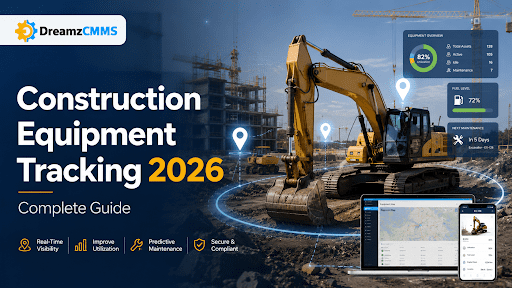
Construction Equipment Tracking 2026 is an illustrated guide to construction equipment tracking, including how it works, tracking methods, benefits, and purchase guidance for companies in the building industry.
What Is Construction Equipment Tracking?
Construction equipment tracking is the monitoring, recording and managing of the real time location, utilisation and condition of the heavy plant and other assets on site by the construction equipment tracker. Utilising ruggedized hardware such as GPS, rfid tags and other forms of IoT sensors or devices connected to software applications the construction equipment tracking systems and tools provide the construction equipment manager or supervisor with real time and historical access to job site asset information.
Our Inventory Management module for equipment tracking allows users to note a piece of heavy equipment is parked in a particular location and locked for the night, but there is far more to the process of equipment tracking for a large scale track construction project.
- Real-time location information (static GPS coordinates, not updated; however, the relative position is updated every few seconds).
- Engine hours and utilisation rates
- Idle time and fuel consumption
- Geofence alerts for unauthorised movement
- Maintenance schedules and service history
- Operator behaviour and usage patterns
Tracking equipment within an organisation and implementing Construction Asset Management (CAM) allows the efficient and cost effective delivery of projects by providing the owner of equipment with the information necessary to make the correct decisions in order to reduce costs.
Why Construction Equipment Tracking Matters in 2026
The global construction equipment rental market is expected to grow from $143 billion in 2019 to over $230 billion in 2027. As large fleets of expensive, specialized pieces of construction equipment are deployed to multiple job sites under difficult operating conditions, including remote sites, poor working conditions, and hazardous work environments, organizations can’t afford poor visibility into their equipment’s health and operational status.
Far from being a costly luxury, construction equipment tracking offers a tangible return on investment.
- Heavy equipment theft is a serious problem for the construction industry, losing billions of dollars each year. Within the US alone, an estimated $300-$1 billion worth of equipment is stolen every year. Of the stolen equipment, unfortunately only 20-25% is ever recovered.
- It is a widely accepted fact that heavy plant equipment is under utilised on most building and construction sites with most reports indicate that the average actual usage is between 35-70%.
- When equipment failures occur on active jobs, they can end up costing contractors a pretty penny. On average, there is an estimated $2,000–$5,000 loss per hour, per machine for every minute of unscheduled downtime.
- Using GPS tracking on construction plant could free up to 35% more site time in the first year, according to a host of major manufacturers and end users.
The comment, made at a recent conference, was greeted with a mixture of laughter and nods of agreement from the large audience of plant operators.
Time to take construction equipment tracking out of the overheads budget. Just as Managing Construction Timelines Effectively requires data-driven scheduling, managing your equipment fleet requires real-time visibility at every stage of the asset lifecycle.
Key Technologies Behind Construction Equipment Tracking
State and local contractors are finding that there are multiple methods of construction asset tracking, and that the most effective solution will depend on the job site, project budget, or type of assets that need to be monitored.
1. GPS Tracking for Construction Equipment
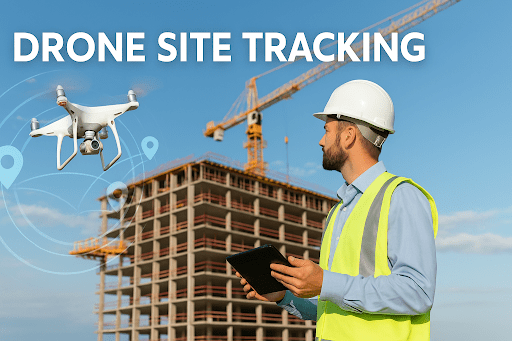
GPS tracking is the most common method for monitoring the location of equipment on site. The tracking device is typically hard wired into the machines power system or comes as a magnetic transceiver that can be clipped on to the piece of construction equipment. The tracking unit transmits a signal on an interval set by the manufacturer and receiver. The signal is sent via cellular transmission to a web based software application where you can view the location of the machine.
Best for: Large / High Value Equipment (Excavators, Cranes, Bulldozers, Pavers, etc).
Key capabilities:
- Live location on a map dashboard
- Historical route and movement playback
- Geofencing - is an automated feature that triggers alerts to the owner of the item of equipment, and to other members of the maintenance team, when that item of equipment enters, or leaves, a predefined area (the fence).
- Hours-of-operation tracking linked to the machine's ignition
Construction equipment GPS tracking solutions have become so affordable that small contractors with 10 to 20 pieces of heavy plant and equipment can afford to use this technology. Whilst the monthly subscription per device has come down dramatically, the quality and relevance of the data derived from this technology has increased dramatically.
2. RFID Construction Equipment Tracking
Radio Frequency Identification (RFID) is an asset tracking system utilising radio waves to identify and track tags attached to objects. This is different to the Global Positioning System (GPS) method of tracking, as RFID does not require a line of sight to the asset being tracked. Therefore RFID is useful in scenarios where GPS signals are not received (such as in locations such as tunnels, basement excavations or very confined urban sites).
In RFID systems there are two main components. Passive or active tags are fixed to the asset and reader units are placed at entry and exit points such as site gates or tool stores.
These shelves are ideal for use with tool organiser boxes and are designed to hold a range of equipment, consumables and other tools that are regularly removed and replaced into the shelf.
For more on RFID and its impact on site operations in general see RFID in Construction Projects.
Key advantages:
- Low-cost passive tags (no battery required)
- Automated check-in/check-out at controlled points
- Fast inventory reconciliation without manual scanning
3. IoT Construction Equipment Tracking
The Internet of Things (Ioetm) (IoTm) goes beyond simple location tracking of equipment. IoT construction equipment tracking uses a variety of sources of information including information from embedded devices or hardware attached to the equipment and machinery as well as information from other sources.
IoT sensors can measure:
- Engine temperature and RPM
- Fuel levels and consumption rates
- Hydraulic pressure
- Vibration patterns (indicative of mechanical stress or misuse)
- Battery voltage
- Hours of operation broken down by activity type
The integrated data can then be used within construction equipment tracking software to provide operators with valuable insights, using machine learning to predict when specific maintenance will be required from incoming data, meaning failure can be prevented not throughReacting to failure but through Proactive maintenance.
The 5 Core Benefits of Construction Equipment Tracking
1. Construction Equipment Theft Prevention
Construction equipment is notoriously easy to steal. Since most construction equipment is left sitting alone at night or over the weekends on an open construction site with little to no perimeter security, there is little to deter a motivated thief. In fact, many construction gear thefts are carried out within hours. But with GPS equipment tracking, you can prevent equipment theft — and recover stolen gear just as quickly.
Geofencing enables theft detection by identifying when a machine has left the site boundary, potentially outside working hours. Many of these systems also enable machines to be remotely immobilised by sending a command to the telematics system to prevent use by simply disabling the starter motor to prevent the engine starting.
2. Improved Equipment Utilisation
Construction equipment utilisation tracking is a measurement of actual usage versus potential usage of equipment. Understanding idle time is key to saving fuel, operators time and ROI. Construction companies that track equipment utilisation can tell which equipment is being put to full use and which has potential to work harder. Project managers can then use this data to maximise efficiency of equipment not in full use.
- Redistribute underused equipment across sites
- Re-use existing buildings to make the most of the original investment.
- Make data-driven decisions about fleet size and composition
- Make sure your under utilised assets are sold / disposed of at the optimal time.
3. Reduced Maintenance Costs and Downtime
Maintenance without data is guesswork. Heavy equipment tracking construction systems like HeavyEquipmentTrack.com capture real engine hours and other operating parameters allowing maintenance to be scheduled based on how the equipment is actually used as opposed to being locked on a calendar schedule.
- Our services run at the right time, and you won't waist resources by running a service too early. On the contrary, running a service too late can fail to complete your mission critical tasks.
- We report Fault Codes before your truck becomes a problem that needs repairing. Save Time and Money by fixing problems before they become major repairs.
- Service history is recorded on the vehicle. Having a full service history can increase the resale value of the vehicle and make future VTx compliance easier to achieve.
4. Enhanced Workforce Productivity
Having your equipment location tracked at all times will save your workers time and productivity not having to look for the equipment. On a large site this time can add up quickly. Automatically having your equipment check in will also save your supervisors time allowing them to put their time to better use.
5. Compliance and Audit Readiness
For many industries accuracy of asset records is critical for proper insurance, law and compliance, and contract requirements. Construction equipment tracking software provides a long history of a machine’s operations, maintenance, and inspections making it very easy to complete audits and inspections on time.
Choosing the Right Construction Equipment Tracking System
The sector focused on providing construction fleet tracking solutions is growing at an amazing pace and resulting in a huge choice of products offering a range of benefits for operators in the construction industry. Before making the choice of fleet management solution you need to establish what your businesses needs are and what specific problems you are trying to resolve.
Coverage and Connectivity
Test the solution in real-world construction scenarios. A GPS only solution may not work as well in confined tunnel/underground construction scenarios. Hybrid solution using GPS plus cellular, RFID and/or BLE technologies will perform better.
Integration Capability
By integrating your tracking system with your Construction Project Management Software, CMMS, or other maintenance tools, all your project information can be centralized and efficiently reported on for effective decision making.
Scalability
Invest in a platform that scales with your growing fleet - from 10 pieces to 200 and everything in between. Our cloud-based solution grows with you.
Mobile Access
For field-based teams using tablets or mobile phones, it is often critical that they are able to access the very latest tracking information – even in remote locations with poor connectivity. Having a mobile-enabled tracking solution can really make a difference in these situations.
Reporting and Analytics
Make sure your fleet tracking solution is turning your data into insights. Look for robust and customized dashboards and reports that include key pieces of information around equipment, fuel and idle time, and other key factors affecting your business such as the utilization of your maintenance costs and overall fleet performance.
Construction Equipment Tracking Best Practices
Installing a tracking system is easy and fun (for a while). But what really has value is creating lasting processes to use the newly acquired data.
Make sure all assets are documented when they are first added to the fleet. This information should be added to the asset record in your CMMS including the purchase date, asset number, barcode / serial number, warranty information, options and maintenance interval.
There are also organization-wide geofencing standards to consider. Ensure that boundaries are set around all relevant locations including warehouses, construction sites, storage yards, etc. update for site changes and understand when an asset is missing or at risk within those boundaries. For example, an operator may receive an alert when a piece of equipment departs from a geofence and then another alert a short time later if that same piece of equipment is traveling during late night hours.
Examine idle or underutilized assets (daily for active projects, weekly/semi-annually for stored equipment, etc.). SP Capital’s utilization reports highlight where assets are actively being used and where decommissioning underperforming assets can drive cost savings.
In addition to tracking the maintenance schedule, also track any other relevant data, such as recorded engine hours from a GPS or IoT device. Maintenance will be on schedule and work orders will be created in the CMMS at the correct time.
In addition to deploying the most effective equipment tracking solution for your needs, it is equally important to educate your operators on the intent of the system. Many are left wondering if they are being monitored. Your equipment tracking solution is there to protect your company’s assets, to improve maintenance, to reduce downtime and to keep your operation running as efficiently as possible. Now they will see the value you are bringing to the table.
Construction Equipment Tracking for Specialty and Commercial Contractors
Construction equipment tracking utilizes the same principles and technologies for all contractors; it is the implementation that can be different.
For commercial contractors with large crews working on large projects and a sizable equipment fleet, the ideal tool for managing their business would be an enterprise-grade Commercial Contractor Management Software solution with built-in equipment and asset tracking features. This software would allow for multi-site, detailed reporting and integration with leading ERP and accounting software packages.
Specialty contractors like Electrical, Mechanical, HVAC or Pool builders require a way to track and manage their vehicles, tools and other equipment. Specialty Contractor Management Software and Pool Construction Management Software provides the tracking and asset management solutions that are specifically designed to handle the needs of these types of contractors and how they manage their workflow and assets.
Conclusion
What was once a ‘nice to have’ for those in the construction industry has become a necessary investment for operators aiming to remain competitive in 2026. Irrespective of the key objectives surrounding equipment, a correctly implemented construction equipment tracking solution can bring tangible benefits to operators.
The tracking of our plant and equipment using RFID or Active RTLS is provided by dedicated rfid or active rtls device and monitor. However critical to realising as much value as possible from this process is the use of the provided data within broader Construction processes.
By 2026, companies that win the most projects on margin and reliability won’t be guessing where their steam turbines and generators are or how they are performing—they will know in real time.See Construction Equipment Lifecycle Tracking in Action! Find Out How Full Lifecycle Equipment Tracking and Maintenance Can Save You Money, Protect Your Assets and Give You A Positive Return on Investment. Book your Free Demo today with DreamzCMMS.





Subscribe to Our Newsletter
 100% SECURE
 We Respect Your Privacy
Ready for More?
Talk to one of our CMMS experts and see how DreamzCMMS can simplify your maintenance operations.
Book a free consultation