 BACK TO Blog
Asset Rental Management
Uncategorized
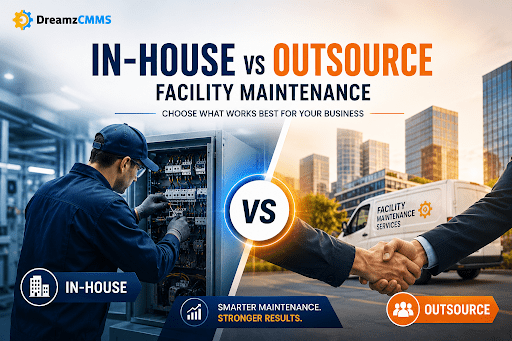
Outsourcing vs In-House Facility Maintenance: Pros and Cons
- May 21, 2026
- DreamzCMMS Team
- 13 minutes read
- May 21, 2026
- DreamzCMMS Team
- 13 minutes read
Deciding whether to outsource your facility maintenance or manage it internally is a big decision for the Facility Manager. The wrong choice can have long lasting effects on a company’s operating costs, the amount of time that equipment is in operation, the amount of time maintenance activities take and compliance with local, state or federal regulations. Many of the negative effects of wrong choice of maintenance delivery can lead to lower productivity, less safe working environment, lower customer satisfaction and in the end lower profitability for the company.
What Is In-House Facility Maintenance?
In-house facility maintenance refers to work being carried out by employees of an organization and who are on the organization’s payroll. The majority of maintenance work takes place within offices, hospitals, schools, warehouses and government buildings and is carried out by staff within the facilities department who manage the organization’s facilities, equipment and infrastructure utilizing Facility Management Software. continued maintenance and the necessary specialist knowledge is vital to the effective management of the facilities.
What Is Facility Maintenance Outsourcing?
Outsourcing of the facility maintenance means that the maintenance activities are performed by a third-party service provider. The scope of work can be for example for a single trade (e.g. for the servicing of the air-conditioning) or for the integrated facilities management – IFM – where one vendor is contracted for virtually all of the maintenance activities. The services that are delivered (e.g. by fixed contract, time-and-materials, performance-based etc) are then paid for by the organization.
Often the vendor bringing in the technicians and workers has their own set of tools, training programs for their technicians, as well as a full management structure, including supervisors and other managers to oversee the work that is to be done at the organization’s facilities.
Cost Comparison: Outsourced vs In-House Maintenance
A cost comparison between in-house and outsourced maintenance as a means to decide whether to go with in-house maintenance or to contract out the maintenance to a service provider or contractor. And after having identified the various costs for in-house maintenance and for outsourced maintenance, these costs have to be more closely examined.
In-House Maintenance Cost Analysis
More to listing out potential costs. details are needed when accurately viewing the true costs of both in-house and outsourced maintenance, in addition
- Salaries and benefits: Salaries and related benefits (e.g. health insurance, the company matched portion of retirement, paid time off, etc.)
- Training and certifications: To service today’s complex products and safely keep buildings in compliance with local, state, and federal building codes, your in-house team will continue to need training.
- Tools and equipment: As an example, even simple hand tools as well as sophisticated diagnostic software, etc. to service particular equipment, cost a lot to purchase.
- Management overhead: This could be the supervision of maintenance staff, the administration of HR for maintenance staff, or the scheduling software used by your facility to manage work requests.
- Downtime risk: Vacations, sick leave, and turnover can leave coverage gaps that cost you dearly during equipment failures.
utsourced Maintenance Cost Breakdown
When you outsource, you're paying for:
- Service contract fees: The annual fee, typically paid on a monthly basis, could be a retainer or on a per call basis and could include labor, parts and overhead.
- Markup on parts and materials: The cost of the parts and materials used by a maintenance vendor to service your facilities up front as part of your service agreement so that you have some idea of what you are being charged for.
- Mobilization costs: Some vendors charge for travel to a customer’s site and this could be a fixed fee or on an per hour basis. Also some vendors could.
- Contract management time: While in-house maintenance is more cost effective in scenarios with high volume /Contract frequent maintenance for more cost effective.
The bottom line on cost: In outsourcing; but for a few facilities with specialized equipment and for facilities with infrequent maintenance outsourced maintenance summary, for facilities with high volume/frequent maintenance, in-house maintenance can be more cost effective than complete a full in-house maintenance cost analysis including fully loaded labor costs. Do not just use their wages.
Pro tip: By the use of Property Maintenance Software you are able to make an analysis of the costs of the property maintenance. With this software you are able to register the costs of labor, parts and downtime for the different facilities. In this way you get a better insight in the maintenance costs and you are able to compare the costs for in-house maintenance and outsourced maintenance.
Control vs Cost: The Core Tension in Facility Maintenance
If cost is the "what," control is the "how." This is where the outsource vs in-house maintenance debate gets genuinely complex.
With an in-house team, you have direct command over:
- Work prioritization and scheduling
- Quality standards and inspection protocols
- Response times during emergencies
- Data security and access to sensitive areas
- Compliance documentation and audit trails
On the negative side, when you outsource your maintenance, you give up some control over the work that is being done. This can be a major issue if the vendor that you chose is not very good. For example, you contract with a company to do your annual preventive maintenance. However, once they are on contract, they do very little work and your equipment begins to deteriorate. The worst part is that you are locked into a contract and can not get the provider to perform as promised.
The best way to strictly manage Compliance Management in these types of environments is strictly managed in-house maintenance to ensure that proper documentation is kept to support the fact that all work has been carried out in complianceMM) program.
Facility Maintenance Outsourcing Pros and Cons
Facility Maintenance Outsourcing Advantages
1. Access to specialized expertise
Specialized expertise — in every trade — is available to contract as part of the package with an outsourced, for example. All the specialists you need are available as part of your contract.
2. Scalability on demand
Scalability on demand – whether it’s for a sudden increase in size, seasonal upturns or to service individual projects requiring specific maintenance. Management of the contract will be far easier than having to recruit, deploy and then make redundant maintenance staff in order to reduce costs as demand falls.
3. Reduced HR burden
Recruitment, training, benefits administration, and labor relations are the vendor's problem, not yours.
4. Predictable budgeting
These services are typically contracted for a fixed price allowing management to treat maintenance costs as a fixed, predictable cost of finance as opposed to unknown variable cost.
Facility Maintenance Outsourcing Risks
1. Loss of institutional knowledge
The chance that the technicians, that have gained knowledge of the equipment, will leave the company within a short period of time.
2. Response time variability
While 4 hours response time may be acceptable for routine maintenance during normal working hours, after hours and on holidays it may not be sufficient for immediate attention of an emergency. The customer may expect same prompt service at 2 a.m. on a holiday weekend.
3. Hidden costs
Unforeseen extras: scope creep, inflated price of spare parts, and change orders which, in the end, cost more than the savings of contract maintenance in the first place.
4. Vendor dependency
Over time, your organization can lose the internal competency to even evaluate vendor performance, making you increasingly captive to a single provider.
In-House Facility Maintenance: Benefits and Challenges
The Real Benefits of Keeping Maintenance Internal
Your in-house maintenance team will be more organized and bring greater benefit to your organization than would be realized by outsourcing the maintenance of your facility. This is because your in-house maintenance team will be more organized and better aligned with your production, the people who occupy your building and the leadership of your organization. Thus, your in-house maintenance team will have an “inside out” focus on meeting the needs of your organization as opposed to an “outside in” focus on meeting the requirements of a maintenance service contract for your facility. As a result, in-house maintenance for an energy intensive facility will provide greater benefit for Energy Efficiency in Facility Operations.
Tools for in-house Personnel and Labor Tracking hours help managers within the department understand what everyone is doing. This allows the manager to see if there are any skills being under utilized, and determine if there any contractor.
Challenges of In-House Maintenance
- Talent acquisition is difficult: The number of qualified personnel available to work in the building maintenance field is decreasing in many areas of the country. Maintaining an in-house staff of skilled trades people can be difficult as other industries as well as companies providing outsourced maintenance services are looking for similar services.
- Fixed cost structure: Yes there is a cost to employing a team of in-house maintenance staff but at least that cost will remain fixed and not fluctuate like a contract price during low demand periods.
- Skills coverage gaps: While an organization can try to develop all the necessary skills within the workforce, there will be times when the organization cannot find the required skills, especially for specialized work.
When to Outsource Facility Maintenance
Outsourcing makes the most sense when:
- Your facility is small or lightly maintained: For organizations with only a few facilities, the cost to establish and maintain an in-house staff may not be warranted.
- You need specialized skills episodically: There are certain unique maintenance needs such as testing a transformer, inspecting an elevator, or maintaining a fire suppression system that require unique skill sets.
- You're scaling rapidly: You are growing quickly and need to open up facilities quickly before you can hire and train up a sufficient in-house maintenance staff.
- Your core business is not operations: Most important for any company is the work that they are trying to grow and have perform at the highest level. That typically is not the work of maintaining a facility. Thus, if your work is in Sales, R&D, and Customer Service, then it is best to outsource the work of maintaining your facility.
- Capital constraints limit tool investment: Another capital expense for tools that are used by a vendor is typically spread across all of the vendor’s clients and therefore the best way to have access to the same quality of diagnostic tools that you could not afford to purchase outright for your in-house team.
When to Build an In-House Maintenance Team
Keep maintenance internal when:
- Uptime is mission-critical: Manufacturing lines, data centers, cold storage operations, and healthcare facilities cannot afford vendor response delays.
- Your equipment is highly specialized: Proprietary machinery often requires technicians trained specifically on your systems — a vendor's generic workforce won't cut it.
- Regulatory compliance is intensive: Scrubbing of documentation and processes for regulatory purposes is easier when done by the company’s own staff rather than a contractor.
- You have sufficient volume: You have enough work to keep the person employed continuously in maintenance. In-house maintenance staff are typically cheaper than
For cold storage and temperature-controlled facilities specifically, the operational stakes are extreme. A Cold Storage Management System integrated with an in-house team's workflows can provide the real-time monitoring and rapid response capability that product integrity demands.
The Hybrid Facility Maintenance Model: Best of Both Worlds?
There are also many companies that fall into the middle ground of neither fully outsourcing the maintenance of their facility nor having it all done in-house. They develop a hybrid facility maintenance model for their particular situation.
In a hybrid approach:
- Day to day work, or high frequency maintenance activities like daily inspection, changing air handler filters, and smaller repairs are conducted by a very lean in house team of very knowledgeable people who have been trained to keep up with all the work that is required for the specific building that they have been assigned to.
- For specialized or occasional work such as testing electrical systems, elevator certification, or roof inspections, DreamzCMMS utilizes specialized experts for best results for each occasion. Additionally, DreamzCMMS utilizes specialized contractors for large maintenance/overhaul projects of individual pieces of equipment as well.
- The work during peak demand is done by the on-call vendors of the respective specialists. They support the in-house team during the planned shut-downs or during the peak periods.
The majority of high frequency, high risk work is completed by your lean in-house team. They have the knowledge, can respond quickly and deliver high quality of work. Plus by not having a full team of all trades to complete minor repairs you are controlling cost.
Using Technology to Optimize Your Maintenance Strategy
Regardless of which model you choose, facility maintenance staffing strategies and operational decisions should be data-driven — not based on anecdote or convention.
Modern Facility Management Software enables facility managers to:
- Track asset history and predict failure before it occurs
- Measure technician productivity and workload balance
- Monitor preventive maintenance compliance rates
- Generate cost reports that make the in-house vs outsourcing math transparent
- Integrate with smart building systems for real-time operational visibility
Smart Building Software for Facility Management - connect all sites and manage them all from one central location. Smart Building Software for Facility Management of multiple sites are connected, in order to enable the facility manager toAt the buildings are connected to the software platform, so that all relevant data of the facilities are displayed in monitor and optimize the operation of all sites from a single software platform. The various systems and sensors of different buildings are connected to the central software platform, in order to allow for a central and fully monitored management of all facilities.
Conclusion: Making the Right Facility Maintenance Choice
There is no right answer for whether or not to outsource the facility maintenance for your company. Each company is at a different stage in the company’s life and need to be able to meet the specific needs of their facilities and meet the risks of their operations.
There grows, as risk changes and as new strategic objectives are set. The only constant is that the assessment are generally right and wrong choices, but they are organization specific and can change over time as an organization should be made using ‘hard’ data, costs should be compared honestly, capability assessed and a strategic choice made. This is an ongoing strategic question not a one off decision.
You and matures, you transition to a hybrid model that best serves your business and facilities – no matter who does the repairs, DreamzCMMS supports your maintenance model.
Whether you're building a world-class in-house maintenance team, selecting your first outsourced maintenance partner, or designing a hybrid model that blends the best of both, the right technology foundation makes everything easier. is built to support every maintenance model — giving your team the tools to deliver reliable, cost-effective facility operations no matter who's turning the wrench.Ready to bring more intelligence to your facility maintenance strategy? Book a Free Demo and see how DreamzCMMS helps leading facility teams make smarter maintenance decisions.



Subscribe to Our Newsletter
 100% SECURE
 We Respect Your Privacy
Ready for More?
Talk to one of our CMMS experts and see how DreamzCMMS can simplify your maintenance operations.
Book a free consultation