 BACK TO Blog
Asset Rental Management
Facility
HVAC Maintenance Planning for Commercial Buildings: The Complete Guide
- June 16, 2026
- DreamzCMMS Team
- 13 minutes read
- June 16, 2026
- DreamzCMMS Team
- 13 minutes read
The worst time for your commercial building’s HVAC system to fail is in the middle of summer when your entire tenant base or workforce is in the building. It’s only natural that they will express their anger over the situation and the additional repair costs that can end up being 3-4 times as much as a normal service call had it been serviced properly prior to failure.
Creating a commercial HVAC maintenance plan does not have to be painful. In this complete guide to HVAC maintenance planning for commercial buildings, you will learn how to develop a plan that meets the needs of your building to reduce your HVAC related down time, extend the life of your expensive HVAC equipment and save you money on energy costs.
Why Commercial HVAC Maintenance Planning Is Different
The biggest difference between commercial HVAC systems and their residential counterparts is scope. A house with several rooms and corresponding pieces of equipment can have a few pieces of air handling equipment for the whole house and a handful of fan coils for individual rooms. But a commercial building such as an office tower is just the opposite: dozens of individual fan coils servicing individual rooms or areas, as well as a corresponding amount of air handling units, chilled water systems, cooling towers, and even variable refrigerant flow (VRF) systems. A single piece of equipment can affect an entire building.
The most important aspect of designing an HVAC maintenance program for commercial buildings is to include provisions for compliance with the many laws and regulations applicable to such HVAC systems. There are a host of environmental laws that must be managed including the management of refrigerant as required by the Environmental Protection Agency, as well as the laws that require building owners to provide their employees and their guests with clean air as required by OSHA. In addition to these Federal laws, building owners must also comply with a wide array of State and local laws that require the frequent inspection of equipment and that require building owners to keep and to provide to government officials a wide array of records and reports. To this end, the programs designed to manage the required maintenance of the many systems found in large commercial buildings must be sufficiently flexible in order to manage all of the required maintenance as well as all of the required inspections and the required records and reports.
Building Your Commercial HVAC Maintenance Strategy
There are three main components of an effective commercial HVAC maintenance strategy. These are a schedule of work, the best method of maintenance and a record of the work that has been done.
1. Conduct a Full Equipment Audit First
When planning your HVAC maintenance strategy, start with a full equipment audit. An HVAC equipment audit is completed to make a list of all of the HVAC related equipment in your building. All pieces of equipment are recorded with details such as type or model number, serial number, age, and other pertinent information as well as a record of the last maintenance performed on the piece of equipment. The maintenance strategy is formed from the information in the AMMS (Asset Maintenance Management Software) database or Asset Register for the building.
This step is important for setting up any Asset Maintenance Management Software for HVAC equipment in your facility. You can’t develop a sound maintenance strategy without an accurate understanding of the assets that you are maintaining. Often facilities have equipment that is no longer installed or no longer in service – and conversely – are likely to find that there are many assets unknown to be installed that require a maintenance strategy.
2. Design a Tiered Commercial Building HVAC Maintenance Schedule
A commercial building HVAC maintenance schedule needs to be designed to operate on a number of different time scales with different tasks to be carried out on a monthly, quarterly, annual or other basis.
Monthly Tasks
- Inspect/replace air filters,
- check that thermostat(s) are set correctly,
- clear drain lines as required,
- lubricate all moving parts and
- check refrigerant pressure for monthly tasks.
Quarterly Tasks
- Clean outside coil,
- test safety controls,
- inspect electrical connections,
- inspect duct work and
- test economizer.
Semi-Annual Tasks
- Clean the condenser coils in greater detail,
- inspect and/or replace belts as necessary,
- inspect and test the cooling tower,
- test and/or calibrate the BAS controls,
- test the ventilation equipment and
- related components as necessary.
Annual Tasks
Yearly tasks are designed to test the HVAC system as a whole. They identify areas of failure and the annual search for refrigerant leaks for compliance with EPA guidelines. This is typically part of an annual inspection and testing of the heat exchanger(s), all electrical components and connections and an analysis of the facility’s energy consumption.
This is a suggested schedule for monitoring, maintaining and even possibly repairing your HVAC equipment in order to prevent possible failures, increase efficiency and extend life of systems.
Preventive vs. Predictive: Choosing the Right Approach
However, a strictly time-based (preventive) approach to HVAC maintenance for commercial facilities can have drawbacks. There are some items that don’t need to be serviced when they are due for maintenance, and other items can fail between scheduled maintenance visits.
If a commercial facility is equipped with monitoring tools then it can implement a Predictive HVAC Maintenance strategy. Such system of sensors will typically monitor the following parameters: vibration, temperature, current (amperage), and airflow. Using this data the system will alert the facilities staff of potential failure of key components before it actually happens. For example, the air handler’s motor current draw might start to increase over a three-month period, and the monitoring system would alert the facilities staff before actual failure.
We here at Perfect Temperature believe the best way to service commercial facilities is to utilize a program that has a good foundation of time-based scheduled maintenance and additional Predictive HVAC monitoring of high-value at-risk pieces of equipment in the building. Learn more about the topic of this article in our article Preventive vs Predictive Maintenance: Picking the Best Fit for Your Assets.
HVAC Maintenance Planning Best Practices for Multi-Unit Buildings
When planning HVAC maintenance for a multi-unit commercial property, it is often necessary to consider the individual needs of the various tenants as well as the operational needs of the different pieces of equipment. For example, a retail facility on the first floor of a mixed-use property may require 24/7 cooling due to the high amount of foot traffic whereas an office on an upper floor may only require cooling during normal business hours. Also, residential tenants on the upper floors of a property may require individual temperature controls that must be taken into consideration when designing the systems and planning routine maintenance.
Several best practices apply specifically in this context:
Zone your maintenance priorities. The best way to go about this is to “zone” your HVAC system and thus your maintenance as well. So the majority of your maintenance will be put towards the central plant (chiller, boiler, etc.) as well as the major components of distribution. Terminal units (such as fan coils, etc.) that service individual rooms or zones can be serviced less frequently. Even though a failed fan coil in an office can create a big problem, a failed chiller can potentially create a total system failure.
Align maintenance windows with tenant operations. Plan maintenance around tenants’ hours of operation. Schedule maintenance of systems that will be down for extended periods of time for repairs during off hours or when the tenant is on holiday. It is also a good idea to outline your scheduled maintenance in the lease and keep your tenants advised of any changes to your maintenance schedule as the year unfolds. Use your facility management software to track complaints on a per zone basis.
Track tenant-specific complaints systematically. Look for patterns in the complaints you receive for your facilities, i.e. a single floor reports hot spots. Or, a tenant reports he or she is getting too much humidity in their space. Use this information to your advantage to help assist in the maintenance of your facilities. In addition, tracking service requests on a per floor basis will assist in determining if there are any problems on a per floor basis as well. Use a Facility Management Software platform to track complaints on a per floor basis as well as per zone basis.
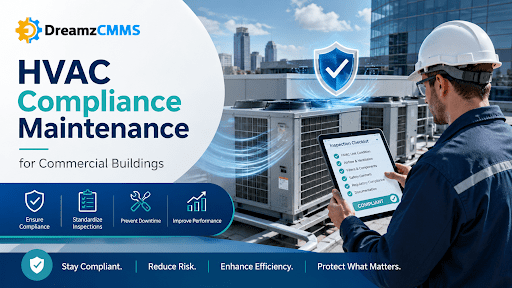
HVAC Compliance Maintenance for Commercial Buildings
HVAC Repairs Cost A Lot More Than Maintenance! Everyone knows that repair work on the HVAC systems of your commercial building can cost so much more than the price of regular scheduled maintenance on your systems. But did you know that a very poorly maintained HVAC system can also cost you a lot in terms of energy, in terms of your efforts to comply with a host of rules and regulations, in terms of safety, and in terms of operating costs that are higher than they have to be.
Section 608 of the EPA’s Clean Air Act – The annual inspections for commercial HVAC systems containing more than 50 pounds of refrigerant MUST BE DONE to detect any refrigerant leaks. If leaks are found, they MUST BE REPAIRED by an EPA-certified service technician within the required time frame (varies depending on type and amount of refrigerant). In addition, records of ALL REFRIGERANT ADDED to a system, as well as ALL REFRIGERANT REMOVED from a system or stored, MUST BE KEPT for at least 3 years.
OSHA Indoor Air Quality Standards - In addition to ensuring your HVAC system is operating safely to meet the indoor air quality working standards of OSHA, maintenance will help your system to operate properly for your employees.
ASHRAE Standard 180 - Establishes minimum requirements for maintenance of commercial HVAC systems. Outlines recommended practices for inspection, testing and maintenance to help extend the life of a building’s HVAC system and improve operating efficiency. Many insurance policies, leases and building facility standards require HVAC systems to be maintained in accordance with this standard as a minimum.
Documentation is the thread connecting all of these requirements. Every inspection, test, repair, and refrigerant transaction should be recorded with timestamps, technician credentials, and work order details. A Preventive Maintenance Software platform automates this recordkeeping, producing audit-ready reports without manual data assembly.
HVAC Maintenance Cost Reduction for Commercial Buildings
Many have already made aware of the fact that repairs to HVAC systems cost a lot more than their maintenance. The vast sums of money that are lost through poor HVAC maintenance, and the ways in which building owners and managers can save through its cost reduction, are however less well-known.
Reducing costs associated with the maintenance of HVAC systems in commercial buildings.
Efficient operation of your commercial HVAC system to save energy – a properly maintained system will be 15–25% more efficient than an poorly maintained similar system. When you have many commercial buildings this can add up to significant annual savings.
Extend the life of equipment such as a chiller. Even if you know that an item of plant is nearing the end of its design life it is still worth trying to extend its operating life for as long as possible. If you are aware of the end of life for a piece of equipment then ensure that you include the cost of replacement in your capital expenditure plan. By doing so you should be able to negotiate the best possible price for the new chiller and ensure that it is commissioned at a time when demand for electricity is at its lowest.
Cost Savings from Lower Tenant Turnover. Leasing commercial space includes the tenants’ perception of the HVAC system and its maintenance. Facility managers are able to command higher rents and enjoy lower turnover costs when they develop, implement and show good results from a documented commercial HVAC maintenance program.
Lower insurance costs. Some property insurance providers will reduce the premium of a property if they can see that the property has a formal PM program completed and documented for fire suppression, electrical and HVAC systems.
Using Technology to Execute Your HVAC Maintenance Plan
A guide or plan for HVAC maintenance is nothing more than a piece of paper or an electronic document until its implementation on a consistent basis on a regular basis. Fortunately, with technology, the facility manager has an array of cost effective tools and software to effectively manage the commercial HVAC maintenance programs on an ongoing basis and ensure optimal performance of the various systems.
Modern Facility Management Software logs all work (inspections, test results, maintenance) with date and time stamp and records the name of the technician along with his/her credentials. Work orders and Preventive Maintenance schedules can be set to repeat at specified time frames and the manager can run reports to confirm that all scheduled PMs have been completed as planned for the annual audit.
Monitoring using IoT: Smart Building Systems – automatically sending of work orders before a failure can occur. Read our article about IoT in Facilities: Prevent Equipment Failures with AI to find out how smart building technologies can implement AI to help prevent facility equipment failures.
Furthermore, smart building technologies are evolving the way HVAC maintenance staff can interact with the building’s systems. Read Implementing Smart Building Technologies for Modern Facilities to learn how the continuous commissioning of a building’s systems is able to automatically detect and correct any inefficiencies before the next scheduled maintenance visit.
Take the Next Step with DreamzCMMS
Commercial HVAC maintenance planning can be an arduous task, especially for large commercial buildings that consist of multiple assets, multiple systems, and multiple locations. DreamzCMMS has been designed to meet these challenges of managing a complex maintenance program while ensuring that all work is being completed in a compliant fashion with proper documentation and reporting.
DreamzCMMS Commercial HVAC Maintenance Software is simple to use and is ideal for your Commercial HVAC Maintenance Planning. DreamzCMMS is designed for Facility Management teams who are responsible for maintaining and managing multiple assets, multiple systems and facilities. Our Commercial HVAC Maintenance Software will save you time and money, reduce downtime and support your building’s compliance needs.
Schedule a free demo today of DreamzCMMS you can see for yourself why the leading commercial facility management teams choose DreamzCMMS above all others for their Commercial HVAC Maintenance Planning and management.











Subscribe to Our Newsletter
 100% SECURE
 We Respect Your Privacy
Ready for More?
Talk to one of our CMMS experts and see how DreamzCMMS can simplify your maintenance operations.
Book a free consultation