 BACK TO Blog
Asset Rental Management
Preventive Maintenance
Reactive vs Preventive Maintenance Cost: True Cost Analysis
- July 22, 2026
- DreamzCMMS Team
- 13 minutes read
- July 22, 2026
- DreamzCMMS Team
- 13 minutes read
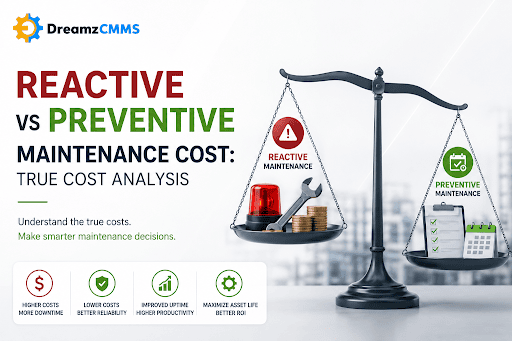
It’s commonly said that in the long run, it will always be cheaper to replace a part or component before it fails, but the cost of emergency repair of a failed item can appear to be low in the short term, because you are only paying to have the failed item repaired.
The Real Cost Comparison: Reactive vs Preventive Maintenance
Many costs associated with performing maintenance are one time in nature and are therefore normally shown as additional costs on the financial statements of a company. In emergency maintenance situations, costs are frequently very high because they are usually spent in a hurry.
This includes such things as: the cost of a part ordered on an emergency basis that has been costed at two to five times the cost of an equivalent part on standard lead time; the cost of a technician that has been pulled from other maintenance work to fix a broken piece of equipment; the cost of the technician at overtime rates as the emergency occurred after hours or on a weekend; the cost of a specialist contractor that is required to perform repair work and are normally costed at high rates for their services.
In many cases, the cost of an emergency maintenance event will be many times greater than the cost of performing the same work as a scheduled, planned maintenance task. Add ons to work order time-and-materials costs for maintenance performed are typically shown on the financial records of a company as they occur, allowing the true cost of the maintenance to be accurately shown.
The way a facility is operated can affect the costs for maintaining equipment. Industry analysis has shown that organizations that use what is called a “reactive” maintenance approach spend significantly more to maintain each piece of equipment than those same organizations that use a “preventure” maintenance approach. By using a Preventive Maintenance Software approach not only can a facility extend the useful life of a piece of equipment and thus have to replace it at a later time for less cost than it would have paid had it used a reactive maintenance approach, the increased cost of maintenance can be spread over a longer period of time and thus have less of an impact on the finances of a facility.
In the assessment of maintenance costs one must also look beyond the expenditure for the maintenance itself, also taking into account the effects on production, safety as well as the value of the assets on the plant floor.
How Much Does Reactive Maintenance Actually Cost?
There is a reason that the cost of an emergency repair can be so high. The cost of the emergency repair itself can be two to five times more than an identical part that was ordered on a regular basis as part of a scheduled maintenance activity and received within the normal lead time for that part. In addition to the higher cost of the part, the hours of work of a technician that are performed on an after hours or weekend basis can cost two to three times more than hours of work performed during regular working hours (after which the technician would be entitled to overtime rates). In some cases, the work performed during an emergency repair may even require the services of an outside contractor or equipment specialist.
For emergency repairs a part that could have been purchased for half the price in a timely manner is purchased at premium prices; a single repair could have cost one half to two and one half times as much as the scheduled replacement of the same part; the technician could be working overtime (double time), on a weekend, or after hours; repairs that require specialists or outside contractors are charged at a higher rate than maintenance personnel; all additional expenses above time and materials on the work order. Read more here: Reactive Maintenance Guide
The Hidden Costs of Reactive Maintenance
These are where the most damage is done to a facility’s budget and, for reasons best known to themselves, no one seems to want to track these in order to include them in your maintenance cost analysis. As such, these costs are generally not logged in your maintenance management system.
A far greater cost is the production that is unable to be completed while a machine or piece of equipment is down for an unscheduled repair. This occurs for several reasons. For start, all of the labor that is required to support the production that is not able to be completed while the equipment is down is paid for but not able to be put to work.
Additionally, the same technicians that are required to perform the repair work that has been caused by the initial failure are required to complete any additional scheduled maintenance that would have otherwise been performed while the other production was being completed. All of this additional backlogged work can have a significant affect on the quantity and quality of the production that is being completed as days turn into weeks. A part failure that only affects a portion of the process can cause the entire production to be of poor quality prior to the time that the part fails completely. And in cases where the failure occurs in a process that the customer can see (e.g. labeling, packaging, etc.) the failure can cause severe damage to a plant’s reputation and subsequently cause a loss of contracts.
These types of failures can cause considerable damage to surrounding parts or other related equipment. For example, a bearing failure can cause considerable damage to a shaft or bearing housing. Sometimes the cost of the damaged parts can be many times the cost of the failed part. In worst case scenario, the cost to repair the damaged parts can be as high as $6,000. Until the damage occurs, these costs are not included in the budget for failure-induced reactive maintenance.
Preventive Maintenance ROI Analysis: Where the Savings Come From
A ROI analysis of PM should be more than just the initial cost of the program. First, as previously stated, PM costs less than reactive maintenance. The savings of PM are made by catching small problems with equipment before they develop into major failures and become very expensive to repair. Finally, In addition, well-maintained equipment will last longer which delays the time when expensive replacement is necessary for that piece of equipment.
Scheduled work is typically completed during standard hours when all parts and documentation are readily available. Therefore, the cost of planned work is generally less than that of reactive work. The cost of preventive maintenance can save three ways. First, the cost of planned labor is less than that of reactive labor. The reason for this is that planned work is typically scheduled and completed during standard hours. The technician has time to thoroughly review the complete history of the asset prior to performing the work. In contrast, reactive work is performed on short notice and therefore the technician has limited time to review the history of the asset prior to beginning work.
Typically, most reactive work is performed during overtime hours and parts are required to be rush ordered. Second, the cost of preventive maintenance addresses wear early in the life of an asset when repair cost are typically very cost effective when compared to the cost of an unexpected failure. Examples of such work are replacing a loose belt before it fails, repairing a small leak before it becomes a large leak, or addressing a temperature reading that is outside of normal operating parameters prior to additional damage occurring. Third, preventive maintenance extends the life of an asset thereby delaying the capital expenditure required for replacement of the asset.
Facilities software for PM can increase the ROI of your maintenance strategies over time. By removing uncertainty as to when to perform a task and having it automatically scheduled so that it never gets forgotten and becomes a form of reactive maintenance, preventive maintenance can be your best form of maintenance.
Downtime Costs: Reactive vs Planned
Downtime due to Reactive Maintenance will incur the repair cost of the equipment that failed as well as additional costs due to the time production is not running (i.e. idle labor, lost production). This can also include indirect costs, i.e. late penalties for not meeting delivery commitments, etc. By scheduling the planned maintenance in the downtime for production, the work can be completed with the least impact on production and thus maintain the related revenue.
Downtime can be scheduled as needed with Planned Maintenance. This means that production downtime can be used for planned maintenance work. This allows work to be coordinated to occur at the worst possible time for the facility, and then turned around and completed when the facility is operating at full capacity. If a facility is running 24 hours a day, for example, all of if it is operating on specific shifts, work can be scheduled around production requirements to maintain downtime on terms that are favorable to the facility. Thus, one of the ways in which PM can protect both the facility and its revenue.
Another point that was brought up during the webinar was that many organizations can also use their scheduled PM work in conjunction with IoT Monitoring & Predictive Maintenance to identify potential problems before they occur and therefore the planned work becomes needed rather than time-driven. This in turn makes the use of maintenance windows much more efficient as it is not being done on a fixed calendar frequency (i.e. every week) and therefore would not be occurring too frequently.
Labor and Repair Costs: Reactive vs Preventive
Reactive maintenance can also end up costing a lot of money in terms of labor hours. When you break down the hours of your maintenance technicians into categories such as Preventive Maintenance hours, PM’s that were completed on a scheduled basis, breakdowns, repairs, emergent maintenance, maintenance investigations, travel etc. you can see where a lot of the labor hours are being utilized for diagnosis and for searching for parts that were not purchased in advance.
This type of maintenance is generally completed in a reactionary mode by the maintenance technician. The technician is trying to fix the problem as fast as possible so that production can get back on track as quickly as possible. This form of maintenance can be very inefficient for a company.
Another way that money can be saved is in the labor for the maintenance itself.
Typically, this would be done during standard hours and on an as needed basis. However, in reactive maintenance, the same work is done during off hours (i.e. overtime) while trying to troubleshoot the problem at hand. In addition to the typical cost of parts for the maintenance, there is an increased cost for the labor. The technician performing the work is typically not as efficient as they would have been if the work was planned in advance.
By utilizing an Asset Maintenance Management Software platform to schedule the work in advance, the same work can be done in less time with all of the required information at the technician’s fingertips. The technician can log into the software and view the work that has been assigned to them. They can also review the complete history of the asset that the work is to be performed on. As a result, the technician will be able to complete more work in less time. In turn, the savings can add up quickly over the course of a year.
How to Calculate Your Maintenance Cost Savings
To determine your Maintenance Cost Reduction for your facility, unscheduled (re-active) maintenance full repair costs for a time period (parts, labor, down time production loss, damage to other parts, etc…), compared to scheduled (pro-active) costs for the same parts (routine maintenance, scheduled labor hours, software, etc…). The costs of unscheduled maintenance for most facilities are 2 to 4 times what they thought. In reviewing the above information, most facilities are only counting the parts for the unscheduled maintenance repairs and are unaware of the other costs of unscheduled maintenance such as down time, overtime for workers, and excessive wear and tear on other equipment and parts.
A common surprise for those who compare the cost of planned maintenance with the costs of reactive maintenance is that the costs of maintenance that was done on a reactive basis are 2 to 4 times greater than the costs for the same work that was done as planned maintenance. Many hidden costs of maintenance are typically not accounted for in managers’ estimates of maintenance costs. Such costs include the cost of production time lost due to a breakdown, the cost of overtime to complete repairs as quickly as possible, and the extra cost to repair additional damage that occurred as a result of the initial failure.
This can include the repair costs and resulting downtime for a repair that could have been prevented with routine maintenance. You can also compare the costs of the scheduled maintenance to the repair costs for the same piece of equipment. The cost analysis of the maintenance for each piece of equipment in your facility can also help you to determine which piece of equipment to add to your preventive maintenance schedule first. It is unrealistic to add all of the equipment in a facility to a preventive maintenance schedule at the same time. Instead, you should add the piece of equipment that will return the greatest value by preventing the most expensive repairs.
Making the Shift with DreamzCMMS
The way that maintenance is carried out today is changing dramatically from being ‘reactive’ to being more ‘proactive’. Many organizations are using old methods of maintenance management and adopting new techniques. A large number of maintenance teams today use spreadsheets, paper based documentation and manually produced schedules in a bid to manage their work. There are many complications that are associated with the methods stated above in relation to managing work, prioritizing work, and attempting to hold a full record of the history of an asset. By adopting the correct processes, and the use of the correct software for management, DreamzCMMS simplifies the management of scheduled maintenance, work orders, asset records and schedules.
By reducing the amount of time spent on administration your team can carry out work to prevent failures, rather than dealing with the paperwork. Planned maintenance replaces break-fix maintenance. Avoiding unnecessary unexpected downtime, saving on repair costs, extending the life of your assets, increasing productivity of your technicians and ensuring that you are always compliant.
Whether you are starting out with Preventive Maintenance or trying to improve the work that you are currently doing with the system that you have now, DreamzCMMS will help you to Plan Better, Execute Better and keep improving as a Maintenance Organization. Book a Free Demo today and see how Proactive Maintenance can help your business.

Subscribe to Our Newsletter
 100% SECURE
 We Respect Your Privacy
 Ready for More?
Talk to one of our CMMS experts and see how DreamzCMMS can simplify your maintenance operations.
Book a free consultation