 BACK TO Blog
Asset Rental Management
Field Sales
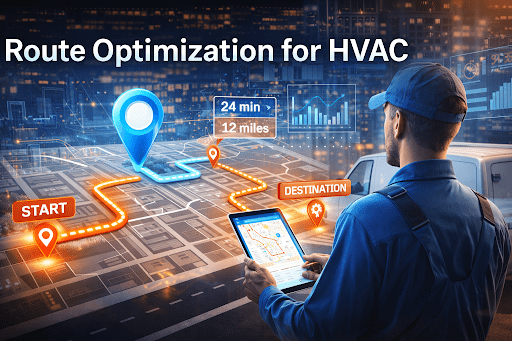
Route Optimization for HVAC: Cut Travel Time, Reduce Fuel Spend, and Serve More Calls
- February 23, 2026
- DreamzCMMS Team
- 13 minutes read
- February 23, 2026
- DreamzCMMS Team
- 13 minutes read
Why route optimization for HVAC Is a Profit Lever
The leadership outcome in one sentence
Route optimization for HVAC improves margin by converting travel time, fuel spend, and scheduling friction into additional billable capacity and better service performance.
Why this is now a C-suite issue
Field service profitability is often decided between jobs, not during jobs. Every unnecessary mile, late arrival, and idle gap is a hidden tax on labor. When leadership invests in HVAC route optimization software, the impact shows up across four board-level priorities: revenue capacity, cost control, customer retention, and operational governance.
What changes when routing becomes a system, not a manual habit
1) More jobs completed per technician per day
Better routing increases capacity without hiring. Field service route planning guide practices such as clustering by geography, matching skill to job type, and sequencing stops properly can unlock meaningful utilization gains.
2) Lower operating cost through fewer miles and less downtime between stops
Fuel and wear cost more than money. They cost time. Reducing fuel costs HVAC route planning improves both, especially when dispatch can re-route in response to cancellations and urgent calls.
3) Faster response for high-priority calls
When teams rely on manual planning, urgent jobs disrupt the day. With HVAC dispatch route optimization, urgent work can be inserted while protecting the rest of the schedule.
4) Consistent service experience at scale
Customers do not experience your internal complexity. They experience arrival windows, updates, and closure quality. Route optimization field service management supports reliable ETAs and repeatable execution.
HVAC and plumbing teams have different routing realities
A strong routing strategy treats HVAC and plumbing as distinct operational patterns:
- HVAC often involves seasonal peaks, planned maintenance visits, and part-dependent jobs. That is where HVAC scheduling and route optimization helps blend planned work with urgent calls.
- Plumbing often involves urgent, short-duration jobs that benefit from rapid insertion and rebalancing, using real-time route optimization for plumbers and dynamic route optimization plumbing.
For both teams, the goal is the same: fewer gaps, fewer miles, and better adherence to promised windows.
The routing mechanics that deliver measurable impact
- Territory and zone design for repeatable planning
- Multi-stop sequencing to remove dead miles using multi-stop route optimization for HVAC
- Real-time adjustments based on cancellations, traffic, and emergency work
- Skill-based assignment aligned with HVAC technician route planning strategies
- Last-mile precision for dense areas using last-mile optimization for HVAC teams
- GPS-driven routing to support GPS route optimization HVAC teams and accurate ETAs
This is also where automated route planning field service prevents dependence on a single dispatcher and standardizes performance.
Where this connects to your operational systems
Routing only becomes a business advantage when it is tied to work execution: job creation, assignment, parts, and closure.
- Facility Management Software and Asset Maintenance Management Software help standardize service across sites and assets.
- Many teams use DreamzCMMS to connect work orders, technician schedules, and service records so routing decisions are informed by asset history and job priority.
- If leadership wants to see how routing, dispatch, and execution connect, a Free Demo can show how a job becomes a work order, gets assigned to the right technician, and is completed with proof.
The 7 Levers of Routing Performance (Executive Scorecard)
Leadership teams get better results from route optimization for HVAC when the program is managed like a performance system, not a dispatch tool. Below are seven levers that directly influence margin, service quality, and scale. Use them as an executive scorecard.
Lever 1: Demand shaping and appointment discipline
Routing collapses when demand is unmanaged. The first win comes from tighter appointment rules:
- realistic time windows
- priority tiers for emergency work
- rules for rebooking when parts are missing
This improves HVAC scheduling and route optimization by reducing mid-day chaos and rework loops.
Lever 2: Territory design that matches real travel patterns
Most organizations inherit territories based on history, not data. Optimized routing requires zones that reflect travel time and service density. This is a core driver of best route optimization for HVAC teams because it reduces cross-territory “ping-pong” travel that destroys utilization.
Lever 3: Skill-based assignment at dispatch
A route is only as good as the first assignment. Matching skill and certification to the job reduces second visits and escalations. This is central to HVAC technician route planning strategies and improves customer outcomes because the right technician arrives first.
Lever 4: Multi-stop sequencing to eliminate dead miles
This is where many organizations see immediate ROI. Use multi-stop route optimization for HVAC to sequence stops by distance, traffic, promised windows, and job duration. For plumbing-heavy schedules, this also supports dynamic route optimization plumbing because short urgent jobs can be inserted without breaking the entire day.
Lever 5: Real-time re-optimization for disruptions
Cancellations, urgent calls, and unexpected job complexity are normal. What matters is how quickly the schedule adapts. HVAC dispatch route optimization improves response without creating overtime spikes, and real-time route optimization for plumbers keeps emergency work from derailing planned visits.
This is where automated route planning field service is essential. It removes dependence on manual reshuffling and keeps performance consistent.
Lever 6: GPS visibility and ETA governance
Accurate ETAs and reliable arrival windows protect customer trust and reduce inbound “where is the technician” calls. GPS route optimization HVAC teams are most valuable when it is paired with customer notifications and dispatcher rules.
A proven approach is to align routing workflows with Leveraging GPS Tracking for Field Technicians so location data supports both operational control and customer experience.
Lever 7: Closed-loop execution through work orders
Routing alone does not create value. Value is created when routing is tied to the work lifecycle: job created, assigned, executed, and closed with evidence. This is why route optimization field service management must connect to work order governance.
Operationally, that means integrating Work Orders with Field Service Management Tools so dispatch decisions are based on priority, SLAs, parts readiness, and asset history, not only geography.
This is also where platforms such as DreamzCMMS help unify work orders, scheduling, and service history, supported by Facility Management Software and Asset Maintenance Management Software.
Executive ROI logic: how to justify the investment
A practical way to communicate route optimization software ROI field service is to convert time and distance into capacity:
- Miles reduced → fuel and vehicle cost reduced
- Travel time reduced → more jobs completed per day
- Second visits reduced → higher first-time fix rate
- Better ETA performance → improved retention and renewals
Even a small reduction in dead miles can translate into one additional job per technician per day during peak season. That is the operational pathway from HVAC route optimization software to margin improvement.
Where customer experience becomes a routing advantage
Routing is a customer communication capability as much as a logistics function. Arrival windows, delay notifications, and closure updates reduce friction and increase renewals. Align routing execution with Customer Communication Best Practices so the service experience stays consistent, even when the day changes.
If you want to show stakeholders the workflow quickly, offer a Free Demo that walks through: job creation → intelligent dispatch → route sequencing → technician proof of completion.
A Practical 90-Day Path to route optimization for HVAC That Leaders Can Trust
Most routing programs fail for reasons that have nothing to do with maps. They fail because the business tries to change everything at once, dispatchers keep old habits, and technicians feel that planning is being imposed on them rather than helping them. The lower-risk approach is a staged rollout with a clear definition of success.
The executive goal is simple: use route optimization for HVAC to convert travel waste into capacity, while protecting service commitments.
Month 1: create stability before you chase “optimal”
Start by fixing the recurring causes of schedule chaos. When appointment windows are unrealistic, when job durations are inconsistent, and when emergency calls are inserted without rules, even the best HVAC route optimization software will appear to “fail.”
In the first month, leadership should insist on two disciplines.
First, clarify the insertion rules for urgent calls, so dispatch can use HVAC dispatch route optimization without breaking the entire day.
Second, standardize how work is defined and closed, so HVAC scheduling and route optimization is anchored to reality rather than wishful estimates.
This is also the stage where skills mapping matters. Dispatch decisions improve when technicians are matched to the right work the first time, which is the operational core of HVAC technician route planning strategies.
Month 2: prove value with one region, then expand
Once the schedule has basic discipline, a pilot becomes meaningful. Choose one region or one service line and treat it as the proving ground. In this phase, the simplest wins usually come from sequencing and clustering. Multi-stop route optimization for HVAC reduces dead miles quickly, and teams often see the impact within weeks.
For plumbing-heavy operations, the schedule reality is different. Jobs are shorter, emergencies are frequent, and rebalancing must happen fast. That is where real-time route optimization for plumbers and dynamic route optimization plumbing prevent urgent work from creating overtime and broken promises.
In the pilot, real-time visibility matters. GPS route optimization HVAC teams improves ETA accuracy and makes dispatch decisions less speculative. It also reduces customer callbacks, especially when you apply the practices described in Leveraging GPS Tracking for Field Technicians.
To keep the pilot honest, routing should not live in isolation. Work readiness should drive routing, not the other way around. Use Work Orders with Field Service Management Tools so parts readiness, priority, and job status influence the daily plan. This is how the business proves route optimization software ROI field service in a way that finance and operations both accept.
Month 3: lock in the operating rhythm
After the pilot shows measurable improvement, the next risk is regression. Performance drops when teams stop reviewing exceptions and when dispatch falls back to manual habits. The fix is governance, not more technology.
A simple operating rhythm works: a short weekly review of travel time, utilization, and on-time performance, plus a monthly review of exception causes and territory boundaries. This is how route optimization field service management becomes a repeatable capability.
At this point, scale is easier when routing is connected to the system that manages work, history, and accountability. Many organizations use DreamzCMMS to connect dispatch decisions to service history and proof of completion, supported by Facility Management Software and Asset Maintenance Management Software. If stakeholders want to see how the workflow behaves in practice, a Free Demo can walk through job creation, dispatch, routing, technician completion, and customer updates.
Customer experience is the final layer. Routing improvements are only fully realized when customers receive accurate windows and proactive updates. Align the process to Customer Communication Best Practices so better routing also produces better retention.
Prove the ROI in One Region FirstSchedule a Free Demo of DreamzCMMS to see how route optimization for HVAC connects to work orders, dispatch, GPS visibility, and closure evidence. The session can validate route optimization software ROI field service with your real constraints and service commitments. |
Executive FAQ
What makes route optimization for HVAC different from basic scheduling?
Scheduling assigns jobs. Route optimization for HVAC reduces wasted travel, sequences stops intelligently, and protects promised windows using rules that can adapt during the day. It combines dispatch priorities with geography, skills, and timing, which is why route optimization field service management has a measurable impact on margin and service quality.
Do we need real-time routing, or is static planning enough?
Static planning helps, but field reality changes hourly. Cancellations, emergency calls, and job overruns require fast adjustments. That is why HVAC dispatch route optimization becomes more valuable when it supports rebalancing and insertion without breaking the entire day. For plumbing-heavy schedules, real-time route optimization for plumbers and dynamic route optimization plumbing reduce disruption while keeping response fast.
How does GPS improve results beyond “tracking”?
GPS is valuable when it improves decisions and customer experience. GPS route optimization HVAC teams increase ETA accuracy, reduces idle time, and supports proactive updates. If you want a clean operational approach, align GPS usage with Leveraging GPS Tracking for Field Technicians so dispatch and customer teams use the same source of truth.
How do we keep technicians aligned with optimized routes?
Adoption improves when routes reduce late days and unnecessary driving. The most effective approach is to tie routing to skill matching and first-time fix. That is the operational reason HVAC technician route planning strategies matter.
How do we prove ROI in a way finance accepts?
Translate waste into capacity and cost. Show miles reduced, travel time reduced, overtime avoided, and jobs completed per day improved. This is the practical logic behind route optimization software ROI field service and it is most persuasive when the pilot includes before-and-after proof.
How do we protect customer experience while optimizing routes?
Routing is part of customer experience. Arrival windows and updates matter as much as speed. Align routing workflows with Customer Communication Best Practices so better routing also improves trust and retention.
Platform checklist for decision makers
If you are evaluating HVAC route optimization software, look for these capabilities:
- Territory clustering and stop sequencing using multi-stop route optimization for HVAC
- Skill-based dispatch for stronger HVAC scheduling and route optimization
- Re-optimization support for disruptions through automated route planning field service
- GPS visibility that improves ETAs, not only tracking, through best route optimization for HVAC teams practices
- Work readiness integration using Work Orders with Field Service Management Tools so parts and priorities drive routing
- A workflow layer that connects routing to execution and proof of completion
For operations that need routing to tie directly into work orders and service history, many teams use DreamzCMMS as the execution layer supported by Facility Management Software and Asset Maintenance Management Software. If stakeholders want to validate fit quickly, schedule a Free Demo focused on “job to route to completion,” not on feature lists.
Closing: why this is a margin decision, not a logistics tweak
The most expensive part of field service is wasted technician time. Route optimization for HVAC converts that waste into usable capacity while protecting service windows and improving the customer experience. When routes are planned with skills, priorities, and real-time disruption handling, leadership gets higher utilization, lower fuel spend, and more consistent delivery.
Turn Travel Waste into More Completed JobsSchedule a Free Demo of DreamzCMMS to see how route optimization for HVAC connects dispatch, Work Orders with Field Service Management Tools, GPS-driven ETAs, and closure proof.Use the session to validate route optimization software ROI field service, reduce fuel spend, and deliver a more consistent customer experience across HVAC and plumbing teams. |
Additional ReadsFor leaders improving dispatch efficiency, service consistency, and customer experience, these perspectives add useful context:Leveraging GPS Tracking for Field Technicians — How GPS visibility improves ETAs, reduces idle time, and strengthens dispatcher control without creating micromanagement. Work Orders with Field Service Management Tools — How structured work orders improve assignment accuracy, first-time fix rates, and execution traceability across field teams. Customer Communication Best Practices — How proactive updates, clear arrival windows, and consistent closure messaging reduce escalations and improve retention. |















Subscribe to Our Newsletter
 100% SECURE
 We Respect Your Privacy
 Ready for More?
Talk to one of our CMMS experts and see how DreamzCMMS can simplify your maintenance operations.
Book a free consultation