 BACK TO Blog
Asset Rental Management
Asset Maintenance
IoT Predictive Maintenance: How Leaders Build a Smart Maintenance Ecosystem, Cut Downtime, and Scale Reliability in 2026
- March 13, 2026
- DreamzCMMS Team
- 18 minutes read
- March 13, 2026
- DreamzCMMS Team
- 18 minutes read
Introduction: Downtime Is No Longer Just a Maintenance Problem
Almost all organizations consider maintenance to be an administrative function. Something needs to be inspected, repaired or replaced. That was OK in the past when things were simple and failure was inexpensive. It is not OK in 2026.
Uptime reliability is a major source of lost production, noncompliances to customer commitments, underperformance, spare parts inventory, exposure to hazardous working environments and asset write downs. IoT Predictive Maintenance has now become a business control system rather than an optional technology.
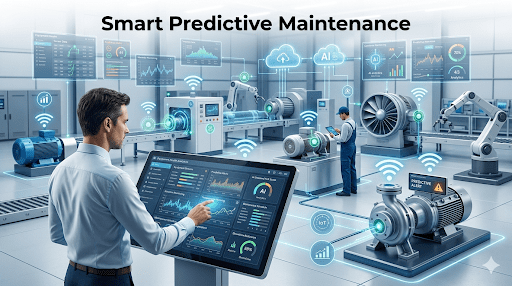
Today’s IoT predictive maintenance (PM) solutions have moved well beyond the days of displaying a never-ending list of sensor readings. The modern PM solution seamlessly integrates the key elements of asset condition, historic maintenance, operational parameters and business rules with real-time data and alerting to empower business leaders with the right information at the right time to avoid actual failures and drive preventive actions. A smart maintenance ecosystem comprises a variety of components including connected assets, real-time sensor data, analytics and automated workflows – all sitting on top of a single maintenance operating model.
Why Predictive Maintenance Matters If you are a DreamzCMMS user then you already know that Predictive Maintenance (PM) is just one part of a larger equation. That equation is “Action = Value”. In other words Predictive Maintenance only holds value when the insights gathered are actually used for maintenance activities. While a good CMMS has to cover many aspects of maintenance activities, it is very important to focus on those core functionalities that can help in the success of PM activities. At DreamzCMMS we have focussed on core functionalities around Preventive and Predictive Maintenance along with embedded functionalities of AI and IoT based machine monitoring, work order automation and centralized asset history. The end goal of all this is to help our customers in minimizing unexpected breakdowns and increasing the reliability of their assets.
When companies lack real-time condition visibility, the consequences spread fast:
- maintenance teams respond too late
- emergency repairs become normal
- overtime and rush-part costs rise
- downtime disrupts customer-facing operations
- asset life shortens while replacement pressure grows
We need to start talking about equipment failures in a different way. With predictive maintenance through IoT, inevitable failures are no longer inevitable for business.
The Executive Reality: Why Predictive Maintenance Has Become a Competitive KPI
The customer isn’t asking if you’re using predictive maintenance IoT sensors, they’re noticing the results. Today, customers are increasingly aware of the benefits and outcomes of industrial digital transformation solutions in production environments. This awareness stems from the :
- They notice when service is delayed because a critical machine failed.
- They notice when production commitments slip.
- They notice when quality becomes inconsistent.
- They notice when asset-heavy operations become unreliable.
Our new eBook: "Reliability is no longer an island" finds that a renewed focus on operations and a desire to generate returns from the investments made in industrial IoT, are bringing predictive maintenance from the plant to the boardroom.
For executives, the business case is straightforward.
First, Predictive maintenance supports a number of goals, such as the uptime of the plant. With the help of an IoT condition monitoring system, abnormal vibration levels, increased temperatures, bearing wear and unusual operating behaviour can be detected at an early stage, before any problems develop. This allows time for planned maintenance work such as replacements or repairs, preventing unscheduled machine stoppages.
Second,The Predictive Maintenance level is the second level of the 3S Maintenance Process and it has a direct relation with the costs. Emergency maintenance work is always the most costly. They involve large amounts of overtime, rapid procurement, production losses and operational disorders. With a connected and data-driven approach, IoT maintenance cost reduction is shifted further along the maintenance process and more work is done on a proactive basis. DreamzCMMS mentions the use of AI and IoT predictive maintenance for reducing unscheduled shutdowns, improving performance and increasing the lifespan of the assets using real-time monitoring and smart notifications.
Third, predictive maintenance improves decision quality. Real-time monitoring of assets using IoT signal data layered over historical work order and asset record data allows maintenance leaders to make more informed and timely work prioritizations and evaluations based on the current condition and risk of their assets, as opposed to past maintenance schedules or assumptions.
Fourth, Predictive Maintenance Enhances Trust Reliable production means that more deliveries can be fulfilled, workers are more productive, and the customer is satisfied.
The Hidden Cost of Reactive Maintenance
Many organizations underestimate the cost of reactive work because it does not always appear in one budget line.
Finance sees repair volatility.
Operations sees delayed output.
Maintenance sees repeated emergency calls.
Procurement sees expedited parts.
Leadership sees margins tighten without always seeing the root cause.
The problem is not only breakdowns. It is friction.
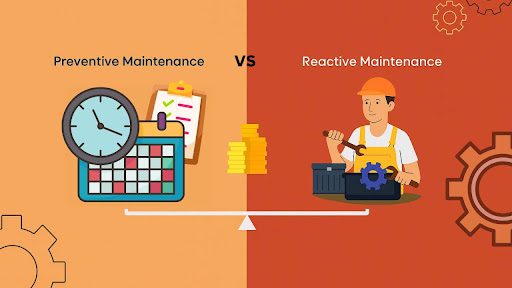
Connected Equipment Predictive MaintenanceWithout connected equipment predictive maintenance, maintenance teams will continue to manually check equipment, hold inventory, needlessly inspect assets and change parts with a healthy margin of safety – resulting in a maintenance team that is just busier.
A reactive model often leads to:
- more low-value routine checks
- less focus on high-risk assets
- poor visibility into actual failure patterns
- slower response to developing faults
- delayed maintenance decisions until symptoms become costly
This is why the real value of IoT predictive maintenance solutions is not just “better monitoring.” It is the removal of uncertainty that slows everything else down.
Why Traditional Maintenance Models Fail in Modern Operations
We are accustomed to work under a maintenance approach based on the appearance of failures according to a periodicity, and always based on the operational calendar. But the reality of our current work is different
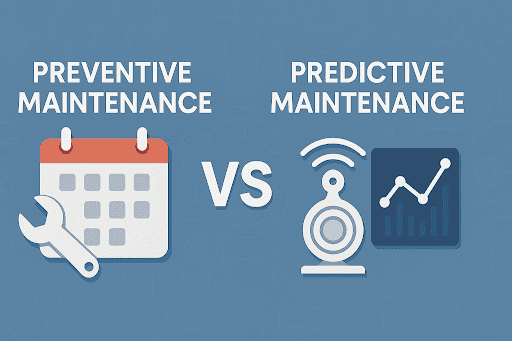
Maintenance schedules are still important, but time-based maintenance is limited. A calendar does not know that the motor is running hotter than normal. A route does not show the slow increase in vibration over a couple of hundred assets. A spreadsheet does not have the ability to dynamically analyze changing vibration trends in real time.
That is why traditional models break down when:
- assets run in variable conditions
- equipment performance changes faster than inspection cycles
- failure cost is high
- teams are stretched thin
- maintenance priorities shift day to day
Routine maintenance that follows a calendar of pre-determined intervals or is based on occasional condition checks and audits is not optimized for use of the rich source of information available to asset managers. IoT sensor predictive analytics can change this. Using real time condition sensor data in conjunction with trending and historical contextual information, the approach can detect where risk is increasing and where work is required in the most critical assets.
DreamzCMMS focuses on the integrated model of asset management through its applications and IoT content, and uses IoT device integration for real time monitoring, predictive maintenance and efficient asset management.
What a Modern IoT Predictive Maintenance System Must Deliver
IoT predictive maintenance is so much more than sensors and dashboards. So comparing the number of sensors installed or the number of users on a portal doesn’t really matter. What actually matters is the business outcome achieved through reduced down time and increased production capacity.
1. Earlier fault detection
The platform should identify abnormal asset behavior before it becomes failure.
2. Smarter maintenance prioritization
Teams should be able to work out what needs doing now, what needs doing later and what needs doing in the future and be able to spot out things that look out of place and don’t.
3. Lower downtime exposure
The system should reduce surprises and improve planned intervention.
4. Better asset-life decisions
Condition data should support repair-versus-replace thinking, not just immediate troubleshooting.
5. Clearer operational ROI
Maintenance cost reduction in relation to the operating capacity of the equipment as well as improvements in terms of availability and labor productivity.
The IoT Predictive Maintenance Blueprint: How High-Performing Organizations Win
Every business we talk to feels they are going to be successful in their IoT endeavour. They buy the equipment and then try to mount it all on a nice little wall board. But with years of IoT implementations under our belt, we see the same thing over and over again. Companies fall short of reaching their IoT goals and end up with a bunch of dumb assets because they are only focussing on putting sensors on equipment. Building a strong business is about creating a smart predictive maintenance platform that is able to surround and augment the many key business operations, processes and high value decision points and at the same time mitigate and reduce the number of risk points in the organisation.
That blueprint rests on five strategic pillars.
Pillar 1: Start With Failure Economics, Not Devices
A predictive program should never begin with, “Which sensor should we install?”
It should begin with questions like:
- Which failures hurt the business most?
- Which assets create the highest downtime risk?
- Where do emergency repairs keep repeating?
- Which failure modes show early warning signs?
- Where would earlier detection deliver the fastest return?
First leadership lesson in IoT predictive maintenance: do not start with hardware. Start with consequence. I am continuing to review my notes from my recent presentations at #MTC16 where I had the chance to give two presentations about IoT predictive maintenance. A few points I want to cover and then will try to add to them with further insight. Predictive Maintenance Is Not Unique to the Internet of Things The term Predictive Maintenance is new in the world of IoT but the concept is not. The mechanics of Predictive Maintenance have not changed; the means to support the mechanics have. All maintenance is reactive or proactive. There is no other category. What differs in Predictive Maintenance is that instead of planning maintenance based on
In one situation a compressor failure might be considered an annoyance. In another it could be a real disaster – potentially affecting production, product quality and ultimately customer satisfaction. Predictive maintenance is only truly strategic when it focuses on those assets where early warning of potential failure is critical.
Pillar 2: Build a Real Condition Monitoring Layer
A true IoT condition monitoring system is about more than the occasional parameter readings. What is required for effective condition monitoring is a real time or near real time flow of data from the asset.
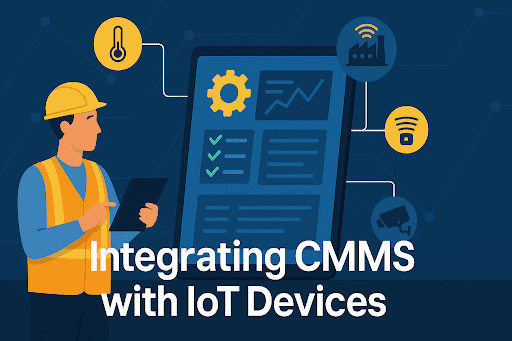
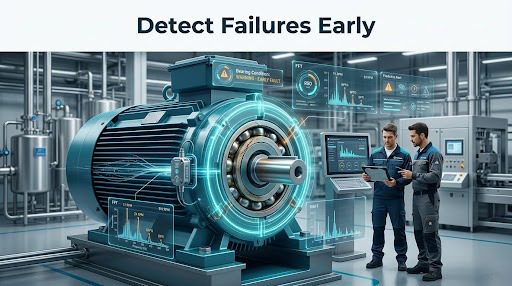
Well, that’s where the wireless sensor predictive maintenance comes in. The sensor can monitor a number of parameters such as vibration, temperature, noise, pressure, current drawn and other parameters. The sensor will send the data to the CMMS – DreamzCMMS, which makes use of the Artificial intelligence and IoT technology, it helps in predicting the failure and uses the sensor data along with FFT analysis in order to predict the anomalies in the equipment and gives alerts to the maintenance teams in order to prevent further damage.
We previously mentioned a few use cases of Edge Computing such as IoT, smart cities and smart homes. Another good example of Edge Computing is in Predictive Maintenance. However, not all data-driven decisions in the production environment can be cloud-based. Most of the data points that need to be used for such decisions - such as vibrations, temperatures or noise levels – need to be filtered, processed or flagged at the Edge in order to be able to trigger timely alerts and in order to keep the costs of the communication infrastructure low. And what are we aiming to get from all this data? More data? No. We are looking for more relevant, more quality data that is more timely.
A mature monitoring layer should answer three questions clearly:
- What is changing?
- How fast is it changing?
- Does it suggest rising failure risk?
Pillar 3: Turn Signals Into Maintenance Workflow, Not Just Dashboards
A sensor alert by itself adds no value. It is the response to that alert that generates the value.
High-performing organizations connect IoT machine learning maintenance insights directly into maintenance workflows:
- anomaly detected
- risk threshold crossed
- inspection triggered
- work order created
- parts checked
- technician assigned
- follow-up history captured
All predictive programs create visibility. However, very few create action. That’s where things go wrong.
The Asset Maintenance Management Software provided by DreamzCMMS is centered around the three pillars of – Automated Work Orders, Real Time Asset Status, Technician Mobility and the ability to have complete maintenance history of the asset. All these are connection points that can be integrated to implement Predictive Maintenance.
The fundamental principle of smart maintenance is that condition data should flow into the same Operations Management System (OMS) that maintenance personnel currently access for work orders, tasks, compliance monitoring and asset history.
Pillar 4: Combine AI, History, and Context for Better Decisions
Predictive maintenance is not just about sensors. It is about interpretation.
An asset running hot is not always abnormal. There are many things to consider when assessing whether there is a problem, including recent maintenance, asset age, hours run, operating parameters, stock levels of spares and failure history.
That is why leading programs combine:
- live condition data
- work order history
- failure patterns
- usage trends
- maintenance cost records
- AI-assisted prioritization
IoT sensor predictive analytics is a huge leap forward from simple threshold alarms. Rather than simply telling you that the temperature is high, it will begin to inform you that the probability of failure is increasing due to increasing trends in historical and actual system loading conditions.
We are currently using the following communication features: - AI first workflows - Predictive and preventive maintenance - Central history and analytics - Condition based scheduling to create an actionable predictive model.
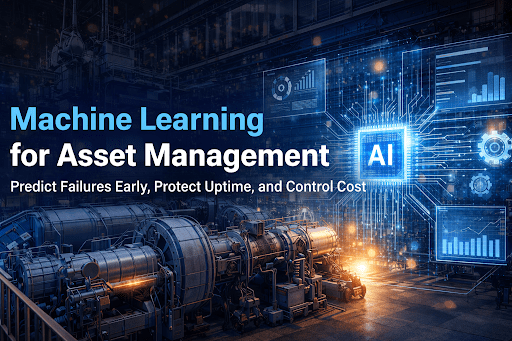
If you like this method, look at the ones shown next to it. Soon we will provide more information on “AI for Predictive Maintenance” and on “Machine Learning for Maintenance 4.0” – how the behavior patterns of the equipment can be identified using Machine Learning algorithms so that the Maintenance can be moved from a reactive to a proactive mode.
Pillar 5: Build for Trust, Scale, and Cross-System Visibility
Plant Reliability, Condition-Based Maintenance and Predictive Maintenance all share one thing in common – they all promise to increase the length of time your equipment will last and increase efficiency if Maintenance is done properly. Reliability Centered Maintenance (RCM) and Predictive Maintenance are the magic pills that are supposed to fix all of the ills of the Maintenance world. The hundreds of alerts that your CMMS and Predictive Maintenance vendors say will provide you with the information necessary to properly maintain and extend the life of your assets are a meaningless string of characters if not supported with proactive Preventive Maintenance. Without preventive maintenance these alerts are simply nothing more than noise.
That is why scale matters.
A strong industrial IoT predictive maintenance program should account for:
- sensor reliability
- data quality
- alert tuning
- integration with CMMS workflows
- technician usability
- governance and permissions
- cross-site reporting
- long-term analytics maturity
Predictive Maintenance will become a very powerful feature in the Dreamz CMMS system after it will be connected to the other visibility layers in the system. In asset-intensive operations there are plenty of scenarios where the location, utilization and condition of the assets are highly correlated. After predictive maintenance will be connected to the maintenance streams of intelligence and combined with the Asset Tracking functionality in the Dreamz CMMS that integrates RFID Asset Tracking Software with location, visibility, utilization and condition information, you will be able to track and record almost everything. We call our enterprise-wide real-time tracking, inventory management system – AI-ready for when the day arrives that tracking with AI will become the standard. RFIDTracks is your one stop solution for Asset Management across multiple sites.
This is what turns separate tools into a true smart maintenance ecosystem.
Technology Is the Engine, Not the Strategy
This is one of the most important lessons for decision-makers.
Maintenance instructions are not indicated on the sensors; - A dashboard alone is not enough to enable effective management of your production assets; - AI alone will not change your way of thinking about your assets.
The strategy must come first.
Leaders should not ask, “How do we install more IoT devices?”
They are asking the wrong questions. Maybe you could highlight these, and in the process come up with a few more pertinent ones. They really need to focus on the critical failure risks that are affecting business today and think about how a system could be engineered to sense and prevent them in a highly scalable fashion.
Who will use your asset? Identifying who will actually use your asset is very important to the success of your asset and all the activities associated with it. It could affect your asset for the project, the information that you put into alerts and what users will like. A more relevant asset is more likely to be used in the workflow of the intended user.
How Leaders Know IoT Predictive Maintenance Is Working
I talk with a large number of reliability professionals each week who think that they have a predictive maintenance (PdM) program that is yielding real results. Most think that they are performing reliability-centered maintenance (RCM) on their equipment and that they are making optimal use of the various PdM methods and procedures available in order to achieve improved reliability and efficiency. I disagree. I do not think that most reliability professionals have an effective PdM program. Probably not at all.
Leaders should judge success by business signals.
The first signal is emergency work. Are urgent breakdown-driven jobs decreasing?
The second signal is downtime exposure. Are critical assets failing less often, or are failures being caught earlier?
Third Metric: Labor Focus Techs doing less work on low value repairs?
We previously wrote about a guide released by the Reliability Maintenance and Machine Learning Forum on the first four reliability signal indicators. In our last blog we broke down the first four and now we will continue with the 4th – maintenance cost trend. Is your maintenance cost trending upward? Contact us to find out.
Reliability of Assets (5th signal) Is repeat failure decreasing because the work team is addressing root cause versus treating symptoms?
Another sign of the times – we’ve been reading about the “return on investment” (ROI) for IoT predictive maintenance. How can you really know that your plant is less prone to unscheduled machine failures, enjoys higher system availability, has fewer overnight emergency maintenance and repair activities during peak demand periods and that your maintenance technical staff are working more efficiently.
The Value of Condition Monitoring for asset reliability is highly linked with Predictive Maintenance, Schedule Maintenance, Automated Notifications and Real Time Analytics of the Maintenance Operations through the power of AI and IoT in DreamzCMMS.
IoT Predictive Maintenance Is Not a Sensor Project. It Is an Operating Model for Reliability.
Predictive maintenance is often one of the top three use cases that are mentioned when talking about IoT. Unfortunately many organisations that deployed sensor based IoT projects to support predictive maintenance projects now deeply regret their investment. The main reason is that the assumed concept of predictive maintenance is quite different from the reality.
At the surface level, predictive maintenance looks like a technology initiative.
Install sensors. Capture readings. Review dashboards.
But at scale, it becomes much bigger.
- It changes how organizations prioritize risk.
- It changes how technicians spend time.
- It changes how leaders think about asset life and downtime.
- It changes how maintenance aligns with operations.
- It changes how reliability becomes measurable.
Why IoT predictive maintenance is more than just condition monitoring for failures There are many good reasons for this. Above all, it is a question of creating an operations model where the condition data from your machines and devices is integrated with artificial intelligence, workflow automation and your operational decisions to deliver the production output and performance you need.
When maintenance is reactive, every other system feels the strain.
When maintenance is predictive, the organization moves with more control.
Build a Smarter Predictive Maintenance Ecosystem With DreamzCMMS
Ready for a change? Are you and your team tired of calendar-based servicing, time-consuming walks around equipment to check everything is ok and the never-ending cycle of emergency maintenance? You’re not alone and now is a great time to start your journey towards digitalization and efficiency.
Predictive Maintenance & Asset Management Software At DreamzCMMS, we are the first to bring Artificial Intelligence, IoT signals, work orders, asset history and operational analytics all under one roof. With Asset Maintenance Management Software within DreamzCMMS, you can carry out automated maintenance on the assets. Integrating it with our RFID Asset Tracking Software will provide you with complete asset visibility. Get a Free Demo of the features of DreamzCMMS. Our Asset Management Software supports the following key product value propositions: - AI-first maintenance with first of its kind capabilities that integrate IoT signals with asset knowledge and operational data to deliver real-time predictive insights to inform maintenance decisions. - Automated scheduling and planning that dynamically considers asset condition and usage to minimize unexpected equipment failures and unplanned downtime. - A comprehensive repair history for all assets and components with a single version of truth and operational data to facilitate business decision-making. - Streamlined workflows specific to each industry to automate operational tasks and minimize staff effort.
Explore More
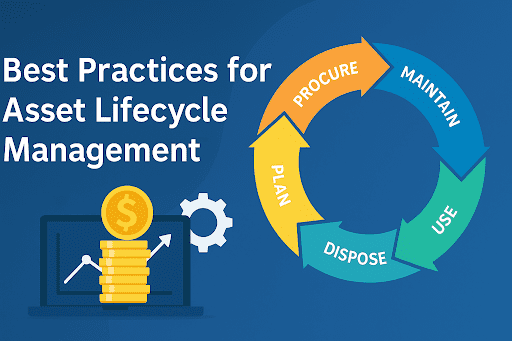
Reliability-centered maintenance requires information on the life expectancy of various assets to optimize maintenance effectiveness. The following should be added to your PM routine to gain a better understanding of an asset’s lifespan.














Subscribe to Our Newsletter
 100% SECURE
 We Respect Your Privacy
 Ready for More?
Talk to one of our CMMS experts and see how DreamzCMMS can simplify your maintenance operations.
Book a free consultation