 BACK TO Blog
Asset Rental Management
Preventive Maintenance
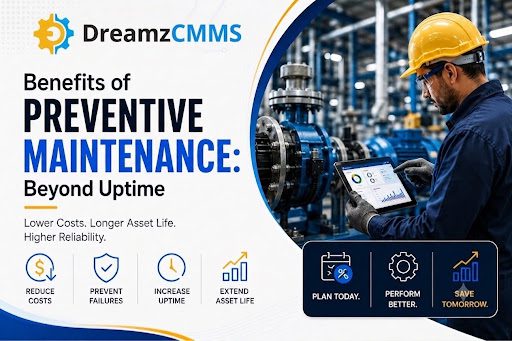
Benefits of Preventive Maintenance:Beyond uptime
- July 22, 2026
- DreamzCMMS Team
- 12 minutes read
- July 22, 2026
- DreamzCMMS Team
- 12 minutes read
Manufacturing and facilities are doing more with less. They have less budgets with which to maintain their assets, fewer skilled technicians to perform the work, and their assets are often required to operate for extended periods of time beyond their design life. Performing work in a planned, or scheduled, manner is key to achieving the many advantages of preventive maintenance as opposed to waiting for an asset to fail.
There is no true strategy in reactive maintenance – only the absence of a proactive strategy. And each repair, though completed successfully, removes the technician from performing planned work. In addition, each repair creates additional delays for other required maintenance. Thus, as a reactive organization, you will always be in a defensive posture as if you are putting out individual fires. Unlike a proactive organization, who is scheduled to perform the same work as planned work, thus all of that work can be completed before any potential problems occur. The work completed as planned work is akin to a smoke detector – in that it helps to prevent fires (potential problems) from occurring in the first place. Unlike a fire department, which can only deal with the effects of a fire (as in potential problems), a smoke detector is far more proactive in the fire prevention process.
As industries and facilities grow and evolve, the maintenance management software needed to implement and manage a proactive preventive maintenance software also has to grow and evolve. No longer can a shop rely on a patchwork of methods including but not limited to spreadsheets, sticky notes, and pure memory in order to attempt to organize, prioritize, and follow through on work to be done on all of an organization’s assets.
By moving in the direction of utilizing a software package for planning, and for scheduling work, an organization is now in a position where all of the work (and by “all of the” I mean EVERY bit of) history relating to any given piece of equipment can be tracked, recorded, and studied. From the simple wear of a bearing to the scheduled replacement of a part prior to its failure, PM work now has the opportunity to be planned, managed, and utilized in the most effective manner possible.
Cost Savings and Preventive Maintenance ROI
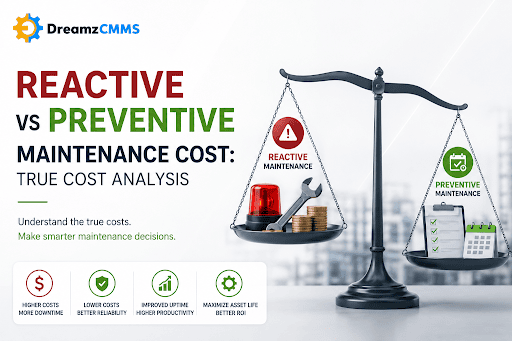
We discussed in our post on maintenance cost savings the many benefits that an organization can experience when they change from a reactive maintenance model to a preventive maintenance. Some of the biggest preventive maintenance cost savings are found in the cost of maintenance itself. By completing planned repairs as opposed to surprise breakdowns, organizations have experienced maintenance cost savings of 12% to 18%.
This percentage of savings can increase even more with the use of a CMMS and the implementation of smart maintenance scheduling, with some organizations reporting maintenance cost savings of 30% to 35% or more. These funds can be used for many purposes within an organization, including additional employee training, expanded production hours or capacity, the purchase of new and better equipment, and even the distribution of additional funds to employees in the form of bonuses.
Where do the preventive maintenance savings come from? First, planned maintenance is typically less expensive than emergency repairs for several reasons. People do not work overtime, or pay to have parts shipped. Second, repairs to small damaged areas are typically less expensive than replacing large damaged areas. Third, by preventing a single failure to cause a down time of an entire production line, all of the time that the line is not in production due to the failure appears on the production facility’s profit and loss statement. This down time is often not included in the maintenance budget for the line.
The cost of repairs that have been done in a proactive manner to maintain equipment to maintain it at optimal levels of performance are typically less than the cost to repair the same piece of equipment after it has failed. This lower cost of repair translates into substantial savings on an annual basis. The nature of the work that is being done by the maintenance staff in proactive maintenance is planned, as opposed to the nature of the work done in reactive maintenance, which is unknown. Labor gets scheduled during planned windows instead of pulled from other priorities. Over a year, that predictability compounds into real, measurable savings — and if you're looking to dig deeper into the specific levers that drive those numbers, our guide to maintenance cost reduction walks through the strategies in more detail.
Extending Equipment Life and Preventing Failures
Extending the life of equipment is one of the major advantages of preventive maintenance. Lubricating the bearings on pumps, for example, can extend the life of the pump for years. Calibrating instruments and sensors, as well as cleaning and servicing air and water filters and other equipment that put strain on motors and bearings, can also extend the life of an asset well beyond its natural life.
Extending the life of equipment is a primary goal of many organizations and is achieved through asset longevity. Many people are familiar with the concept of an asset’s life cycle, but few realize that the life of an asset can be extended through proper maintenance.
Prevent equipment failures: Preventing one bad day is worth its weight in gold. Many failures occur on a regular basis on the same piece of equipment, due to reasons like misalignment, contamination, wear and tear, etc. By using a maintenance program, these patterns can become visible and the root cause can be addressed instead of just treating the symptoms. When using an asset maintenance management software, the complete maintenance history of an asset can be viewed to determine the root cause of failures.
Scheduling maintenance, in conjunction with condition-based monitoring and predictive maintenance using IoT monitoring and predictive maintenance software, can identify potential failures before the typical scheduled time for maintenance. This can mean that by using sensors to pick up any unusual vibration, temperature or pressure readings during normal operation and flagging them up before a human can spot the problem, maintenance can be conducted at the exact moment it is required rather than at a fixed time for a scheduled maintenance visit. Read our preventive vs predictive maintenance article to help decide which is best for your business.
Safety, Compliance, and Customer Satisfaction
Most people don’t even think about the safety benefits of well maintained parts such as belts, wiring, hydraulic lines and safety guards until they have failed causing injury or even a fatality. That is when the reality of the importance of good maintenance really hits home. All of these parts can wear out over time and fail without notice. However, with good and timely maintenance the failure of these parts can be anticipated and repaired before they fail causing harm.
Safety is also another major benefit that can be realized by a facility by properly administering a program of preventive maintenance. A large number of industries today including food and beverage, healthcare, manufacturing and utilities are strictly regulated by governments at local, state and federal levels with respect to the safety of the majority of the equipment found within a number of different types of facilities as well as the maintenance that is completed on that equipment. By developing a well planned and properly administered program of preventive maintenance, a number of different benefits can be realized.
The first major benefit is that of safety. A well planned and administered program of preventive maintenance can ensure that all of the equipment found within a number of different types of facilities is being properly and safely maintained. This not only helps to protect the safety of the employees that work at a number of different facilities, but it also helps to protect the safety of customers as well. In addition to helping to ensure the safety of employees and customers, a well planned and properly administered program of preventive maintenance will also ensure that a facility is in compliance with all of the safety regulations that apply to the specific type of industry that a facility is involved in.
Many facilities are also required to properly maintain and keep accurate records of certain pieces of safety related equipment. A good program of preventive maintenance can also help to provide evidence of compliance with the safety regulations that apply to a number of different types of facilities. This type of documentation is also very important to a facility’s insurance company
Customer satisfaction is also positively impacted when equipment is running for longer periods of time. Late deliveries, poor quality products and unscheduled maintenance activities that cause downtime all have their root cause in unreliable equipment operating somewhere in the supply chain. Customers can’t see what is going on in the maintenance of the equipment but they can certainly tell when things are not being properly maintained and they are not satisfied.
Building a Preventive Maintenance Program That Actually Sticks
While knowing the advantages of preventive maintenance is not enough to start a program of preventive maintenance at your facility, building a PM program is challenging. Many maintenance departments begin with the best of intentions but soon find that the “paper” is no longer current and that the work is again operating in a reactive mode or “firefighting” mode. The biggest challenge to building and operating a PM program is the gap between intention and execution.
To start creating a successful PM program, you need to start prioritizing the assets in your facility. Not all assets are created equally. A critical production piece of equipment that could cause a line to shut down if it were to fail would require more frequent inspections than say an idle piece of equipment. Also, as you are prioritizing your work, you need to be ranking your assets by their criticality and complete the most important work first to safely complete the work on your critical assets.
Frequency of tasks is also an important factor to consider when assigning out preventive maintenance tasks. Just knowing what tasks to perform for any given piece of equipment is not enough. It is also important to consider how often those tasks should be performed. The recommended maintenance schedule provided by a piece of equipment’s manufacturer is a good starting point. However, most manufacturers design their recommended maintenance schedule around average operating conditions for a piece of equipment. This means that the recommended maintenance schedule will likely need to be modified based upon the specific operating conditions of the equipment at your facility as well as any relevant failure data. For example, a facility with high levels of dust and heat in the air would typically need to perform more frequent maintenance on a motor than a facility with climate controlled environments.
Documentation of maintenance activities is a key challenge for many maintenance programs. Some programs fail entirely because of lack of documentation by using paper based systems, or by trying to use different software packages, or by just using spreadsheets. In all cases it is easiest to document work that has been completed as it is being done. Many times work is documented in a notebook, or on a piece of paper, or by email, and the documentation is never looked at again. It is very valuable information that can be used to identify patterns and help prevent future failures. If a warranty claim needs to be filed, or an auditor comes to verify that all required PM’s have been completed, it can be a disaster when all of the required information is scattered throughout various pieces of paper, and emails, etc.
On the other thing to consider is that not all failures can be predicted. Thus, over-maintenance can also cause additional problems. Therefore, the focus should be placed on finding the right amount of maintenance for the specific piece of equipment that it is being used on. The time-based preventive maintenance can be very effective in many situations; however, in many cases, the best way to determine when a piece of equipment requires maintenance is by monitoring its current condition using its available data, such as with Predictive Maintenance.
The organizations that get the most value aren't necessarily the ones with the most sophisticated tools — they're the ones that actually follow through on the schedule they set, week after week, without letting it slide when things get busy. For a closer look at how to structure that follow-through, our preventive maintenance best practices guide covers the habits and workflows that make programs stick long-term.
How DreamzCMMS Powers Your Preventive Maintenance Strategy
So your ready to build a Preventive Maintenance (PM) Program! Knowing the benefits of a PM program is easy, but putting together a plan and making it work in your busy facility is a challenge that many have faced. The challenge is that most maintenance programs fail for lack of proper planning and execution. They usually start out strong but within six months the program falls apart. This occurs for many reasons.
New customers and existing customers alike can utilize our facility and asset maintenance software to create and formalize a preventive maintenance program and achieve the many benefits offered to organizations around the world. In addition to increased uptime of all equipment, programs such as these also help save money, ensure the safety of employees as well as the public at large, increase the morale of any maintenance work force, and meet customer expectations. We have the tools as well as provide sufficient training to help any program pay for itself many times over.
Find out how a free demo of DreamzCMMS can kick-start you to having a better Preventive Maintenance strategy.
Ready to see what a smarter preventive maintenance program looks like in practice? Request your free demo of DreamzCMMS today and start building a maintenance strategy that works for you, not against you.
Subscribe to Our Newsletter
 100% SECURE
 We Respect Your Privacy
 Ready for More?
Talk to one of our CMMS experts and see how DreamzCMMS can simplify your maintenance operations.
Book a free consultation