 BACK TO Blog
Asset Rental Management
Facility
Machine Learning Energy Efficiency: How Leaders Optimize Building Climate, Lower Costs, and Scale Smarter in 2026
- March 17, 2026
- DreamzCMMS Team
- 17 minutes read
- March 17, 2026
- DreamzCMMS Team
- 17 minutes read
Introduction: Energy Performance Is No Longer Just a Utility Issue
There are still far too many people who think of energy management as a cost-saving activity. They only take an interest in their energy bills once a month, switch off lights and radiators when someone else points out that they are on, and only have a serious conversation about energy efficiency when their energy bills have become unaffordable.
That way of thinking does not work anymore.
By 2026 Machine Learning Energy Efficiency will have advanced from being a cost saving factor to a performance factor impacting the performance of buildings and infrastructure, lifespan of buildings and infrastructure, occupant health and wellbeing, environmental sustainability and human health. By 2026, Energy Efficiency will then have advanced to Board Room level priority.
That is where machine learning, building energy efficiency, changes the conversation.
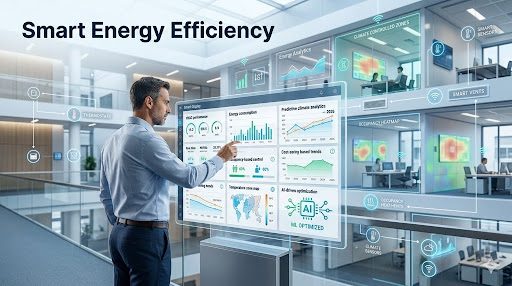
Historically, the applications of machine learning for energy efficiency in buildings have focused on optimizing thermostat performance, heating and cooling systems, and, as a result, there has been little motivation to change performance in other building systems. There are now new techniques and new opportunities. Using these new techniques, a building's energy efficiency can be greatly increased. A building can better predict its energy consumption and can better manage its indoor environmental conditions in order to prevent overheating and overcooling. Problems can be detected in real time to prevent them from developing into long-term energy consumption issues. With advanced sensor networks and real-time analytics integrated with machine learning techniques, buildings can be controlled and operated in a more intelligent manner.
When companies do not update their energy strategy bad things happen:
- Heating and cooling systems run longer than they need to.
- People's schedules are not taken into account.
- Maintenance teams only fix problems after they happen.
- Energy is wasted in spaces.
- Leaders do not know which buildings need attention.
The idea of Machine learning energy management is not really a topic of the future. The rate of change in our lives is accelerating at a pace never seen before in history, and this is forcing companies to rapidly adopt the use of data, analytics, and machine learning in all aspects of their business in order to improve efficiency, lower costs, and enable sustainable growth.
The Executive Reality: Why Energy Efficiency Has Become a Competitive KPI
It is quite normal that building occupants and users do not have any knowledge or awareness of the energy efficiency strategy of the building and the fact that the building exists. What they will be aware of is whether the building is operating efficiently.
- They notice when a room is too hot in the afternoon.
- They notice when the cooling is not consistent across floors.
- They notice when the building systems do not respond enough.
- They notice when comfort and sustainability goals are not met.
There are many good reasons for increased focus on smart building energy efficiency in the industry. Here is the one that is bringing the issue to the boardroom and C-Suite for the first time as a business discussion.
For leaders, the impact on business is clear.
First, Better control means more profit. And energy costs are not falling. Use of AI (machine learning) to control heating and cooling systems will ensure that unoccupied rooms are off for longer and that optimal control of the heating and cooling systems is achieved to ensure the most efficient possible use of energy and therefore to protect profit.
Second, longer system life means longer heating and cooling cycles. Proper heating and cooling system operation and maintenance can result in higher system performance, a better indoor air environment, and longer system life. However, some operating and maintenance practices can have adverse effects on system performance and the indoor air environment. In particular, frequent on/off cycling for an extended period of time and maintaining the same temperature can negatively affect system performance and shorten system life.
Third, better control is an experience for building occupants. Energy control helps in achieving a more comfortable building environment and a more consistent indoor air environment for the occupants.
Fourth, you ask great questions, and I get this one often. So why is Machine Learning Energy Efficiency a Utility-Side Upgrade if clearly all the $ is on the Business Side? The answer is easy. Companies no longer view Machine Learning Energy Efficiency as something that a utility can do for them. Today, companies view ML Energy Efficiency as a strategy for their organization.
The Hidden Cost of Poor Energy Visibility
Despite its potential for impacting profitability, many companies assume that energy waste is a necessary fact of life in a high-profile or large building.
It is not. The real cost of energy visibility affects many departments. The finance team sees it in rising utility bills.
The operations team sees it in building performance.
- The maintenance team is noticing it more in stressed heating and cooling systems, motor overloads, and in reactive repairs and even multiple service calls.
- People in the building see it in comfort.
- Leaders see it when efficiency goals are not met.
- The issue is not about energy consumption; it is about friction.
Most commercial buildings today can benefit from using Machine Learning (ML) to estimate energy consumption. Current practice is for a building and its systems to operate based on a set of predetermined rules and schedules, and to remain in the dark about the state of the external world or the building itself when they are not active during normal hours. There are numerous scenarios where a system may not be able to determine its status in real time. An illustrative example is a ventilation system that is not able to determine that an office room has been evacuated, and so continues to run. Another example is that the heating and cooling systems of a building do not have real time knowledge of the status of their building or zones, meaning that they are unaware of emerging trends and patterns of building occupancy. Thus opportunities for reducing energy consumption are being lost in real time with savings only being realized after the fact.
That is why energy efficiency predictive analytics matters. Our energy strategy is no longer a looking report, but a forward-looking control model.
Why Traditional Energy Management Models Fail in Modern Facilities
The building control systems were designed for relatively simple schedules. Our buildings are not that simple today.
A static schedule can turn equipment on and off at predetermined times.
A manual review can show energy spikes after they have happened.
A thermostat can react to temperature.
Not one of the listed tools can learn, predict and optimize like a building energy optimization algorithm can.
Traditional models start to fail when:
- People's schedules change throughout the day
- Weather conditions shift
- Different zones behave differently
- Comfort and cost need to be balanced together
- Multiple buildings must be managed consistently
This is where AI-driven climate control optimization creates value.
Traditional models start to fail when:
- Occupancy changes throughout the day
- Weather conditions shift rapidly
- Different zones behave differently
- Comfort and cost need to be balanced together
- Multiple buildings must be managed consistently
This is where AI-driven climate control optimization creates value.
This model is based on a set of assumptions that may not be valid at any given time. Our Smart Building model uses Machine Learning technology based on analysis of historical data related to ambient weather, occupation patterns, device behavior, and consumption trends. In this way, the building is prepared in advance to react to avoid possible consumption peaks.
In machine learning terms, the building energy efficiency is not about automation, but about adjustment.
What Modern Machine Learning Energy Efficiency Must Deliver
A Machine Learning Energy Efficiency Program is not about the tools used to manage it; it is about the results achieved.
A modern strategy should consistently deliver five gains:
Better Climate Responsiveness
The facility should adjust faster and more accurately to usage conditions.
Lower Unnecessary Runtime
When the building is unoccupied or the load on the system is light, the system should not be operating at its maximum capacity.
Smarter Comfort Control
Indoor conditions should remain more stable with fewer complaints and fewer manual overrides.
Stronger Planning Insight
Building leaders require a clear view of which of their buildings, floors, and zones are generating the most waste on their estate.
Clearer Efficiency ROI
The company is expecting improvements in a number of areas, including cost savings, operational efficiency of building systems, and improved building control.
Possible Consequences of Applying Machine Learning to Energy Savings and of Using Predictive Controls for Building Climate Systems. Do leaders want to better understand the possible effects of implementing machine learning energy savings methods and predictive climate control systems? Read
The Machine Learning Blueprint: How High-Performing Organizations Win on Energy
Most organizations mistakenly believe that there are only two options when they want to increase the productivity of their IT department. The first is by implementing more controls, audits, and reports to enforce strict compliance with company policies. The second is to introduce more administrative and labor-intensive tasks that require employees to do more work by hand.
High-performing teams take a different path.
Our energy efficiency approach using machine learning is business and operational workflow-centric and scalable in a way that is consistent with the performance model of a facility or campus. Standalone efficiency projects rarely lead to material change.
Start With the Cost of Waste, Not the Technology
The smart grid discussion should not begin with the question of which algorithm should be used.
It should begin with questions like:
- Where is energy waste often happening?
- Which heating and cooling systems run inefficiently?
- Which zones experience recurring comfort complaints?
- Where do occupancy patterns and schedules fail to match?
- Which buildings would benefit most from control?
This is the leadership lesson. Machine learning HVAC optimization only matters when it addresses an operational problem. For one customer, that may be cooling an underutilized office space. For another, it may be balancing comfort in a healthcare facility, campus, or a multi-zone commercial building.
Our Machine learning energy efficiency project should always begin with business pain and align with the priorities of the organization.
Build Around Real-World Building Behavior
Buildings are dynamic systems and their condition can change due to a wide range of factors such as weather, occupant behavior and building use changes, equipment failure and system operational changes.
That’s why the machine learning energy management system learns from the past performance of your building.
A strong system should account for:
- weather patterns and seasonal shifts
- occupancy-based climate control signals
- time-of-day usage changes
- zone-level demand variation
- historical energy behavior
- comfort expectations across spaces
Where the magic of a Smart Thermostat and Deep Learning Building Automation truly begins. In contrast to typical buildings with simple heating, ventilation and air conditioning systems that react to the current room temperature (which might not always be representative of the actual needs), the system we have developed can learn patterns and gain unique knowledge about the needs of the building and the people inside.
This is the context in which we see the use of machine learning. A building that is more intelligent and more responsive than more automated.
Connect Energy Intelligence to Facility Operations
A predictive model does not create value if its insights stay isolated. That is why machine learning energy efficiency must connect with operations.
A practical system should support actions such as:
- flagging heating and cooling behavior
- adjusting schedules based on real occupancy
- identifying inefficient zones for review
- triggering maintenance follow-up when equipment drifts, from normal patterns
I know that my own facilities team are very busy. They spend a lot of time trying to work out what needs to be done and what can be deferred. Cutting waste out of facilities management is an ongoing challenge, and having the right information to support priority setting is a key part of this.
Using a Facility Management Software and Asset Maintenance Management Software can significantly improve the ability to understand and measure the consumption of energy. Knowing that energy is being consumed is relatively easy, but having this data in isolation is not of much value. Understanding when maintenance needs to occur to maximize asset performance is more valuable. Understanding asset performance within the context of a connected operations workflow is critical.
Data is not information, and information is not action. The purpose of data is action. Action that leads to better results.
Use Prediction, Not Just Reporting
The way most organisations today operate their energy assets is based on understanding what has just happened, based on yesterday's reports on energy performance. But energy assets are highly dynamic and rarely operate in a steady state condition and therefore cannot be reliably managed by looking at simple static records of performance which are only a snapshot of performance from many hours or even days previously. This lack of up to the minute visibility of the current operating performance means that they are not sufficiently reliable or up to date for operational and short term management decisions to be effective.
That has some value. It is not enough.
That is why we are interested in developing the ability to forecast energy consumption by combining data and using machine learning to control energy consumption. This enables automatic preparation for periods of peak demand, proper calibration of heating and cooling systems, and early detection and remediation of rising trends in waste energy that can prevent small issues from becoming large problems.
A smart grid is essential in this respect. Although a few household appliances can still be operated with simple switches or a price tariff that has several consumption ceilings, this approach will no longer be suitable for a large number of devices. Furthermore, regulating the power consumption of numerous devices with a simple, if/then-based switch-on/switch-off regime that takes into account only the electricity price, the load, or other factors is not satisfactory in a large-scale deployment. The grid has to be able to manage the consumption patterns of a huge number of individual devices, which are likely to be unpredictable for the human operator, by exploiting the patterns present in the large quantities of consumption data available.
This leads to many fascinating methods for energy conservation. This is particularly true in large commercial buildings where the variations in energy usage, heating and cooling zones, and occupancy make for an interesting challenge.
Energy efficiency should benefit many people and companies.
And that in a reliable way. Unless building owners believe that improvements will actually occur when data is poor and cannot be captured in all buildings, an energy efficiency plan will not have an impact.
That is why leaders need to look at more than the plan itself. Leaders have to plan for the uncertainties that arise when a plan is implemented.
A good plan for saving energy using machine learning needs to have:
- data from the building and its sensors
- strong integration with the workflows of the facility
- a clear view of how each zone is performing
- control logic that can be maintained
- consistent reporting across all locations
- trust from both the facility and maintenance teams
This is also why a broader facility strategy matters. Teams exploring machine learning energy efficiency often benefit from related resources such as facility energy tools, facility maintenance software, and Energy Efficiency in Facility Operations.
This is also one of the reasons why a facilities strategy is important. Buildings and facilities optimization using machine learning technologies for energy efficiency is a relatively new field and many organizations that try to implement it, have to look for many tools in order to prepare for the implementation process such as energy efficiency tools for the facilities, tools for energy management systems and facility management software as well as other operational guides for facilities optimization.
Machine learning is at the heart of a whole host of tomorrow’s innovations. In order to deploy models that are both robust and user-friendly and that will be widely adopted and deployed by individuals and companies, it is essential to work on the interoperability of the resulting systems.
Technology Is the Engine, Not the Strategy
This is one of the important things for decision-makers to remember.
Machine learning does not fix goals for energy use.
Automation does not fix discipline in operations.
Dashboards do not replace judgment by leaders.
The plan must come first.
Leaders should not be asking “How can we add artificial intelligence to our building systems?” — because by now it should be well understood that most buildings are ripe for some level of AI integration. In fact, today’s buildings contain
You should be asking: What are the biggest opportunities for improving efficiency in my home/business? And where will the greatest benefits be derived? And how can I balance efficient system performance with indoor air quality, comfort, and overall system performance?
That is the wrong mindset for better adoptions, stronger ROI, and long-term success.
How Leaders Know Machine Learning Energy Efficiency Is Working
Many organizations say they are saving energy because they installed controls.
That is not enough.
Leaders need to identify the right business metrics when measuring the success of machine learning energy efficiency initiatives.
Energy Intensity
The energy intensity of products or services refers to the amount of energy required to deliver them to end-users. One way to cut this intensity is to deliver more using the same amount of energy, without sacrificing performance or causing discomfort to people.
HVAC stability:
Is the HVAC scheduling having the desired effect of reducing system cycling and improving system stability?
Comfort Consistency:
What are some indicators of comfort consistency issues that could be asked: Are people in the building experiencing hot and cold complaints across different zones?
Maintenance impact:
Cooling systems running more reliably and less reactively?
Forecast quality:
Is machine learning helping teams get ready for the demand of just reacting to spikes?
Scalability
Can the same efficiency logic work across multiple facilities without losing visibility or control?
If these signals are improving, then AI energy efficiency optimization is not just active. It is delivering value.
Machine Learning Energy Efficiency Is Not a Feature. It Is an Operating Model for Smarter Facilities.
At first, it may seem like a technical improvement.
Add some analytics, improve scheduling, and reduce some waste.
The whole is more than the parts. If we look back from a distance, we will see that the whole is more than just a sum of separate parts.
- It changes how buildings respond to demand.
- It changes how heating and cooling systems are managed.
- It changes how maintenance teams identify inefficiency.
It changes how leaders think about cost, comfort, and control.
In short, the word sustainability means that the concept of sustainability turns from being a concept into practice, from an illusion to reality.
That is why, for machine learning, energy efficiency is no longer a technology trend it is a way of operating for companies that aim to have smart buildings that enhance efficiency in 2026 and beyond.
When building control stays the same, waste can hide in sight.
When control becomes predictive, the entire facility runs with confidence.
Build Smarter Energy Performance
If you are looking to move beyond the manual key entry by staff to understand performance of the HVAC system and to get away from reports that don’t result in action then it is time to take a serious look at your energy strategy.
DreamzCMMS is a facility management system that enables the integration of operations, maintenance, and asset management of properties within a single application. The Facility Management Software enhances the environmental and operational conditions of the facilities. Asset Maintenance Management Software links energy-related maintenance activities to the assets. Book a Free Demo to learn more about DreamzCMMS.
Organizations can connect facility operations, maintenance workflows, and smarter asset oversight in one platform. Teams can improve climate and operational visibility through, align energy-related maintenance decisions through, and evaluate the platform through a
For facility leaders, that means a more connected way to reduce waste, improve control, and scale building performance with confidence.
Explore More
For more information on maintenance relay, please see the following resources from DreamzCMMS that are relevant to this learning strategy.








Subscribe to Our Newsletter
 100% SECURE
 We Respect Your Privacy
 Ready for More?
Talk to one of our CMMS experts and see how DreamzCMMS can simplify your maintenance operations.
Book a free consultation